 Print
Print Word
Word PDF
PDF|
This section contains 8,458 words (approx. 29 pages at 300 words per page) |

|
Introduction
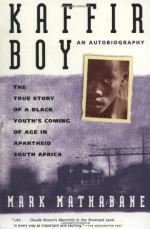
In Kaffir Boy: The True Story of a Black Youth's Coming of Age in Apartheid South Africa, Mark Mathabane presents the remarkable story of his childhood and his rise to prominence as a journalist, lecturer, and humanitarian. Mathabane grew up in the terrifying shantytowns of Alexandra, outside of Johannesburg, South Africa. In these urban slums, he witnessed and survived the most repressive period of apartheid, the South African government's system of legalized racism. On a page of explanation before the narrative begins, Mathabane tells the reader, "In South Africa [the word Kaffir] is used disparagingly by most whites to refer to blacks. It is the...
|
This section contains 8,458 words (approx. 29 pages at 300 words per page) |
|