
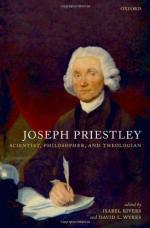
Joseph Priestley
1733-1804
English Physical Scientist and Theologian
Joseph Priestley is best known for his discovery of oxygen, his fundamental studies of gases, and his contributions to the understanding of photosynthesis in plants.
Priestley was largely self-educated through his extensive reading. His formal studies were intended to prepare him for the ministry in one of the Calvinist nonconformist or dissenting churches that disagreed with the teachings of the Church of England. His growing liberal ideas in religion and politics later led him away from Calvinism. He would eventually become one of the chief spokesmen for Unitarianism in England.
Joseph Priestley.
Priestley's constant search for truth led him, in 1758, to begin scientific experiments. Although he was primarily a minister and theologian throughout his life and remained essentially an amateur in science, he was destined to make substantial contributions to the development of modern physical science.
He began teaching at the dissenting academy at Warrington in 1761 where, since the English universities were closed to dissenters, the emphasis was on practical rather than classical education. He wrote a number of textbooks in several subjects to facilitate this approach to education. Among these was Rudiments of English Grammar, which taught contemporary usage of the language rather than the idealized classical form normally taught in the English educational system.
Priestley was ordained in 1762 and received the LL.D. degree from the University of Edinburgh in 1765. His scientific interests resulted in his friendship with Benjamin Franklin (1706-1790), his election as a fellow of the Royal Society in 1766, and his publication of The History of Electricity in 1767 and The History of Optics in 1772.
Beginning in 1767 Priestley devoted most of his scientific attention to the study of pneumatic chemistry, that is, the study of gases and their chemical processes. It is said that his interest in this field resulted from living next to a brewery where he noticed that gases were emitted in the fermentation process. In 1773 he produced a publication on artificially carbonated water that won the Copley Medal of the Royal Society. During 1774-75 he carried out the experiments and observations that led to his discovery of oxygen. Since Priestley refused to give up the phlogiston theory of combustion, he could not fully understand his own discovery. Priestley actually called oxygen "dephlogisticated air." He discussed his work with Antoine Lavoisier (1743-1794) in 1774. It was Lavoisier who gave oxygen its current name and explained its role in oxygenation, respiration, and other chemical processes, and who pointed out that the discovery of oxygen and an understanding of its chemistry disproves the phlogiston theory.
In addition to oxygen, Priestley discovered eight other gases, including nitrogen, ammonia, nitrous oxide, hydrogen chloride, and sulfur dioxide. He also made significant contributions to the understanding of photosynthesis in plants. He discovered that plants take in air and purify it, producing dephlogisticated air (oxygen).
Throughout his life Priestley received significant financial support and encouragement from several influential individuals, such as Lord Shelbourne, who later became Prime Minister, and the industrial potter Josiah Wedgewood (1730-1795).
Priestley's nonscientific work was of significance as well. Twenty-five volumes of his theological writings were published after his death. He was among the originators of utilitarianism, the philosophy which advocates the pursuit of the greatest good for the greatest number, and influenced Jeremy Bentham (1748-1832), who subsequently developed utilitarianism into a full-blown philosophy.
Priestley's outspoken support of Unitarianism led to his growing unpopularity with the government, the Royal Society, and the citizens of England in general. In 1791 a mob destroyed his home and laboratory, and in 1794 he was forced to leave England for America. He settled in Pennsylvania where he continued both his theological and scientific studies until his death.
This is the complete article, containing 608 words
(approx. 2 pages at 300 words per page).

