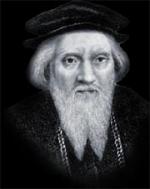
Born c. 1450,
Genoa, ltaly
Died c. 1499,
Possibly in Newfoundland
Giovanni Caboto (John Cabot) was born in the Italian port city of Genoa. In 1476 he was granted citizenship in Venice, which at the time was the major trading center for all the Mediterranean region. Cabot worked as a merchant and navigator, and it is thought that from 1490 to 1493 he lived in the Spanish city of Valencia. There is speculation that he may have been in Valencia in April 1493, the month when Christopher Columbus (see entry) traveled through the city on his way to report to the king and queen of Spain about his successful voyage to America.
Columbus had, in fact, announced he found a new route to Asia, not a new landmass. Cabot was skeptical of this claim, concluding the distance was much greater than that traveled by Columbus. Instead, he believed it was possible to reach Asia by sailing around the northern end of the body of land discovered by Columbus, later called the North American continent. Cabot’s theory gave rise to the search for a “Northwest Passage,” which would involve many voyages of exploration over the next 350 years.
In 1495 Cabot went to England, where he tried to sell his plan for reaching Asia to King Henry VII. On March 5, 1496, the king issued “letters of patent” that granted to “John Cabotto, Citezen of Venice” the right to sail with five ships “to all parts, countries and seas of the East, of the West, and of the North,” where he was to “discover and find whatsoever isles, countries, regions or provinces of heathens and infidels, in whatsoever part of the world they be, which before this time were unknown to all Christians.” Cabot made a first attempt to sail to North America in 1496 but was forced to turn back because of a shortage of food, bad weather, and problems with the crew.
On May 20, 1497, he sailed again from the port of Bristol, this time in a small ship named the Matthew with a crew of 20 that included his son Sebastian Cabot (see entry). Initially sailing along the south of Ireland, they headed west into the ocean, and 35 days later, on June 24, they sighted land. Cabot went ashore and saw signs of human habitation but did not meet anyone. He then explored the coastline from his ship before turning back and heading for Ireland. It took Cabot 15 days to cross the Atlantic to Brittany and from there to Bristol, where he landed on August 6. On August 11 he arrived in London to report to the king, who gave him a reward. He was back home in Bristol with his family by August 23.
Since Cabot’s voyage people have speculated about where he actually landed in North America. Most likely he touched land somewhere on the coast of Maine and then headed north along the coast of Nova Scotia and Cape Breton Island as far as Cape Race in Newfoundland. From there he probably sailed back to Europe. Like Columbus, however, he claimed to have reached Asia.
Having found land that was unknown to Europeans, Cabot was able to secure backing from the king for a new expedition. This time he commanded five ships and a larger crew. The ships sailed from Bristol in May 1498 but were never heard from again. Evidence obtained by later explorers suggests this second expedition may have reached the coast of Newfoundland. It is possible that some of the ships or survivors fell into the hands of the Spanish. Later explorers—such as Gaspar Corte-Real, the Portuguese adventurer, and Alonso de Ojeda (see entry), the Spaniard who founded a colony in Colombia—seem to have sailed with some knowledge of previous discoveries made by the English.
This is the complete article, containing 647 words
(approx. 2 pages at 300 words per page).