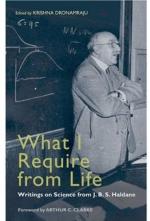
John Burdon Sanderson Haldane
1892-1964
British Geneticist
John Burdon Sanderson Haldane was born in Oxford, England, but spent much of his childhood in Scotland. He was the son of an eminent physiologist, John Scott Haldane. His sister became the well-known novelist Naomi Mitchison. He went to Eton and then Oxford University, where he began to study classics, but then switched to the study of genetics. He was particularly interested in the mathematical study of biological questions and eventually became Professor of Biometry at University College, London, for 20 years from 1937. His father had worked on poison gases and the efforts to devise an effective gas mask during the First World War. The young Haldane and his sister often served as experimental subjects for these studies. As a young boy he went into mines with his father to test devices for detecting dangerous gas buildups, and took a 39 foot (12 m) dive off the Scottish coast to study the process of decompression as he surfaced. He was even called back from the Black Watch regiment on the Western Front during the First World War to serve as an experimental subject in his father's chlorine gas experiments.
After the First World War, Haldane argued that poison gas weapons were a relatively humane means of waging war. He based this on a mathematical analysis of the casualties caused by the chemical weapons such as mustard gas, calculating that only 4,000 or 1 in 40 of the 150,000 British soldiers who had been gassed had died, whereas conventional weapons such as bayonets, shells, and incendiary bombs killed one out of three men they hit. So he concluded that these weapons were disabling rather than killing mechanisms and therefore preferable. He did not consider the evidence that many of the disabilities were very long term and deeply affected the quality of life of the survivors. He dismissed the possibility that these gases might cause cancers in the victims. His critics suggested that experimentation in his father's laboratory with chlorine gases was rather different than the experience of fighting men in the trenches facing mustard gas and that while he was free to offer himself for experiments conducted by his father, the soldiers were in rather different circumstances.
In the inter-war years Haldane became interested in Marxism as a political philosophy, which suggested that human experience could be understood analytically as something that was regulated by its own forces, just as he felt the natural world was. He joined the British Communist Party in the 1930s and was chairman of the board of its newspaper, the Daily Worker, throughout the 1940s. But during the Second World War he returned to government service at the Admiralty and concentrated on understanding the effects of submarine service on the blood and breathing of navy personnel. He continuedto experiment on himself to determine dangerous levels of carbon dioxide buildup.
John Haldane. (Library of Congress. Reproduced with permission.)
Haldane left the Communist Party in 1956 in disagreement with its promotion of the dubious science of the Russian plant geneticist Trofim Denisovich Lysenko (1898-1976). The next year he left Britain in protest against the Anglo-French invasion of Suez and went to India, where he became Director of the Genetics and Biometry Laboratory in Orissa. He became an Indian citizen in 1961 and died of cancer in that country in 1964. He had become a very well-known writer and broadcaster on scientific questions and had made major contributions to both genetics and physiology.
This is the complete article, containing 575 words
(approx. 2 pages at 300 words per page).