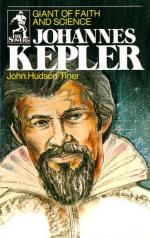
Johannes Kepler
1571-1630
German Astronomer and Mathematician
Johannes Kepler was a mathematician and astronomer. He used observations of heavenly bodies to destroy the ancient idea that planets move in perfect circles. He also mathematically described the relationship of Sun and planets in our solar system. His three laws of planetary motion, along with the work of Nicolaus Copernicus (1473-1543) and Galileo (1564-1642), helped Isaac Newton (1642-1727) devise his law of universal gravitation.
Kepler was born in 1571 in Weil, Germany, a sickly, myopic child with a brilliant mind and intermittent double vision. He became interested in astronomy after seeing the 1577 comet when he was six years old and an eclipse of theMoon when he was nine. He attended a seminary and the University of Tubingen intending to enter the church. His abilities as a mathematician led him instead to teach math in Graz, Austria, where he was also district mathematician. He cast official horoscopes and was court astrologer. While in Graz he cast many horoscopes for local citizens and published a calendar of astrological forecasts to augment his income. At this time he already believed that Earth moves around the Sun, not vice versa. Kepler was an original thinker and could grasp and manipulate new ideas. He was exceedingly patient and made calculations with scrupulous care.
In 1596 he published his first book corroborating Copernicus and looking for a relation between planetary bodies. In 1600 he moved to Prague, where he became an assistant to Tycho Brahe (1546-1601), Imperial Mathematician. This was a fateful association because Brahe, a Dane, was a tireless recorder of movements of heavenly bodies. When Brahe died, Kepler became Imperial Mathematician and possessor of Brahe's observations. Brahe's family insisted that he had usurped the data, but Kepler was able to keep and use the material.
Johannes Kepler. (Library of Congress. Reproduced with permission.)
It is said that Kepler "discovered" his three laws, but it is more accurate to say he constructed them to fit the observations. Kepler explained celestial phenomena to fit these observations and believed that a mathematical relationship existed between celestial bodies. In 1602 he discarded perfect circles, which had been the model of the heavens since the Greeks. Using Brahe's data, he postulated that a planet's distance from the Sun determined its speed and calculated the exact relationship with precise accuracy. This became his second law. In 1605 he came to the conclusion that planets move in elliptical orbits, his first law. These were the first instances of discoveries made to fit observed data. In 1618 he formulated the third of his three laws, which states that the square of the time a planet takes to revolve around the Sun is proportional to the cube of its distance from the Sun.
He occasionally corresponded with Galileo, but they worked on different aspects of astronomy. After he and his family moved to Linz, Austria, Kepler published several books on astronomy and the harmony of the spheres. They were unique but read by few because they were complex and hard to understand. He continued to look for relations between planets and the Sun.Some of his published ideas failed or were deemed absurd. His reputation was not helped by the fact that his mother was put on trial for witchcraft in 1615 and imprisoned for a time.
When he died in November 1630 in Regensburg, Germany, he was famous for his writings and revered as a careful mathematician whose work had aided the advancement of of astronomy. Kepler's work assisted Newton in formulating his 1687 theory of universal gravitation that led to modern ideas about physics and astronomy.
Kepler's Mother's Witch Trial
Johannes Kepler's mother, Katharina, was known in her hometown as a cantankerous old woman. During the upheavals of the Thirty Years' War she became a victim of witch-hunting. A dutiful son, Kepler helped in her defense, which was both long and costly. Katharina's accusers pointed to dozens of occasions where various aliments or actions had occurred due to her magical potions or spells. Kepler's successful defense strategy was to show how all these occurrences could be explained by natural causes. For instance, a young girl claimed Katharina had made her arm temporarily paralyzed. Kepler pointed out that she had been carrying many bricks, and the heavy load had caused her problem. A woman's sickness was revealed to be from an abortion. The schoolmaster had been injured while jumping a ditch. The butcher had lumbago. And so on. Kepler was careful never to dismiss witchcraft out of hand, as many officials believed deeply in such magic. However, he showed that for each specific event attributed to witchcraft there was a more likely natural cause that explained the result at least as well. Yet, while Katharina was acquitted, she died shortly after, a broken woman.
DAVID TULLOCH
This is the complete article, containing 790 words
(approx. 3 pages at 300 words per page).