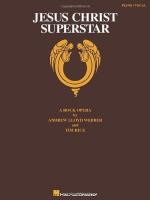
Jesus Christ Superstar
Few musical forms have fallen into such low repute as the rock opera. Through the bombastic efforts of a handful of well-meaning composers, the whole enterprise has become almost synonymous with egotism in the minds of pop music consumers. Yet the form continues to have its adherents. A stage revival of The Who's trailblazing Tommy opened to packed houses on Broadway in 1995. And Jesus Christ Superstar, the mind-blowing 1970 rock opera about the last days of Christ, continues to work its magic on theatergoers the world over in countless touring company and summer stock productions.
Originally conceived as a stage musical, Jesus Christ Superstar was the brainchild of two enterprising English whiz kids, composer Andrew Lloyd Webber, who was twenty-three, and lyricist Tim Rice, who was twenty-six. The pair's 1968 collaboration, Joseph and the Amazing Technicolor Dreamcoat, had set the Old Testament story of Jacob's feuding sons to a throbbing backbeat, to the consternation of many in the rabbinate. With Superstar, the composers took the even more audacious step of setting the sufferings of Jesus to music. Not surprisingly, they had difficulty finding financial support for such a venture. Eventually they were forced to give up their stage plans and settle instead for a double-sided record set. Dubbed a "concept album" in the hipster parlance of the times, the LP was released in late 1970 with a drab brown cover featuring almost no religious iconography. But such precautions did little to stave off the inevitable ecclesiastical backlash.
The question of blasphemy aside, few could dispute the quality of the recording itself. A tight backing band provided muscular support for vocalists Murray Head, Ian Gillian, and Yvonne Elliman. The LP's 24 songs chronicled the final days of Jesus, from his entryinto Jerusalem through his trial and crucifixion by the Roman authorities. A number of songs were cast in the form of dialogues, with various New Testament figures hurling accusation and invective at one another. The balladeering chores were assigned to the Hawaiian-born Elliman, whose mellifluous renditions of "Everything's Alright" and "I Don't Know How to Love Him" became FM radio staples.
A scene from the film Jesus Christ Superstar.
Not surprisingly, a mass market rock 'n' roll composition on so hallowed a subject could not pass public scrutiny without generating some religious controversy. But negative reaction to Superstar was muted and with good reason. While hardly the stuff of a theological dissertation, Superstar in the final analysis was no less scripturally sound than the average Catholic missal. Other than the arguably tasteless references to Christ as "J.C.," there was little here to offend Christian traditionalists. The issue of Jesus's resurrection was bypassed entirely, consistent with the entire "opera's" depiction of Jesus as an imperfect mortal struggling with a divine commission he could not fully understand. "If you knew the path we're riding," wailed "Jesus" Gillian in one typical number, "you'd understand it less than I." Perhaps most galling to strict spiritual constructions, however, was the central role afforded to Judas Iscariot, voiced with quivering urgency by Murray Head. Questioning both the political message and personal behavior of his master in such songs as "Heaven on Their Minds," this Judas is no treacherous asp but rather a conflicted, doubting Thomas.
Jesus Christ Superstar sold more than 2 million copies in 12 months and became 1971's number-one-selling album. In July of that year, 13,000 Superstar fans packed Pittsburgh's Civic Arena to see the opera performed in concert. That performance was just the runner-up to a full-blown Broadway production—the realization of Rice and Lloyd Webber's original dream—that opened at the Mark Hellinger Theater in New York on October 12, 1971. Newcomer Jeff Fenholt assumed the role of Jesus, while a youthful Ben Vereen essayed the part of Judas. Surprisingly, Andrew Lloyd Webber would later renounce this production, which lasted just 20 months on the Great White Way.
More to the composer's liking was the 1973 film version, directed by Norman Jewison. Today the film seems dated, with its army of scraggly hippies disembarking from a psychedelic bus. But it benefits from a number of strong performances. Black actor Carl Anderson makes a dynamic Judas, while Texas rock drummer Ted Neeley, an understudy in the Broadway production, brings a wild-eyed passion to the title role. Derided by some as "the screaming Jesus" for his piercing tremolo, Neeley got the part only after Ian Gillian turned it down because he could make more money touring with his band Deep Purple. Neeley has since turned playing Jesus Christ into a career, calling himself "a palette on which people project the Jesus they came to see."
Spurred on by a wave of 1970s nostalgia, Superstar has been revived in the 1990s. A 25-month, 116-city anniversary tour, starring Styx's Dennis DeYoung, was mounted in 1994. It is estimated that musical theater productions of the show have grossed in excess of $150 million worldwide. Certainly it launched its co-composers into celebrity status. Since ending their professional relationship in 1978, Rice has gone on to co-write the songs for Disney's Lion King; Lloyd Webber created Cats and Phantom of the Opera, which would amass a fortune of some $1.15 billion.
Jesus Christ Superstar continues to meet with some localized pockets of resistance from those who disagree with its portrayal of a flawed, all-too-human Jesus. But its greatest defenders remain its legions of devoted fans who were acknowledged in a comment by one-time Judas Ben Vereen: "What the people up in arms failed to look at is that as long as people were rockin' to Jesus, everything was gonna be all right for humanity."
Further Reading:
Daly, Steve. "A Hit of Biblical Proportions." Entertainment Weekly. July 19, 1996, 88.
Kelly, Christina. "A Superstar Is Reborn." Entertainment Weekly. December 23, 1994, 65.
Sella, Marshall. "Is God Ted?" New York. January 23, 1995, 46.
This is the complete article, containing 961 words
(approx. 3 pages at 300 words per page).