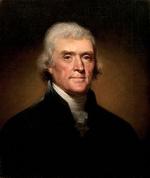
Jefferson, Thomas
Thomas Jefferson, 1743–1826. The American philosopher and statesman was the third president of the United States. A man of broad interests and activity, he exerted an immense influence on the political and intellectual life of the new nation. (The Library of Congress.)
The early American political philosopher and politician Thomas Jefferson (1743–1826), was born in Albemarle Country, Virginia on April 13. By the time of his death at his home of Monticello just outside Charlottesville, Virginia on July 4, Jefferson considered his three greatest achievements to be writing the Declaration of Independence, writing the Statute of Virginia for Religious Freedom, and founding the University of Virginia. It is nevertheless also the case that Jefferson's views on science, politics, and ethics present a uniquely American perspective on technological progress as flowing from individual liberty, economic freedom, and personal Christian morality.
This "American System" of viewing advances in scientific knowledge as part of political freedom and moral development, remains a distinctive approach to the social issues of economic development, education, crime, religious freedom, and personal happiness. Its confidence in technological and scientific progress tempered by religious and ethical considerations is the basis for American concerns with problems of medical/genetic ethics, environmentalism versus economic development, and private rights versus social responsibility. Its enthusiasm for the free individual and for relatively unrestrained international expansion of these American values has, at times, caused it to be accused of imperialism, hegemony, and disregard for traditional nontechnological and more hierarchical societies (including Islamic, African, and Asian societies) and for socialist economics. Much of contemporary world conflict, such as terrorism, is to some extent an extension of the debate over this "Jeffersonian" worldview of progress, knowledge, religious liberty, democracy, and individual freedom.
Jefferson as Scientist and Inventor
Jefferson's scientific and technological interests were wide ranging. He investigated every branch of science, from botany to biology, meteorology, archaeology, astronomy, chemistry, geology, mathematics, paleontology, and ethnology. He designed the curriculum at the new University of Virginia (1819) to revolve around a core of natural philosophy (science), including physics, engineering, and mineralogy, when most American colleges still focused exclusively on the liberal arts and divinity. He wished to develop as a discipline "the science of the mind" (contemporary psychology), calling it "moral zoology." Throughout his life, Jefferson conducted scientific studies and collected data. He studied new methods for determining the heights of mountains (using mathematical calculations with barometer measurements), tested atmospheric moisture with a hygrometer, and used double-refraction optical instruments to measure small angles, eclipses, lunar movement, and Earth's longitude. Jefferson was a close observer of nature, recording the appearance of many plants, animals, and birds on his Monticello estate and wherever his travels took him. He kept weather data all his life and shared it with other meteorological observers around the country.
Not confining his scientific interests to observation alone, Jefferson invented several useful products. His most famous invention was a new design for a moldboard plow, the simple and efficient design of which drew attention throughout the Association of Agricultural Societies in America and within England's Board of Agriculture. He also invented a swivel chair, a writing desk that could be placed on one's lap, a walking cane that converted to a chair, and a copying machine that duplicated letters as they were being written. He enthusiastically supported other inventions, including the hot-air balloon, dry docks for ships, the submarine, fireproofing for houses, telescopes, the camera obscura, carriage odometers, and personal pedometers. He was an advocate of the decimal system of American currency.
While U.S. minister to France (1785–1789), Jefferson consulted with European scientists on new inventions and the natural environment of the Old World. When he moved to Philadelphia as vice president in 1797, Jefferson brought a box of prehistoric bones for the American Philosophical Society museum. As U.S. President (1801–1809), Jefferson conducted botanical expeditions around the Washington, DC, area and distributed European seeds to the local vegetable markets. In the White House, he displayed scientific instruments, globes, charts, a dry-dock model, a mockingbird, and a grizzly bear (in the garden) brought back by the Lewis and Clark expedition (1803–1806), which he had commissioned. He led discussions on the serious cowpox disease and presented an evening slide show on "The Natural History of French Parrots."
Jefferson's Science Policy
Jefferson's main interest in science was as technology, or for its usefulness. The practical benefits to humanity, economic development, and individual happiness were always foremost in his mind. This explains his special devotion to agriculture, because food production was, for him, the basis of all other social wealth. For the same reason, he believed in the free sharing of scientific knowledge: that it would enhance the prosperity of all people in the world. He gave every new discovery to his neighbors without charge, showing that such shared knowledge "is the great parent of science and of virtue;
… a nation will be great in both, always in proportion as it is free" (Letter to Joseph Willard, March 14, 1789). Therefore, the advance of science and technology, for Jefferson, necessitated economic freedom (capitalism, free markets) and intellectual freedom (freedom of speech, press, and academic inquiry), including religious freedom. Thus, political democracy is integral to technological advances.
Jefferson's intellectual attitudes and scientific interests sometimes earned him ridicule, especially from his political opponents (who caricatured them as "philosophical fogs"). But his own international reputation for scientific inquiry raised the prestige of American science throughout the world. Jefferson was elected to the Institut de France, the Dutch Royal Institute of Sciences, the Board of Agriculture in England, the Agronomic Society of Bavaria, and the Linnaean Society of Paris. His comparative study of European and North American animals refuted the French naturalist Buffon's claim of New World degeneracy (proving, for example, that North American otters weigh more than their European counterparts).
The cosmological foundations of Jefferson's scientific ethics may be described as "deistic science." That is, he believed (after Aristotle, Thomas Aquinas, Isaac Newton, and John Locke) that a divinity created the universe, rather than that the world emerged out of itself randomly. "[I]t is impossible for the human mind," Jefferson wrote, "not to perceive and feel a conviction of design, consummate skill, and infinite power in every atom … up to an ultimate cause, a Fabricator of all things from matter and motion, their Preserver and Regulator … an eternal pre-existence of a Creator" (Letter to John Adams, April 11, 1823). Such Creationist ethics for Jefferson implied that all of nature, including humankind, exists within God's laws. This commends, for him, a humble, reverent appreciation of the universe and shows the limits of human knowledge. Such divine, moral limitations serve as checks on scientific presumption and hubris, or human pride. Ethical concerns regarding genetic engineering, embryonic research, euthanasia, and nuclear power in the early twenty-first century reflect such Jeffersonian ethical sensibilities.
Jefferson's ethical philosophy reflected his scientific empiricism by placing values in a human "moral sense" (akin to other physical senses such as sight and hearing). Though of divine origin, this moral sense provides for Jefferson a biological basis for ethics, or knowledge of good and evil, justice and injustice. As with Aristotle's teleological ethics, however, this human capacity is innate but undeveloped. Society must educate and refine this ethical faculty, especially through religion, politics, and law. "I consider ethics, as well as religion, as supplements to law in the government of man," Jefferson wrote (Letter to Judge Augustus B. Woodward, March 24, 1824). The highest ethics for him was "the ethics of Jesus," or what he called "the most sublime and benevolent code of morals which has ever been offered to man" (Letter to John Adams, October 12, 1813). This consisted of a simple Christian ethics, such as that presented in Jesus' Sermon on the Mount. But the best means of learning these ethics, for Jefferson, was freedom of religion—the liberty of every individual to investigate, proclaim, and believe religious truth, and the freedom to change religious faiths on the basis of personal conscience. Jefferson believed that such religious freedom, like freedom of intellectual inquiry, economic activity, and scientific advancement, would produce the most prosperous, happy people.
Agrarianism;; Democracy.
Bibliography
Bedini, Silvio A. (1990). Thomas Jefferson: Statesman of Science. New York: Macmillan.
Bedini, Silvio A. (2002). Jefferson and Science. Charlottesville, VA: Thomas Jefferson Foundation.
Sheldon, Garrett Ward. (1993). The Political Philosopy of Thomas Jefferson. Baltimore: Johns Hopkins University Press.
This is the complete article, containing 1,382 words
(approx. 5 pages at 300 words per page).