Forgot your password?  

Not What You Meant?  There are 72 definitions for Jefferson.  Also try: Tinsley or TJ or Jack of all trades.

Jefferson, Thomas | Research & Encyclopedia Articles

Print-Friendly   Order the PDF version   Order the RTF version
About 4 pages (1,130 words)
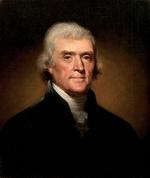
Thomas Jefferson Summary


Jefferson, Thomas

(b. April 13, 1743; d. July 4, 1826) Third president of the United States (1801–1809).

Thomas Jefferson was among the preeminent founders of the United States, advocating strong states' rights and separation of church and state. He drafted the Declaration of Independence, founded the University of Virginia, served as governor of Virginia, minister to France, secretary of state, vice president (1796–1800), and finally president (1801–1809). Although he was never in the military, war nevertheless tested Jefferson's philosophy and political will.

Jefferson was a highly idealistic and complex individual; he believed and argued for a small and weak federal government, strong states' rights, a conservative reading of the Constitution, and peaceful means to end conflict. He drafted the inspiring "all men are created equal" words of the Declaration of Independence. However, he constantly agonized over the details of these ideals and, in practice, contradicted himself for the benefit of the new nation and his own personal desires—for example, by upholding slavery even though he had a long term relationship and fathered children with his slave, Sally Hemings.

Thomas Jefferson was born in Albemarle County, Virginia. His mother, Jane Randolph, was from one of the most famous Virginia families, giving Jefferson contact with prominent citizens. He received a huge inheritance of land, of which his estate Monticello was a part, and his marriage to Martha Wayles Skelton doubled his holdings. He studied at the College of William and Mary, then read law under George Wythe, the leading law teacher of his generation.

Jefferson practiced law until the revolution suspended the courts in 1774, and he went on to represent Virginia in the Continental Congress, drafting A Summary View of the Rights of British America, which fore-shadowed the Declaration of Independence. During the Revolution, he served as governor of Virginia. There was an inquiry into his conduct as governor due to the loss of Richmond to the British, but he was exonerated; the incident haunted him politically for decades.

While vice president, Jefferson argued against the Alien and Sedition Acts, which allowed the government to deport people who were deemed dangerous and punished writings against the government with fines and imprisonment. He argued that these acts were unconstitutional because the Tenth Amendment gave states the powers not delegated to the federal government by the constitution and that therefore, states could nullify federal legislation in order to protect their citizens' rights.

During his first term as president, when Napoleon offered the Louisiana Territory to the United States, Jefferson disregarded his unease about the federal government acting on its own to add territory without a constitutional amendment and sent negotiators to France. The Louisiana Purchase helped the United States double in size and guaranteed access to the Mississippi river and interior territories, but also set the stage for troublesome wars to come. The question of slavery in the new territories and the balance of power between slave and free states, key issues leading to seccession and the Civil War, was debated at this time. Displacement of American Indian tribes by the U.S. government would also accelerate, resulting in increasing armed conflict over the next century.

Jefferson expanded the executive powers of the presidency by fighting undeclared wars such as the Barbary Coast Wars (1802–1805), when Jefferson sent the Navy and Marines during a congressional recess. During his second term, the conflict between Britain and France was intensifying, putting the neutrality of the United States in danger because of those two nations' shipping blockades. Furthermore, Britain actually removed sailors from American ships to impress them into its navy. The attack on the American frigate Chesapeake in 1807 led Jefferson to the verge of war with England. He tried to bring pressure on both sides by suspending commerce through the Embargo Act, and to enforce the embargo, he infringed on individual and states' rights by ordering the U.S. army and navy to act against its own citizens in a time of peace (one of the main complaints against King George III listed in the Declaration of Independence). The Embargo did not have the desired economic effect on Britain and France, and commerce states (mainly New England) suffered so much that there was talk of "disunion." The Embargo Act, along with the Non-Importation Act, was repealed in 1809 with Jefferson's consent in order to save the Union. Weaker measures enacted did nothing to avoid the War of 1812.

After his presidency, Jefferson retired to Monticello but maintained an active correspondence with Democratic Republican party members and elected officials. After the British burned the capitol in the War of 1812, he sold his library of 6,487 books as a replacement for the Library of Congress lost in the fire. In 1823 he advised Monroe on what became the Monroe Doctrine—essentially non-intervention and an end to colonization by European powers in the Western Hemisphere. Always wary of European influence, Jefferson wanted to keep the Western Hemisphere free so republics could flourish; he supported a joint declaration desired by the formerly distrusted England in order to secure this ideal.

Thomas Jefferson helped to forge the nation. The Declaration of Independence and the Virginia Statute on Religious Freedom that he drafted were products of the American Revolution and Enlightenment ideals, fused and powerfully expressed by him. Jefferson was a slave-holder who wrote eloquently about liberty; he favored a federal union but feared the power of central government; he wanted limited government, but expanded executive powers and stretched the limits of the Constitution to serve his policies; he was suspicious of a strong military, but conducted undeclared wars. In many ways his ideals and contradictions, forged in war and the making of a new nation, represent enduring features of American society and culture.

Declaration of Independence; Embargo; Jeffersonian Republican Party; Madison, James; Monroe, James; Revolution and Radical Reform; Slavery and the Home Front, 1775–1783.

Bibliography

Beran, Michael Knox. Jefferson's Demons: Portrait of a Restless Mind. New York: Free Press, 2003.

Bernstein, Richard B. Thomas Jefferson. New York: Oxford University Press, 2003.

Bishop, Arthur, ed. Thomas Jefferson, 1743–1826: Chronology, Documents, Bibliographic Aids. Dobbs Ferry, NY: Oceana Publications, 1971.

Bowers, Claude G. Jefferson in Power: The Death Struggle of the Federalists. Boston: Houghton Mifflin, 1936.

Brodie, Fawn M. Thomas Jefferson: An Intimate History. New York: Norton, 1974.

Kaplan, Lawrence S. Jefferson and France: An Essay on Politics and Political Ideas. New Haven, CT: Yale University Press, 1967.

Malone, Dumas. Jefferson and His Time: The Sage of Monticello. Boston: Little, Brown, 1981.

Mayo, Bernard, ed. Jefferson Himself: The Personal Narrative of a Many-Sided American. Charlottesville: University Press of Virginia, 1970.

McDonald, Forrest. The Presidency of Thomas Jefferson. Lawrence: University Press of Kansas, 1976.

Onuf, Peter S. Jefferson's Empire: The Language of American Nationhood. Charlottesville: University Press of Virginia, 2000.

Vidal, Gore. Inventing a Nation: Washington, Adams, Jefferson. New Haven, CT: Yale University Press, 2003.

Wills, Garry. Negro President: Jefferson and the Slave Power. Boston: Houghton Mifflin, 2003.

This is the complete article, containing 1,130 words (approx. 4 pages at 300 words per page).

More Information
  • View Jefferson, Thomas Study Pack
  • 72 Alternative Definitions
  • Search Results for "Jefferson, Thomas"
  • More Products on This Subject
    Thomas Jefferson
    Thomas Jefferson's universally acknowledged importance as a statesman has tended to overshadow his ... more

    Thomas Jefferson
    American philosopher and statesman Thomas Jefferson (1743-1826) was the third president of the Unit... more


    Ask any question on Thomas Jefferson and get it answered FAST!
    Answer questions in BookRags Q&A and earn points toward
    discounted or even FREE Study Guides and other BookRags products!
    Learn more about BookRags Q&A
    Copyrights
    Jefferson, Thomas from Americans at War. Copyright © 2001-2006 by Macmillan Reference USA, an imprint of the Gale Group. All rights reserved.