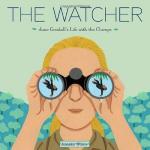
Jane Goodall
1934-
English Primatologist
Primatologist Jane Goodall is best known for her long-term field studies of chimpanzee life and behavior. A leading expert on the subject, many Americans came to know her through a public television series chronicling her life and ongoing research on chimpanzees in Tanzania.
Born in England in 1934, Goodall moved with her family to France when she was five years old. When the Nazis threatened to subjugate France during World War II, the Goodalls returned to England and lived at the family estate known as the Birches, located in Barnemouth and managed by Goodall's maternal grandmother. Goodall remained there until she graduated from high school.
Goodall subsequently attended secretarial school, followed by an assortment of jobs at Oxford University. She later worked briefly for an independent film company specializing in documentaries. Her life brightened considerably when an old school friend invited her to Kenya, where she was living at the time. Since Goodall had long been interested in the African continent, the invitation was a welcome opportunity to see and experience what she had read about for many years.She secured passage on a liner called the Kenya Castle and sailed at the earliest opportunity.
Goodall was in Africa only two months before she was introduced to Louis Leakey (1903-1972), the world-famous anthropologist. He gave her a job on his research staff and, after nine months in Africa, she had saved enough to invite her mother for a visit. During this visit, Leakey suggested that Goodall take a companion with her and begin a comprehensive study of chimpanzees in the wild. The project interested Goodall and, when her mother agreed to accompany her, she began making plans for the study.
After a series of short delays, Goodall and her mother took off for the boat trip to Gombe on July 16, 1960. They were accompanied by two scouts from the Gombe National Park and their cook, Dominic.
Until that time, the observation and study of animals in their natural habitats fell under several different scientific disciplines. However, it was then given its own classification—Ethology. When Leakey suggested that Goodall study chimpanzees, he did so because of their genetic similarity to humans. Since chimp DNA is only one percent different from that of humans, he believed that satisfactory data could be gathered in months rather than years of research.
However, the months that Leakey anticipated turned into more than 30 years of work. During this time, Goodall earned a Ph.D. from Cambridge University (1965) and international recognition for her fieldwork and popular books. She also married (and later divorced) Dutch photographer Hugo van Lawick, with whom she collaborated on several books and films, and gave birth to a son.
Goodall encountered a series of adventures and challenges. She and her mother contracted malaria early in their stay in Gombe, but recovered and remained to see the first evidence of a chimp using a tool. In the ensuing years, Goodall corrected many erroneous misunderstandings about her subjects. For instance, it was generally believed that all primates were vegetarians. However, Goodall observed chimps in Gombe eating meats. They were also filmed making and using various implements to improve their subsistence.
All these events, and many more, were effectively chronicled in her books, including In the Shadow of Man (1971) and The Chimpanzees of Gombe: Patterns of Behavior. (1986). Goodall has been honored for her work in conservation and is the recipient of the Albert Schweitzer Award (1987), the Encyclopedia Britannica Award (1989), and the prestigious Kyoto Prize for Science (1990). She remains personally involved in the longest, unbroken field study of any group of animals in the wild.
This is the complete article, containing 598 words
(approx. 2 pages at 300 words per page).