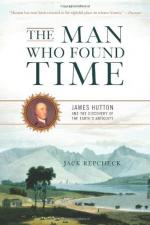
James Hutton
1726-1797
Scottish Geologist and Chemist
James Hutton was born in Edinburgh, Scotland, in 1726. There was no early indication that this quiet, modest boy would achieve worldwide renown and secure his place in history as "the father of modern geology." With no corroborating data or earlier research to support his conclusions, his personal observations generated the concept of the "rock cycle," which—in three stages—shows that the matter of which rocks are made is never created or destroyed. It simply is redistributed and transformed from one type to another in an eternal recycling manner. This principle, called "uniformitarianism," is one of the foundations of modern geology.
This futuristic thinking matured over many years of study and field work that began when Hutton attended the University of Edinburgh, initially to study the law. He soon abandoned this pursuit for medicine and studied in both Paris, France, and Leiden, Holland. He earned his doctorate in Leiden but never actually practiced medicine.
He returned to Edinburgh to pursue an earlier interest in chemistry, which he had shared with his friend James Davie. The pair had investigated the possibilities of manufacturing sal ammoniac from coal soot in an inexpensive manner and decided to market the resulting product. The results were so successful that Hutton was soon a prosperous, independently wealthy man.
He used part of his fortune to become a gentleman farmer in Berwickshire, England. With this second good source of income athand, he gave up active farming and returned to Edinburgh, where he planned to devote himself to scientific research—especially in the area of soil, rocks, and the natural processes that altered their appearance and locations.
Caroline Herschel. (Library of Congress.)
Hutton was among the first researchers who made a cycle connection between the three known types of rock: igneous, sedimentary, and metamorphic. His observations were published in two papers in 1788 and later in the book Theory of Earth (1795). Unfortunately, Hutton was a far better scientist than author, and his 1795 book was not truly appreciated until it was explained, amplified, and supported by his friend John Playfair in 1802, when the latter published Illustrations of the Huttonian Theory of the Earth. In this work Playfair elaborated on the theme that eventually became fundamental to the world of geology: deep time. This was a phenomenal concept that centered on "Unconformity," the visual evidence of a loss of sedimentary layers that indicate a loss of geologic time.
Hutton described Earth as a self-renewing, eternal recycling machine that continues to renew itself in three distinct stages. Stage one is the inevitable decay resulting from the erosion caused by rivers, waves, and tides that wash the soils ofthe continents into the oceans, creating stage two: layers of sediment that build upon each other. The increasing weight of these layers precipitates stage three: the heating and melting of the sediments, thus producing magmas that generate intolerable heat forces. These forces in turn result in "uplifts": earthquakes, volcanoes, and other catastrophic actions that form new continents, islands, and other surface transformations.
This, of course, is a highly simplified version of Hutton's theories and observations. To this date, there are still thousands of pages he authored that have never been printed (or even translated, since he wrote in French much of the time). However, the impact of his work is still highly regarded and is part of the coursework in most geological curriculums. His contributions to the field receive high acclaim from notable authors and evolutionary biologists such as Stephen Jay Gould (1941-), whose Time's Arrow, Time's Cycle (1987) praises Hutton generously.
During the eighteenth century when Hutton came to his amazing conclusions, there was no way of proving the existence of the vast expanses of time in a geological sense. It was not until the twentieth century that scientists (specifically chemists) were able to use radioactive decay in estimating the ages of rocks and other ancient discoveries.
James Hutton died in 1797, leaving a staggering amount of written material to support his field work and studies. The last two sentences of one of his pioneering 1788 treatises have guaranteed him his rightful place at the top of the geological pyramid: "If the succession of worlds is established in the system of nature, it is in vain to look for anything higher in the origin of the earth. The result, therefore, of our present enquiry is, that we find no vestige of a beginning—no prospect of an end."
This is the complete article, containing 730 words
(approx. 2 pages at 300 words per page).