Forgot your password?  

Not What You Meant?  There are 47 definitions for Jesse.

Jackson, Jesse Louis | Research & Encyclopedia Articles

Print-Friendly   Order the PDF version   Order the RTF version
About 3 pages (929 words)
Jesse Jackson Summary


Jackson, Jesse Louis

(b. October 8, 1941) Civil rights leader; organized PUSH and the Rainbow Coalition; active in presidential politics in the 1980s.

Jesse Louis Jackson was born in Greenville, South Carolina, and became a leading civil rights activist, preacher, and politician. Jackson attended Greenville's segregated public schools and graduated from Sterling High School. Young Jackson entered the University of Illinois on an athletic scholarship. After a year there, he transferred to North Carolina Agricultural and Technical College at Greensboro, where students had launched the sit-in movement in January 1960. In June 1963, he graduated from college just as massive civil rights demonstrations gripped Birmingham, Alabama, and other Southern cities. As leader of the campus chapter of the Congress of Racial Equality, Jackson had declared his willingness to go to jail or to the chain gang if necessary. In June 1963 he led 278 civil rights demonstrators who were arrested in Greensboro.

Jackson was torn between a desire to prepare for the ministry and a determination to be on the movement's front lines. He was ordained in the Baptist ministry and enrolled for study at Chicago Theological Seminary. In 1965 he enlisted in the voting rights campaign of the Southern Christian Leadership Conference (SCLC) in Selma, Alabama, where he first met Martin Luther King, Jr. Thereafter, Jackson returned to Chicago to play an important role in its civil rights campaign. From 1966 to 1971, he directed SCLC's Operation Breadbasket, which encouraged private industries to end employment discrimination and sought contracts for black businesses with the threat of an economic boycott.

As an SCLC staff member, Jackson was very young and very ambitious. He was at the Lorraine Motel in Memphis when King was assassinated, but his claim to have cradled the fallen leader when he was shot and his wearing a shirt with King's blood on it for days after the assassination irritated many SCLC insiders as crass exploitation of the tragedy. In 1971 Jackson organized People United to Save Humanity (PUSH). Modeled on Operation Breadbasket and promoted as a multiracial coalition to mobilize the economic and political power of poor people, it was an exclusively black vehicle for Jackson's campaigns against drugs, teenage pregnancy, and violence. During the Carter administration, Jackson lobbied for a more aggressive American stance against white regimes in southern Africa. In 1983, he was active in the

Reverand Jesse Jackson addressing the 1984 Democratic National Convention in San Francisco, California, during his unsuccessful presidential campaign. AP/WIDE WORLD PHOTOSReverand Jesse Jackson addressing the 1984 Democratic National Convention in San Francisco, California, during his unsuccessful presidential campaign. AP/WIDE WORLD PHOTOS

campaign which elected Harold Washington as Chicago's first African-American mayor. Jackson left PUSH and it was scaled back when he organized his "rainbow coalition" of ethnic minorities, farmers, feminists, gays, lesbians, and workers to support his campaigns for president.

In 1984 Jesse Jackson made his first bid for the Democratic Party's presidential nomination. His campaign became marred by tension between African Americans and Jewish Americans when his private reference to New York City as "Hymietown" became public. The tension mounted when he refused to repudiate the political support of the Nation of Islam's Louis Farrakhan and after he conferred with the Palestine Liberation Organization's Yasser Arafat about a Palestinian homeland in Israel. Yet Jackson's Rainbow Coalition won about 3.25 million of 17 million votes cast in Democratic primaries, controlled the third largest bloc of delegates to the convention, and exercised considerable leverage in the design of the party's platform. Jackson ran again for the Democratic presidential nomination in 1988, winning nine state primaries and over 7 million of 23 million votes cast.

During the 1980s Jackson's stance on the left of mainstream American politics gave him access to nations whose leadership was hostile to official American positions and he gained some international reputation by pursuing "citizen diplomacy." His international activities relating to wars involving the United States included negotiating the release of an American pilot shot down in Syria in 1983; the release of 48 prisoners, including 22 American citizens, from Cuba in 1984; and the release of 47 American hostages in Iraq in 1990.

Late in 1988, Jackson became president of the Rainbow Coalition, Inc., which promoted the progressive agenda he had championed for years. As Jackson's political base, it played a lesser role in subsequent campaigns. In 1992 Jackson withheld endorsement of the Clinton-Gore ticket until the last weeks of the presidential campaign. In 1997 the merger of Operation PUSH with the Rainbow Coalition became known as the Rainbow/PUSH Coalition. Based in Washington, D.C., it claimed 13 thousand members in fifty states, pursued Jackson's political program, and monitored the hiring, investment, and promotion practices of American corporations. In 2001, however, Jackson's national influence was substantially damaged when he acknowledged the birth of his child to a former employee and an agreement to pay her maintenance. By then, the torch was passing to his oldest son, Jesse Jackson, Jr., a member of Congress from Chicago.

Besides advocating social justice at home, Jackson used his presidential campaigns in 1984 and 1988 to challenge American Cold War policies by favoring normalized relations with Fidel Castro and Yasser Arafat, and by calling for sharp reductions in American defense spending.

Civil Rights Movement; King, Martin Luther, Jr.; Politics and Elections; Race and Military.

Bibliography

Frady, Marshall. Jesse: The Life and Pilgrimage of Jesse Jackson. New York: Random House, 1996.

Jackson, Jesse. Straight from the Heart. Philadelphia: Fortress Press, 1987.

Reed, Adolph L. The Jesse Jackson Phenomenon: The Crisis of Purpose in Afro-American Politics. New Haven, CT: Yale University Press, 1986.

Stanford, Karin L. Beyond the Boundaries: Reverend Jesse Jackson in International Affairs. Albany: State University of New York Press, 1997.

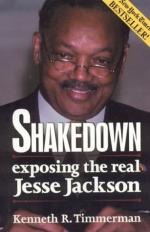
Timmerman, Kenneth R. Shakedown: Exposing the Real Jesse Jackson. Washington, DC: Regnery Publishing, Inc., 2002.

This is the complete article, containing 929 words (approx. 3 pages at 300 words per page).

More Information
  • View Jackson, Jesse Louis Study Pack
  • 47 Alternative Definitions
  • Search Results for "Jackson, Jesse Louis"
  • More Products on This Subject
    Jesse Louis Jackson
    Civil rights leader Rev. Jesse Louis Jackson (born 1941), the most successful African American pres... more

    Jackson, Jesse (1941—)
    Baptist minister and civil rights leader Jesse Jackson was the leading advocate for racial equality... more


    Ask any question on Jesse Jackson and get it answered FAST!
    Answer questions in BookRags Q&A and earn points toward
    discounted or even FREE Study Guides and other BookRags products!
    Learn more about BookRags Q&A
    Copyrights
    Jackson, Jesse Louis from Americans at War. Copyright © 2001-2006 by Macmillan Reference USA, an imprint of the Gale Group. All rights reserved.

    Join BookRagslearn moreJoin BookRags

    Join BookRagslearn moreJoin BookRags