
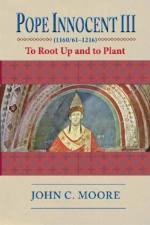
Innocent III
INNOCENT III (Lothar of Segni, 1160?–1216) was a pope of the Roman Catholic church (1198–1216). Innocent was the son of Trasimund of Segni, a count of Campagna, and Clarissa Scotti, daughter of a distinguished Roman family. He was educated first in Rome, possibly at the Schola Cantorum; then in Paris, where he studied theology; and finally in Bologna, where he probably studied law for a short time. Clement III elevated him to the cardinal diaconate of Saints Sergius and Bacchus in 1190. Before becoming pope, Innocent was active in the Curia Romana and took part in a number of legal cases as an auditor. As cardinal, he wrote three theological tracts, De miseria humane conditionis (Misery of the human condition), De missarum misteriis (Mysteries of the Mass), and De quadripartita specie nuptiarum (Four typologies of marriage), in addition to sermons. De missarum misteriis and De miseria humane conditionis enjoyed enormous popularity until the sixteenth century. Innocent was not a profound theological thinker. His thought was derivative and conventional, even a little old-fashioned.
When Innocent became pope in January 1198, the political situation in Italy and the German empire was very unstable. Emperor Henry VI had died in 1197 after subjecting most of the Italian peninsula to imperial authority. He left a young son, the future Frederick II, and two rival claimants for the imperial throne, his brother, Philip of Hohenstaufen, and Otto of Brunswick. Innocent skillfully extracted promises from both candidates that they would respect the integrity of the papal states. He regained control over the city of Rome and gradually reasserted papal hegemony over the Patrimony of Saint Peter. Although he eventually turned to Henry VI's young son Frederick in 1212, Innocent used the rivalry of Philip and Otto to establish the pope's right to judge a disputed imperial election in an important decretal, Venerabilem. He also indicated the importance of imperial affairs for the church by entering many letters, papal and secular, in a special register, the Regestum super negotio imperii.
Lack of imperial leadership during his pontificate permitted Innocent to strengthen papal prerogatives outside the papal states and inside the church. He received the kingdom of Sicily as a fief and was regent to young Frederick. In the Roman church he reorganized the Curia and managed the complex administrative and judicial affairs with consummate skill. He developed a new vision of papal monarchy, using earlier traditions, but with a powerful change of emphasis. An ingenious biblical exegete who cleverly used the Bible to support his vision of papal monarchy, he exalted the pope and his authority within the church as no earlier pope had done, and also attempted to mediate the affairs of secular rulers. He extolled the pope's status as Vicar of Christ, placing him above man but below God. The pope exercised divine authority granted by Christ only to him and held fullness of power (plenitudo potestatis) within the church.
Innocent formulated most of his ideas about ecclesiastical government early in his pontificate. His theories had practical consequences of strengthening the judicial hierarchy of the church, underlining the pope's position of supreme judge, and, at the same time, fundamentally destroying the last vestiges of the decentralized church of the early Middle Ages. He demanded the subordination of the bishops to the pope and insisted that all episcopal translations, resignations, and depositions fall entirely under papal jurisdiction. His anonymous biographer and other chroniclers drew a picture of a pope with enormous capacity and skill in judicial affairs, who frequently participated in the cases before the papal court and enjoyed the exercise of authority.
During Innocent's pontificate, law became a central concern of ecclesiastical government. He authenticated a collection of his decisions and sent them to the law school in Bologna in 1209–1210. This collection, the first officially promulgated code of canon law, signaled Innocent's awareness that the papacy was an institution with many of the same concerns as secular states. He heard appeals from all parts of Christendom, issued rulings on disputed points of law, and established a professional cadre of trained men in Rome to carry out his policies.
Crusades
Innocent called for a new, papally led crusade in August 1198 and imposed a special tax on the clergy to support it. Although the Fourth Crusade (1202–1204) lacked strong leadership and sufficient money, Constantinople, capital of the Byzantine Empire, was successfully assaulted in 1204. Innocent hoped that the conquest of Constantinople would result in the reunification of the Latin and Greek churches, but his hopes were in vain.
In 1218 he summoned another crusade, for which he made final arrangements at the Fourth Lateran Council (1215). Although he died before the Fifth Crusade (1217–1221) departed, it bore his imprint. Financed by the church and directed by the papacy, this crusade was a more sophisticated attempt to elaborate the policies Innocent had conceived in 1198. It was the last attempt of the papacy to organize a crusade without strong secular leadership.
Innocent also turned his attention to the proliferation of heretics, especially in the papal states. In 1199 he issued Vergentis, which decreed that condemned heretics should be dispossessed of their lands because heresy is treason. In effect, he defined the church as a state that the heretics had betrayed. This new conception of heresy led to his calling a crusade against the heretics of southern France, the Albigensian crusade (1208–1229). An army was gathered together under the leadership of a papal legate, Arnold Amalric, and at a heavy cost in lives the crusade was successful in extirpating heresy in Languedoc.
Pastoral Care and Reform
Innocent exalted the authority of the pope but also had a profound understanding of his pastoral duties. His ability to balance power and solicitude marks him as the greatest pope of the Middle Ages. In November 1215, some 412 bishops convened in Rome to take part in the Fourth Lateran Council. The council's seventy-one canons reflect Innocent's concerns. Heresy and the crusade were important items on the agenda—canon 8 established the foundations for the Inquisition—but the canons covered a wide range of other topics. Canon 18 forbade the participation of clerics in ordeals, which necessitated changes of judicial procedure in secular courts; canon 21 dictated that all Christians should confess their sins and receive Communion once a year; canon 50 changed the limits of consanguinity and affinity for marriage from seven to four degrees. Innocent also promulgated a number of canons regulating the lives of the clergy and the administration of churches.
The Fourth Lateran Council was the most important general council of the Middle Ages and provided a fitting end to Innocent's pontificate. Its canons are a measure of Innocent's strengths and serve as a guidepost for his policies. Innocent may have, in the words of the thirteenth-century Franciscan Salimbene, involved the church too much in worldly affairs, but he was a militant pastor and a great monarch.
Bibliography
Ernest F. Jacob's chapter on Innocent in the Cambridge Medieval History, vol. 6, edited by J. R. Tanner et al. (1929; reprint, Cambridge, U.K., 1957), pp. 1–43, though dated, is still readable and full of insights. For a longer treatment, Helene Tillmann's Pope Innocent III (1954), translated by Walter Sax from the German (New York, 1980), is sympathetic but not uncritical, and sprinkled with keen observations. Christopher R. Cheney's Pope Innocent III and England, "Päpste und Papsttum," vol. 9 (Stuttgart, 1976), is a brilliant study, the sum of a lifetime's work, and broader than its title might indicate. Three German scholars have recently discussed Innocent's thought and policies: Helmut Roscher's Papst Innocenz III. und die Kreuzzüge (Göttingen, 1969) examines all aspects of Innocent's crusades; Manfred Laufs's Politik und Recht bei Innocenz III. (Cologne, 1980) describes the dispute between Philip of Hohenstaufen and Otto of Brunswick, and Innocent's handling of this complex problem; Wilhelm Imkamp's Das Kirchenbild Innocenz' III., 1198–1216, "Päpste und Papsttum," vol. 22 (Stuttgart, 1983), explores the theological basis of Innocent's ecclesiology. Brian Tierney gives a masterful analysis of Innocent's ideas on the relationship of church and state in "'Tria quippe distinquit iudicia.…': A Note on Innocent III's Decretal Per venerabilem," Speculum 37 (1962): 48–59. Innocent's vision of papal monarchy is studied in my book Pope and Bishops: The Papal Monarchy in the Twelfth and Thirteenth Centuries (Philadelphia, 1984). Editions of Innocent's works cited at the beginning of the article can be found in Cheney and Imkamp.
This is the complete article, containing 1,385 words
(approx. 5 pages at 300 words per page).

