
 Print
Print Word
Word PDF
PDF|
This section contains 1,635 words (approx. 6 pages at 300 words per page) |

|
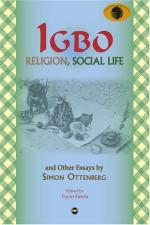
IGBO RELIGION. The Igbo are the largest ethnic group of southeastern Nigeria, numbering about fifteen million people in 2000. Until the mid-twentieth century the overwhelming majority of Igbo were farmers, raising yams as their staple crop. Traditionally, the Igbo lived in villages or village-groups surrounded by their farms. The village-group was the primary unit of political authority; there was no sustained tradition of centralized states within Igbo society. Rather, there were strong ties of the village community, the extended family system, age-group associations, and the various religious organizations that were important to community life. The Igbo have been exposed to Christian missionary activity since 1841; in 1857 an Anglican mission was opened at the important town of Onitsha along the Niger River. The Roman Catholics came in 1885. By the mid-twentieth century most Igbo had adopted Christianity, though the tensile strength of Igbo traditional religion sustained millions of devotees.
Igbo...
|
This section contains 1,635 words (approx. 6 pages at 300 words per page) |
|



