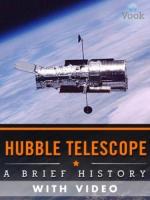
Launched April 24, 1990
The Hubble Space Telescope (HST) was named for Edwin P. Hubble, the first astronomer to prove the existence of galaxies beyond Earth’s galaxy, the Milky Way. Launched from the United States space shuttle Discovery in 1990, the HST is the most powerful telescope in the world. The spacecraft is orbiting 380 miles above Earth and is scheduled to remain in space for 15 years. Although it has been plagued by problems since it was put into orbit, the HST has nevertheless provided scientists with valuable information about the stars and the universe.
Telescopes have been used by astronomers since the seventeenth century. The Dutch inventer Hans Lippershey reportedly built the first telescope in 1608; the Italian scientist Galileo made the first astronomical studies with the instrument in 1610 when he discovered the craters on Earth’s moon as well as the moons of Jupiter and the rings of Saturn. Galileo also determined that the Milky Way was not a “heavenly cloud” but rather a cluster of stars “so numerous as to be beyond belief.”
These early telescopes were called refractors because they worked with lenses—an outside lens collects and focuses light and the eyepiece lens magnifies the image—a design that is still in use today. In the 1660s Isaac Newton, the English scientist, invented a telescope called a reflector, which uses mirrors to reflect an image to the magnifying eyepiece. Since Newton’s time telescopes have become bigger and more powerful; for instance, the Hale reflector on Mount Palomar in California measures 200 inches in diameter and can photograph stars that are 15 million times fainter than those seen by the naked eye. These giant modern telescopes rely on Newton’s basic reflector design.
Although telescopes built in the twentieth century have helped astronomers piece together a fairly comprehensive picture of the universe, they are not powerful enough to answer important questions: How large is the universe? Do other stars beyond Earth’s galaxy have planets? The HST was developed to provide this kind of information. While it is only 94 inches in diameter, the HST can see even farther than the Hale reflector and other powerful telescopes because it has a unique perspective—it is located in space.
Telescopes that are located on Earth must look through the air, or the atmosphere, which naturally dims and distorts star images and which is made even more dense by pollution and city lights. For this reason most observatories are located as far above the atmosphere as possible, on mountain tops or other high elevations. Yet there is no site on Earth that can be free of the atmosphere. Only outer space, where there is no air, can offer the best view of the stars.
In 1977 the National Aeronautics and Space Administration (NASA) began the HST project, with assistance from the European Space Agency. The goal was to put into space an unmanned observatory that would orbit outside Earth’s atmosphere and send back photographs of stars and galaxies. It was to become the most expensive instrument ever developed for astronomical research, eventually costing over $2.1 billion.
Considered the most significant development in astronomy since the invention of the telescope, the HST was designed to assist scientists in determining the structure, age, and future of the universe. It would help to discover planets around distant stars; the faint-object camera would photograph planets and the fine-guidance sensors could detect “wobbles” in stars, which indicate whether planets are pulling apart.
Another important function would be the study of quasars and black holes. Having the appearance of a star, a quasar is a distant object that generates more energy than an entire galaxy. A quasar can contain an invisible object called a black hole, which pulls in nearby adjacent stars and gas; this process releases great amounts of energy as the stars and gases are destroyed.
Access to the HST would not be limited to NASA and its partner. Astronomers who worked on the project would be permitted to use the telescope for their own projects; astronomers throughout the world could compete for use of the observatory by submitting proposals to the Space Telescope Science Institute.
Weighing 12.8 tons, the HST is equipped with a high-quality mirror that can detect a lighted candle over 250,000 miles away; other features include a faint-object camera that can photograph dim objects and fine-guidance sensors that can determine the exact location of stars. The HST also carries computers that can receive commands from two data-gathering sites, the NASA Space Flight Center outside Washington, D.C., and the Space Telescope Institute in Baltimore, Maryland.
The HST was designed to be put into space by a manned space shuttle that would take it to a distance of 370 miles above Earth. Once the HST was aloft, a mechanical arm on the shuttle would release the observatory to orbit Earth alone. The HST was originally scheduled for launching in 1983, but construction problems moved the launch date to 1985 and then to 1986. The longest delay occurred when the shuttle Challenger exploded in space on January 28, 1986, killing the seven crew members aboard. Although the Challenger project was unrelated to the HST, the disaster caused delays in all space shuttle programs until the reason for the accident was discovered. After investigators determined that faulty O-rings, elastic gaskets used for sealing, were not properly designed, NASA changed several features on the space shuttle.
The HST was finally launched on April 24, 1990, aboard the shuttle Discovery. Within two months, however, engineers discovered major flaws in the mirror: because of faulty manufacturing procedures it was shaped incorrectly and therefore was not able to form sharp images in visible light; vibration problems also developed. They estimated that as much as 40 percent of astronomers’ work would be lost. In July 1990 NASA appointed a commission to study repair procedures for the observatory.
In spite of these difficulties, however, the HST produced impressive results. It was able to send back pictures of such quasars as the Einstein Cross, which is eight billion light-years away; it also detected a white spot on Saturn, which turned out to be a storm system at least three times the size of Earth. Because computers could compensate for fuzzy images, the HST has provided remarkable details about supernovas (exploding stars), the motion and composition of celestial objects, the formation and merging of galaxies, the activity of black holes, the composition of binary stars, and the physical processes surrounding shock waves.
In December 1993 astronauts aboard the space shuttle Endeavour completed repairs to the HST during five space walks over a period of ten weeks. Using an apparatus called the Corrective Optics Space Telescope Axial Replacement (COSTAR), they installed corrective mirrors the size of quarters on the primary mirror; they also put in a new main camera and made other repairs. A month after the repairs astronomers reported that virtually full vision had been restored to the HST; the spacecraft’s first discovery was a globular cluster that consists of a large population of aging white dwarf stars in a dense field of other stars. In January 1994 HST embarked on an ambitious mission to search for black holes. By the following May it had reportedly been successful in locating a massive black hole that promised to be a significant discovery.
In July 1994 the HST took hundreds of pictures as 20 large chunks of the comet Shoemaker-Levy 9 smashed into Jupiter, raising fireballs more than 1,200 miles wide and scarring the planet with a black dot about half the size of Earth. Taken after the impact points had rotated into view as seen from Earth, the images have helped astronomers learn more about the composition of comets and Jupiter and the dynamics of celestial crashes.
This is the complete article, containing 1,300 words
(approx. 4 pages at 300 words per page).