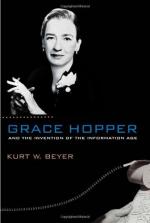
Hopper, Grace
American Mathematician and Computer Programming Pioneer 1906–1992
American mathematician and computer pioneer Grace Murray Hopper was called "Amazing Grace" by coworkers because of her determined ways. Born to parents who believed in quality education, Hopper was fascinated with gadgets, and she disassembled clocks and built vehicles with her "Structiron" kit. She was strongly influenced by her parents, and described her mother as having a "very great interest in mathematics" and her father as having "a house full of books, constant interest in reading, and insatiable curiosity."
Hopper entered Vassar in 1924 to study mathematics and physics and graduated with a bachelor's degree. She performed mathematics research at Yale and earned her master's degree in 1930 and her doctorate degree in 1934. During this era, these were rare achievements, especially for a woman.
Grace Hopper is best known for her contribution to the design and development of the COBOL programming language for business applications. She is shown here working on an early form of computer.
Hopper taught mathematics at Vassar and continued her tenure there as a professor until 1943. Her unusual methods applied mathematics to real life. She required her probability students to play dice and instructed students to plan a city by managing expenses.
Hopper's great-grandfather, a Navy rear-admiral, was her personal hero. When the United States entered World War II in 1941, she was crestfallen when the U.S. Navy would not accept women. By 1943 a shortage of men allowed women to enter the ranks. Hopper eagerly joined, but was rejected because she was too old, did not weigh enough, and was considered essential to the war effort as a civilian professor of mathematics. Undaunted, Hopper convinced the Navy to accept her, and in 1943, she started officer training, graduating at the top of her class. Assigned to Harvard's Computation Project, she worked with Howard Aiken on the Mark-I, which is considered one of the first programmable digital computers.
Post-War Years
In 1946 Hopper ended her Navy duty but remained a reservist and was appointed a Harvard research fellow and continued work on the Mark-II and Mark-III computers. Even though colleagues said only scientists had enough knowledge to use computers, Hopper was undaunted and continued to write programs that made computers easily accessible.
In 1949 Hopper joined the Eckert-Mauchly Corporation as a senior mathematician where she worked on UNIVAC (UNIVersal Automatic Computer), the first computer to handle both numeric and textual information. Her original staff was comprised of four men and four women. Hopper liked hiring women, she said, because "Women turn out to be very good programmers for one very good reason. They tend to finish up things, and men don't very often finish."
During this time, Hopper designed an improved compiler that translated instructions from English commands to machine language. This reduced the need for writing tedious machine code. She finished the A-O compiler in 1952 using easy terms like SUB (for subtraction) and MPY (for multiplication).
In 1957 Hopper developed FLOW-MATIC, the first commercial, data-processing compiler that allowed computers to be used for automated billing and payroll calculation. FLOW-MATIC became the foundation for Hopper's next development in 1959, the computer language COmmon Business Oriented Language, or COBOL. Whereas IBM's FORTRAN programming language used a highly condensed, mathematical code, COBOL used common English language words. COBOL was written for use on different computers and was intended to be independent of any one computer company. For her wide-reaching influence on COBOL's development, Hopper was deemed the "grandmother of COBOL."
Later Honors
Hopper retired from the Navy in 1966 but was recalled to help standardize computer languages. In 1969 she was named the first computer science "Man of the Year" by the Data Processing Management Association and was known among coworkers as "the little old lady who talks to computers." Her office contained a skull-and-crossbones flag and a clock that ran backward to remind people to use flexible thinking.
Grace Hopper retired in 1986 as the oldest Naval officer on active duty. In 1991 President George Bush awarded Rear-Admiral Hopper the National Medal of Technology, saying she was the first woman to receive America's highest technology award as an individual, and recognizing her "as a computer pioneer, who spent a half century helping keep America on the leading edge of high technology." Throughout her life, Hopper held to her belief that "Most problems have more than one solution."
How Did Computers Get "Bugs?"
Grace Hopper was at Harvard University in 1945 when, while working on the Mark-II, she discovered a hardware failure caused by a trapped moth. She coined the now common term "bug" to refer to unexpected computer failures.
Computers, Evolution of Electronic.
Bibliography
Billings, Charlene W. Grace Hopper: Navy Admiral and Computer Scientist Pioneer. Hillside, NJ: Enslow Publishers, 1989.
"Unforgettable Grace Hopper." Reader's Digest, October 1994.
Whitelaw, Nancy. Grace Hopper: Programming Pioneer. New York: Scientific American Books for Young Readers, 1995.
Internet Resources
"The Wit and Wisdom of Grace Hopper," Yale University Department of Computer Science, <http://www.cs.yale.edu/homes/ta p/Files/hopper-wit.html>. (From The OCLC Newsletter, March/April, 1987, no. 167).
This is the complete article, containing 820 words
(approx. 3 pages at 300 words per page).