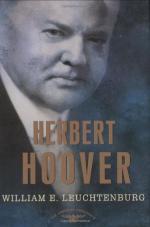
Hoover, Herbert
(August 10, 1874; October 20, 1964) Thirty-first president of the United States (1929–1933).
Herbert Hoover dedicated nearly fifty years to public service in roles ranging from international relief administrator to president of the United States. Few Americans played as significant a part in American wars or international relations as did Hoover during, and between, the great wars of the twentieth century. Hoover's activities on behalf of the U.S. government and nongovernmental international relief agencies during World War I first garnered him international renown. Deeply influenced both by the Quaker faith and the positivism of the Progressive era, Hoover applied the tenets of cooperative voluntarism and efficiency to the spheres of international relations and trade throughout his long public service.
While living in London in 1914, Hoover witnessed firsthand the commencement of European hostilities and the effects of World War I on noncombatants. As chairman of the American Committee, Hoover volunteered to assist Americans stranded in Europe, helping to repatriate thousands and giving material assistance to those in dire financial conditions. From 1914 to 1917, Hoover acted as the chairman of the Commission for Relief in Belgium (CRB), the nongovernmental international relief agency that raised millions of dollars to relieve the hardships of Belgians struggling to survive between two warring armies. The CRB distributed the aid with the grudging recognition of the belligerent nations.
After the United States entered the war, President Woodrow Wilson appointed Hoover the United States Food Administrator. In this capacity, Hoover managed the conservation and distribution of food material during the U.S. mobilization. Through a publicity campaign stating "Food Will Win the War," Hoover challenged Americans to voluntarily conserve their consumption of vital foodstuffs to help feed the American and Allied armies and Allied nonmilitary populations. By "Hooverizing" on "meatless Tuesdays" and "wheatless Wednesdays," Americans reduced food consumption by 15 percent without mandated rationing.
In 1919 Hoover played a notable role in the Versailles peace process as an economic advisor. More important, he became the director of the American Relief Administration (ARA) in war-ravaged Europe. The ARA ultimately fed 350 million people in twenty-one countries. Hoover acquired the label of the "Great Humanitarian" for his Herculean efforts to stave off starvation and material privation in postwar Europe.
Under Presidents Warren G. Harding and Calvin Coolidge, Hoover served as secretary of commerce. In
Herbert Hoover inspecting a food shipment bound for Europe. GETTY IMAGES
this position, Hoover emphasized the interdependence of the American and European economies in his attempts to redress the war debt and reparations issues. Hoover also called upon his wartime experiences with relief. In 1927, when the Mississippi river flooded in seven states, Hoover helped raise $15 million for the American Red Cross relief effort by appealing directly to the American people in a radio address.
Based on his successful career in public service, Hoover easily won the 1928 presidential election. During his term, he encountered a number of issues relating to American experiences during World War I. In the interests of peace and economic stability, Hoover attempted to lead the world toward disarmament and implemented the Kellogg-Briand Pact outlawing war. The U.S. government under Hoover sanctioned and paid for Gold Star Mothers to travel to Europe to attend the graves of their slain sons. In 1932, during the height of the Great Depression, Hoover faced the unwelcome presence in Washington, D.C., of 20,000 World War I veterans demanding immediate payment of their bonus. Fatefully, the Bonus March, and its dispersal at the hands of the U.S. Army, emerged as a symbol of Hoover's supposed disregard for American suffering during the Depression. Hoover lost the 1932 election to Franklin D. Roosevelt.
Hoover's post-presidential career showed no signs of weakening his commitment to public affairs. Hoover emerged as a staunch critic of the Roosevelt administration's foreign policy and cautioned that a slide into another world war would have catastrophic effects on American liberties. Although Hoover opposed U.S. involvement in the European conflict between 1939 and 1941, he continued to coordinate humanitarian assistance to noncombatants by aiding Finland and establishing the Polish Relief Commission. After Pearl Harbor, Hoover supported the war and stressed the need for international organizations to construct a lasting peace. Summoned by President Harry Truman, Hoover reexamined food shortages in the United States and conducted worldwide surveys as a member of the Famine Emergency Commission. Until his death in 1964, Hoover cautioned Americans about the spread of Communism but also the expansion in size and scope of the federal government. From World War I to the Cold War, Herbert Hoover was a prominent administrator and public servant, and an influential voice in American society during war.
Starvation in Europe and American Relief
During World War I the Allies used naval blockades to prevent the enemy from getting supplies from other sources, thus turning hunger into a weapon. As a result, the elderly and children suffered the most because soldiers and military support people received priority in the rationing of food and other necessities.
As the driving force behind the CRB (Commission for Relief in Belgium), which provided foodstuffs to occupied Belgium and France with the assurances of the German government that none of these supplies would be used by the German military, Herbert Hoover was in a position to assess the need for humanitarian relief in other war-torn countries as well. Hoover foresaw the likelihood that at war's end most of the population of Europe, winners and losers alike, would face famine and illness, in part a result of the blockade, in part because of the inability to farm and raise livestock. Hoover did not support the blockade. "I do not believe in starving women and children," he later wrote, recalling, "I did not believe that stunted bodies and deformed minds in the next generation were the foundation upon which to rebuild civilization."
In advance of America's likely entrance into the war, Hoover ordered the stockpiling of food and medical supplies. He left the CRB in capable hands in order to manage the American Relief Administration (ARA), which was responsible for mobilizing food and medical supplies. To Allied thinking, bread ranked with bullets in the inventory of war priorities. Thus the goal of the ARA was to procure enough exports from the United States, Canada, and the West Indies to make up the large deficits of the Allies and certain neutral countries (and after the armistice all of Europe) and to do so without ruining the U.S. economy.
Hoover solicited the voluntary cooperation of individuals, food producers, and restaurant owners to reduce the amount of food consumed by Americans at home. Farmers also voluntarily stepped up production of crops and livestock, so that no Allied servicemen or American civilians were issued short rations during America's involvement in the conflict. After the United States entered the war in 1917, a complex shipping and distribution system was put into place. Like the CRB, the ARA operated as separate departments: one for provisioning of rations, for which people paid a meager sum; and another for benevolence, for which necessities were given at no cost. Hoover ordered that ten to twelve million children in the liberated countries get first priority for provisions for many of them were dangerously malnourished. In the year following the Armistice, the ARA brought in and distributed 27 million tons of food, seeds, clothing, medical and other supplies together valued at $5.5 billion. Among its numerous activities, the ARA directed coal mines and railroad operations and ran a delousing program to obliterate the typhus epidemic that cost over 10,000 lives in eastern Europe. In addition to supervising general relief activities, Hoover created the privately funded Children's Relief Fund, which cared for some 8 million children in central and eastern Europe.
Bonus March; Gold Star Mothers Pilgrimage; Red Cross, American.
Bibliography
Best, Gary Dean. Herbert Hoover: The Postpresidential Years, 1933–1964. Stanford, CA: Hoover Institution Press, 1983.
Gelfand, Lawrence E., ed. Herbert Hoover: The Great War and Its Aftermath, 1914–1923. Iowa City: University of Iowa Press, 1979.
Nash, George H. The Life of Herbert Hoover, 3 vols. New York: Norton, 1983–1996.
Wilson, Joan Hoff. Herbert Hoover: Forgotten Progressive. Boston: Little, Brown, 1975.
Internet Resources
The Herbert Hoover Presidential Library-Museum. Available at <http://www.hoover.archives.gov& #x003E;.
The Hoover Institution on War, Revolution, and Peace. Stanford University. Available at <http://www-hoover.stanford.edu& #x003E;.
This is the complete article, containing 1,360 words
(approx. 5 pages at 300 words per page).