
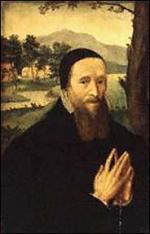
Hooker, Richard
HOOKER, RICHARD (1554–1600), was an apologist and theologian of the Church of England, famous for his work Of the Laws of Ecclesiastical Polity (hereafter cited as Laws). Born at Heavitree near Exeter, Hooker received his basic education in the Exeter Grammar School. His parents could not afford more advanced schooling for him, but his uncle took the boy to see Bishop John Jewel of Salisbury (1560–1571), who agreed to be his patron and arranged for his admission as a clerk at Corpus Christi College, Oxford, in 1568. His tutor was Dr. John Rainolds (1549–1604), a leader of the moderate Puritans at the university.
Hooker received his B.A. in 1574 and his M.A. in 1577. He was made a fellow of the college and a lecturer in Hebrew, and in 1581 he was ordained. His wide learning, gentle disposition, and genuine piety were admired at Oxford. Among his pupils two became lifelong friends and advisers in the writing of the Laws: Edwin Sandys, son of Bishop Edwin Sandys of London (1570–1576; archbishop of York, 1576–1588), and George Cranmer, grandnephew of Thomas Cranmer, archbishop of Canterbury (1533–1556).
In December 1584 Hooker received the living of Drayton Beauchamp, Buckinghamshire, but a few months later he was appointed master of the Temple in London. He was soon involved in bitter controversy with Walter Travers, the afternoon lecturer at the Temple, who was a noted Puritan of presbyterian views and ordination. Instead of living in the master's house, which was in disrepair and partly occupied by Travers, Hooker took lodging in the nearby home of John Churchman, a prosperous member of the Merchant Taylors' Company and a friend of Sandys. In February 1588, Hooker married Churchman's daughter Joan, who bore him two sons (both of whom died in infancy) and four daughters.
Hooker resigned from the Temple in 1591 and was given the living of Boscombe, near Salisbury. It is doubtful if he was ever resident there, for he was already writing the Laws in the Churchmans' home, where he lived with his growing family. There also Sandys, who had entered Parliament, and Cranmer could easily confer with him about the work. In 1595, Hooker moved with his family to a living in Bishopsbourne, near Canterbury. He remained there, except for frequent visits to London, until his death on November 2, 1600.
In the preface to the Laws, Hooker outlined the themes of his eight projected books and made clear the purpose of the work. It was a defense, based on scripture, the tradition of the church, and reason, of Queen Elizabeth's settlement of the Church of England against the radical Puritans. The latter sought to overthrow the settlement by abolishing the royal supremacy, episcopacy, and The Book of Common Prayer and to substitute a presbyterian system of church government and discipline modeled on Calvin's church at Geneva.
Because Hooker had difficulty finding a publisher, Sandys contracted with a printer, John Windet, Hooker's cousin, to produce the work. Sandys agreed to bear the entire cost. Archbishop John Whitgift of Canterbury gave his license, and the preface and first four books were issued in early March 1593. The publication, as Sandys had hoped and planned, came just before the opening of Parliament to consider (and pass) the Act to Retain the Queen's Subjects in Obedience, a stringent ruling against all who refused to attend the Church of England's services or who were "present at any unlawful assemblies, conventicles, or meetings, under colour or pretence of any exercise of religion."
Book 5, much longer than the others, appeared in 1597. Hooker completed drafts of the last three books before his death. They were not published for many years—books 6 and 8 in 1648 and the complete work, with book 7, in 1662. Their authenticity, often questioned, is now generally accepted. A large portion of the beginning of book 6 has been lost, although notes on it by Sandys and Cranmer are extant, and Hooker's manuscript pages of book 8 were left in some disorder.
Books 1–4 deal with laws in general: the divine law of God himself, the immutable natural law implanted by God in creation, and the positive law of human societies. Yet human reason, impaired by the fall but assisted by divine revelation and grace, can understand the natural law and be guided in positive law according to times, circumstances, and experience. No positive law is perfect, but it is always reformable.
Against the radical Puritans, Hooker argued that the scriptures were not self-authenticating. Their authority had been determined by the church. Nor did the scriptures contain a detailed ordering of the governance and worship of the church, but only its basic principles. These principles were different from the unchanging and essential revelation for faith and salvation. On the basis of scriptural principle, Hooker defended in book 5 the rites and customs of The Book of Common Prayer and in book 6 its mode of penitential discipline.
In book 7 he based episcopacy not on any divine institution but on the universal practice of the church since apostolic times. Book 8 on the royal supremacy is cautiously ambivalent. Hooker defended on scriptural grounds the necessity of obedience to constituted civil authority by the consent of the people. In his England, as in ancient Israel, civil and ecclesiastical societies were coextensive. He was aware, however, that the Crown had used its prerogatives to limit the church's freedom in ordering its own internal life.
Hooker's extensive and erudite documentation of his arguments, the richly textured eloquence of his style, and his openness to reforms in the Church of England have made his work a constant resource in the later development of Anglican theology. His political philosophy has been judged as both a conservative apology for the status quo and a liberal critique of the Elizabethan church. He has been acclaimed as the first major prose writer in modern English literature. Yet his lasting legacy has been his appeal to reason in the interpretation of scripture, the church's government, and worship.
Bibliography
The standard text is that edited by John Keble, The Works of that Learned and Judicious Divine, Mr. Richard Hooker, With an Account of his Life and Death by Isaac Walton (1838), 3 vols., 7th ed., revised by R. W. Church and F. Paget (1888; reprint, New York, 1970). Another edition is The Folger Library Edition of the Works of Richard Hooker, edited by William S. Hill (Cambridge, Mass., 1977–1998). For an introduction to this edition, see Studies in Richard Hooker: Essays Preliminary to an Edition of His Works, edited by William S. Hill (Cleveland, 1972), with an extensive annotated bibliography.
Charles J. Sisson's The Judicious Marriage of Mr. Hooker and the Birth of The Laws of Ecclesiastical Polity (Cambridge, U.K., 1940), by researches into parish, chancery, and other records, effectively questions and revises many statements in Isaac Walton's famous Life and opens new insights into the publication of the Laws and the fate of Hooker's posthumous manuscripts.
An important Anglican interpretation, which errs in an attempt to make the Laws a summa of Anglican theology, is John S. Marshall's Hooker and the Anglican Tradition: An Historical and Theological Study of Hooker's Ecclesiastical Polity (Sewanee, Tenn., 1963). Robert K. Faulkner's Richard Hooker and the Politics of a Christian England (Berkeley, Calif., 1981) gives a fresh reading of the Laws.
This is the complete article, containing 1,210 words
(approx. 4 pages at 300 words per page).

