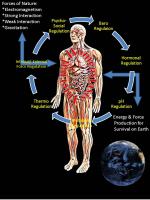
Homeostasis
Living things are incredibly complex. They are constantly using and creating energy with countless cellular reactions. An organism must constantly maintain conditions which are favorable for these reactions to occur. The internal state of every living thing must be kept fairly constant. Homeostasis is the maintenance of internal conditions within certain boundaries.
The concept of homeostasis was developed by a French physiologist, Claude Bernard, in 1851. He was the first to recognize the presence and relative constancy of an organism's internal environment, which he called the milieu intérieur, while living in an ever-changing external environment, or milieu extérieur. An organism needed to maintain a dynamically constant internal environment in order to survive. Shortly after Bernard's pioneering work, an American physiologist, Walter Cannon (1871-1945), coined the term homeostasis, referring to this internal dynamic constancy.
An organism has many mechanisms and structures for maintaining homeostasis. Some of these mechanisms are under involuntary control from the autonomic nervous system; for example internal temperature, blood pressure, or the digestion of food. Motor pathways carry commands from the central nervous system to regulate the glands and nonskeletal muscles of the body, regulating the body's internal physiological condition. Some mechanisms for maintaining homeostasis are more directly controlled by the organism. For example, a lizard needs to maintain its internal temperature by modifying its external environment; moving from direct sunlight to shade as needed.
Homeostasis operates at many levels, including the molecular, cellular, organismic, and populational levels. Homeostasis at the molecular level involves a process known as feedback inhibition. This limits the amount of product produced in a chemical reaction. With feedback inhibition, the end product of a reaction has an inhibitory effect on the reactants, which causes the reaction to cease until the levels of the product fall below a certain level, at which time the reaction continues. This maintains a fairly constant level of product in a system.
At the cellular level, the cells themselves regulate their internal and external environment. One example is contact inhibition. Many cells will stop dividing if they become so numerous that they touch each other. A chemical messenger is passed from cell to cell, inhibiting further cell division. Cancer cells do not exhibit contact inhibition which may account for the uncontrolled growth of tumors.
At the organismal level, the autonomic nervous system in cooperation with other body systems help maintain homeostasis. An example of homeostasis in an organism is the endocrine system. Hormone levels help regulate the activities of many body systems. Hunger and thirst are also examples of a homeostasis mechanism in an organism. These sensations help regulate the amount of nutrients and water that are digested by an organism.
Finally, at the population level, homeostasis can also be maintained. Relationships between predatory animals and their prey are examples of mechanisms of homeostasis. These relationships help control population size. If a prey animal becomes too numerous, so do their predators. The increase in predation will eventually decrease the prey population, which will in turn cause the predator population to decrease as well. The population size of both organisms are maintained in a delicate balance with each other. This balance, much like the balance maintained in the individual cells of an organism, is a kind of homeostasis.
This is the complete article, containing 532 words
(approx. 2 pages at 300 words per page).