Forgot your password?  

Not What You Meant?  There are 52 definitions for Equilibrium.  Also try: Balance.

Homeostasis | Research & Encyclopedia Articles

Print-Friendly   Order the PDF version   Order the RTF version
About 5 pages (1,486 words)
Homeostasis Summary


Homeostasis


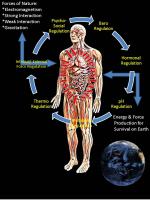
Humans, all other organisms, and even ecological systems, live in an environment of constant change. The persistently shifting, modulating, and changing milieu would not permit survival, if it were not for the capacity of biological systems to respond to this constant flux by maintaining a relatively stable internal environment. An example taken from mammalian biology is temperature which appears to be "fixed" at approximately 98.6°F (37°C). While humans can be exposed to extreme summer heat, and arctic mammals survive intense cold, body temperature remains constant within vary narrow limits. Homeostasis is the sum total of all the biological responses that provide internal equilibrium and assure the maintenance of conditions for survival.

The human species has a greater variety of living conditions than any other organism. The ability of humans to live and reproduce in such diverse circumstances is due to a combination of homeostatic mechanisms coupled with cultural (behavioral) responses.

The scientific concept of homeostasis emerged from two scientists: Claude Bernard, a French physiologist, and Walter Bradford Cannon, an American physician. Bernard contrasted the external environment which surrounds an organism and the internal environment of that organism. He was, of course, aware that the external environment fluctuated considerably in contrast to the internal environment which remained remarkably constant. He is credited with the enunciation of the constancy of the internal environment ("La fixité du milieu intérieur...") in 1859. Bernard believed that the survival of an organism depended upon this constancy, and he observed it not only in temperature control but in the regulation of all of the systems that he studied. The concept of the stable "milieu intérieur" has been accepted and extended to the many organ systems of all higher vertebrates. This precise control of the internal environment is effected through hormones, the autonomic nervous system, endocrines, etc.

The term "homeostasis," derived from the Greek homoios meaning similar and stasis meaning to stand, suggests an internal environment which remains relatively similar or the same through time. The term was devised by Cannon in 1929 and used many times subsequently. Cannon noted that, in addition to temperature, there were complex controls involving many organ systems that maintained the internal stability within narrow limits. When those limited are exceeded, there is a reaction in the opposite direction that brings the condition back to normal, and the reactions returning the system to normal is referred to as negative feedback. Both Bernard and Cannon were concerned with human physiology. Nevertheless, the concept of homeostasis is applied to all levels of biological organization from the molecular level to ecological systems, including the entire biosphere. Engineers design self-controlling machines known as servomechanisms with feedback control by means of a sensing device, an amplifier which controls a servomotor which in turn runs the operation of the device. Examples of such devices are the thermostats which control furnace heat in a home or the more complicated automatic pilots of aircraft. While the human-made servomechanisms have similarities to biological homeostasis, they are not considered here.

As indicated above, temperature is closely regulated in humans and other homeotherms (birds and mammals). The human skin has thermal receptors sensitive to heat or cold. If cold is encountered, the receptors notify an area of the brain known as the hypothalamus via a nerve impulse. The hypothalamus has both a heat-promoting center and a heat-losing center, and, with cold, it is the former which is stimulated. Thyroid-releasing hormone, produced in the hypothalamus, causes the anterior pituitary to release thyroid stimulating hormone which, in turn, causes the thyroid gland to increase production of thyroxine which results in increased metabolism and therefore heat. Sympathetic nerves from the hypothalamus stimulate the adrenal medulla to secrete epinephrine and norepinephrine into the blood which also increases body metabolism and heat. Increased muscle activity will generate heat and that activity can be either voluntary (stamping the feet for instance) or involuntary (shivering). Since heat is dissipated via body surface blood vessels, the nervous system causes surface vasoconstriction to decrease that heat loss. Further, the small quantity of blood that does reach the surface of the body, where it is chilled, is reheated by countercurrent heat exchange resulting from blood vessels containing cold blood from the limbs running adjacent to blood vessels from the body core which contain warm blood. The chilled blood is prewarmed prior to returning to the body core. A little noted response to chilling is the voluntary reaching for a jacket or coat to minimize heat loss.

The body responds with opposite results when excessive heat is encountered. The individual tends to shed unnecessary clothing, and activity is reduced to minimize metabolism. Vasodilation of superficial blood vessels allows for radiation of heat. Sweat is produced, which by evaporation reduces body heat. It is clear that the maintenance of body temperature is closely controlled by a complex of homeostasis mechanisms.

Each step in temperature regulation is controlled by negative feedback. As indicated above, with exposure to cold the hypothalamus, through a series of steps, induces the synthesis and release of thyroxine by the thyroid gland. What was not indicated above was the fact that elevated levels of thyroxine control the level of activity of the thyroid by negative feedback inhibition of thyroid stimulating hormone. An appropriate level of thyroid hormone is thus maintained. In contrast, with inadequate thyroxine, more thyroid stimulating hormone is produced. Negative feedback controls assure that any particular step in homeostasis does not deviate too much from the normal.

Historically, biologists have been particularly impressed with mammalian and human homeostasis. Lower vertebrates have received less attention. However, while internal physiology may vary more in a frog than in a human, there are mechanisms which assure the survival of frogs. For instance, when the ambient temperature drops significantly in the autumn in northern latitudes, leopard frogs move into lakes or rivers which do not freeze. Moving into lakes and rivers is a behavioral response to a change in the external environment which results in internal temperature stability. The metabolism and structure of the frog is inadequate to protect the frog from freezing, but the specific heat of the water is such that freezing does not occur except at the surface of the overwintering lake or river. Even though life at the bottom of a lake with an ice cover moves at a slower pace than during the warm summer months, a functioning circulatory system is essential for survival. In general, frog blood (not unlike crankcase oil prior to the era of multiviscosity oil) increases in viscosity with as temperature decreases. Frog blood, however, decreases in viscosity with the prolonged autumnal and winter cold temperatures, thus assuring adequate circulation during the long nights under an ice cover. This is another control mechanism that assures the survival of frogs by maintaining a relatively stable internal environment during the harsh winter. With a return of a warm external environment, northern leopard frogs leave cold water to warm up under the spring sun. Warm temperature causes frog blood viscosity to increase to summer levels. It may be that the behavioral and physiological changes do not prevent oscillations that would be unsuitable for warm blooded animals but, in the frog, the fluctuations do not interfere with survival, and in biology, that is all that is essential.

There is homeostasis in ecological systems. Populations of animals in complex systems fluctuate in numbers, but the variations in numbers are generally between limits. For example, predators survive in adequate numbers as long as prey are available. If predators become too great in number, the population of prey will diminish. With fewer prey, the numbers of predators plummet through negative feedback thus permitting recovery of the preyed upon species. The situation becomes much more complex when other food sources are available to the predator.

Many organisms encounter a negative feedback on growth rate with crowding. This density dependent population control has been studied in larval frogs, as well as many other organisms, where excretory products seem to specifically inhibit the crowded species but not other organisms in the same environment. Even with adequate food, high density culture of laboratory mice results in negative feedback on reproductive potential with abnormal gonad development and delayed sexual maturity. Density independent factors affecting populations are important in population control but would not be considered homeostasis. Drought is such a factor, and its effects can be contrasted with crowding. Populations of tadpoles will drop catastrophically when breeding ponds dry. Instead of fluctuating between limits (with controls), all individuals are affected the same (i.e., they die). The area must be repopulated with immigrants at a subsequent time, and the migration can be considered a population homeostatic control. The inward migration results in maintenance of population within the geographic area and aids in the survival of the species.

Resources

Books

Hardy, R. N. Homeostasis. London: Edward Arnold, Ltd., 1976.

Langley, L. L. Homeostasis. New York: Reinhold Publishing Co., 1965.

Tortora, G. J., and N. P. Anagnostakos. Principles of Anatomy and Physiology. 5th ed. New York: Harper and Row, 1987.

This is the complete article, containing 1,486 words (approx. 5 pages at 300 words per page).

More Information
  • View Homeostasis Study Pack
  • 52 Alternative Definitions
  • Search Results for "Homeostasis"
  • More Products on This Subject
    Homeostasis
    Hypotheses Perspiration Depending on the individual skin moisture should increase during and imme... more

    Homeostasis
    In 1865 French physiologist Claude Bernard pointed out that in order for an organism to survive, a ... more


    Ask any question on Homeostasis and get it answered FAST!
    Answer questions in BookRags Q&A and earn points toward
    discounted or even FREE Study Guides and other BookRags products!
    Learn more about BookRags Q&A
    Copyrights
    Homeostasis from Environmental Encyclopedia. ©2005-2006 Thomson Gale, a part of the Thomson Corporation. All rights reserved.

    Join BookRagslearn moreJoin BookRags

    Join BookRagslearn moreJoin BookRags