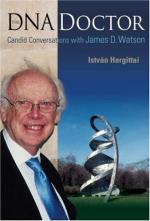
History of Genetics: the Discovery of the Watson-Crick Model of Dna
Modern genetics can be seen as the result of the integration of three lines of investigation: breeding tests, cytology, and biochemistry. Classical genetics could address the question of how the gene was transmitted, but it could not explain how genes work. Indeed, some geneticists argued that it was impossible to imagine that any particle or molecule could constitute the genetic material. Others were sure that the gene must be a chemical entity with a specific, defined molecular arrangement. Once scientists were able to identify DNA as the genetic material and a model for the three-dimensional structure of DNA was proposed, molecular biologists were able to investigate the biochemical basis of gene structure and function.
The correlation between chromosomal structure and measurements of linkage became well established in the 1930s for several plant and animal species. During this time period, the development of ultraviolet microspectrophotometry and special staining techniques extended the range of cytological studies. Ingenious use of such techniques brought cytochemists very close to understanding the chemical nature of the chromosomes. Walter Flemming (1843-1905), who suspected that nuclein was an important component of the cellnucleus, coined the term chromatin because the relationship between nuclein and the chromatic threads had not been clearly established. Oscar Hertwig (1849-1922) suggested in 1885 that nuclein was probably responsible for fertilization and the transmission of the hereditary characteristics.
Scientists thought that the gene might be a molecule with the property of self-duplication and it might act as a kind enzyme, that is a catalytic protein. Until the 1950s, it seemed quite unlike that the genetic material could be nucleic acid. During the early decades of the twentieth century the nucleic acids, which are now known to be the material basis of heredity, were thought to be simple, repetitive, and rather uninteresting chemicals.
The work of Johann Friedrich Miescher (1844-1895), who discovered nucleic acids, is virtually unknown. Indeed, the elucidation of the double helical structure of DNA in the 1950s is often confused with the discovery of nucleic acids in the 1960s. While studying the chemistry of pus cell nuclei, Miescher discovered "nuclein," a previously unknown organic acid with a high phosphorous content. Miescher also isolated nuclein from salmon sperm, which are a good source of cell nuclei. Nuclein was unstable and its purification was very difficult. Critics charged that Miescher's nuclein was a crude, chemically undefined mixture, or simply albumin contaminated with phosphate salts. Miescher was unsure of the cellular role of nuclein, but he did suggest that it might be involved in fertilization and the transmission of heritable factors.
In 1895 Edmund B. Wilson pointed out that the chromosome sets contributed by the two sexes were precise equivalents. Because the two sexes play an equal role in heredity, chromatin must be the physical basis of heredity. Chromatin seemed to be identical to nuclein, which must be the genetic material. Studying nuclein from thymus and yeast, Albrecht Kossel (1853-1927) proved that there were two kinds of nucleic acids, which were originally known as thymus nucleic acid and yeast nucleic acid. They are now known as deoxyribonucleic acid (DNA) and ribonucleic acid (RNA).
Work carried out by Phoebus Aaron Levene (1869-1940) suggested that DNA was a highly repetitious polymer, which was incapable of generating the diversity that the genetic material should display. Only proteins seemed capable of demonstrating the complexity required by the genetic material, until Erwin Chargaff and other chemists challenged prevailing ideas about DNA. According to Chargaff, Oswald Avery's 1944 paper on the transformation of pneumococcal types led to him to think that specific structural patterns of DNA might be very complex. Sequencing nucleic acids was impossible in the 1940s, but Chargaff found differences in the composition of DNA from different sources. This disproved the assumption that all DNAs were identical to calf thymus DNA. He also proved that the base composition of DNA from different organs of the same species was constant and characteristic of the species. Moreover, when Chargaff analyzed the molar ratio of the bases, he found that the ratio of adenine to thymine and guanine to cytosine was always about one. This suggested that DNAs from different sources must share some fundamental structural principle. From Chargaff's work it was clear that nucleic acids were complex, interesting, and very large molecules.
The experiments that stimulated Chargaff's interest in DNA were carried out in the laboratory of Oswald T. Avery (1877-1955). Avery's results challenged the assumption that genes must be proteins or nucleoproteins. In some respects, Avery's work was a refinement of an approach previously developed by the British bacteriologist Fred Griffith (1877-1941). Avery and his coworkers identified DNA as the transforming principle of pneumococci. However, Avery and his associates realized that it was not possible to reconcile the biological activity of their DNA preparations with prevailing ideas about DNA chemistry.
Work with bacteriophage (bacterial viruses) was especially significant in leading to the collaboration between James Dewey Watson (1928-) and Francis Crick (1916-) that resulted in the discovery of the DNA double helix in 1953. Watson was a member of the "Phage Group, associated with Max Delbrück (1906-1981), one of the founders of molecular biology. Molecular biologists realized that bacteria and bacteriophages could serve as model systems for exploring the nature of the gene. Although bacterial cells do not have a nucleus, in 1946 Joshua Lederberg (1925-) demonstrated that they do undergo genetic recombination. Bacteria and bacteriophages proved to be more convenient systems for studies of the chemical nature of the gene than higher organisms. Indeed, viruses are often described as naked genes wrapped up in protein coats.
Experiments conducted in 1952 by Alfred Hershey (1908-1997) and Martha Chase (1927-) indicated that DNA must be the genetic material. These experiments indicated that bacteriophage DNA enters bacterial cells while their proteins remain outside. Hershey and Chase concluded that bacteriophage protein was not involved in the growth and multiplication of phage inside the infected bacterial cell.
Watson accepted the Hershey-Chase experiment as proof that DNA was the genetic material. However, because the structure of DNA was still unknown, it was impossible to understand how genes acted. The model of DNA structure suggested by Watson and Crick in 1952 immediately suggested an explanation of its biological activity. Both Watson and Crick, who met in Cambridge in 1951, attributed their success to their special relationship: their ability to complement, criticize, and stimulate each other. The Watson-Crick collaboration was a fortunate one, for Crick doubted that either he or Watson could have discovered the structure of DNA alone. According to Crick, if he and Watson had not discovered the double helix, the puzzle might have been solved by Rosalind Franklin (1920-1958), Maurice Wilkins, Linus Pauling, or by further refinements of biochemistry.
Watson and Crick based their model on a combination of model building and X-ray data collected by Franklin. Several X-ray crystallographers had previously attempted to determine the three dimensional structure of DNA. The early, crude X-ray diffraction patterns of DNA suggested that DNA had a regular crystalline structure that might eventually be clarified by more precise X-ray crystallographic studies.
In their first Nature paper of 1953, Watson and Crick described a radically new structure for deoxyribose nucleic acid. Their structure was a two-stranded double helix; the novel feature of the model was the way in which the two chains were held together by the purine and pyrimidine bases. Most importantly, the bases on the two strands were held together by hydrogen bonds: a purine on one chain always paired with a pyrimidine on the other chain. Chemical considerations indicated that adenine always paired with thymine and guanine paired with cytosine. Any sequence of bases could occur on one chain, but the rules of base pairing automatically determined the sequence of bases on the other chain. Thus, the Watson-Crick double helix immediately explained Chargaff's data concerning the molar ratios of purines to pyrimidines and how the structure of DNA encompasses both order and variety.
Despite the obvious elegance of the Watson-Crick DNA model, the X-ray evidence previously published was insufficient for a rigorous test of the hypothetical structure. More precise data, which confirmed the Watson-Crick hypothesis, appeared in two communications that followed their proposal. A paper by Wilkins and his coworkers discussed the available X-ray data for calf thymus DNA, nucleoprotein preparations from sperm heads, and bacteriophage. A paper by Franklin and R. G. Gosling presented the most refined X-ray diffraction patterns of DNA then available, and Franklin demonstrated that the double helix was consistent with the X-ray patterns for DNA.
Although Watson and Crick only alluded to the question of how the genetic material might function at the molecular level, the double helix immediately suggested how DNA molecules could make copies of themselves. In their first DNA paper, Watson and Crick concluded that the specific pairing they had proposed immediately suggests a possible copying mechanism for the genetic material. In another paper Watson and Crick elaborated on the genetic implications of their model. Within a few years of the publication of the Watson-Crick model, researchers had generally confirmed their proposed mechanism of DNA replication and transformed the chromosome theory into the nucleic acid theory. The success of the Watson-Crick model confirms an aphorism attributed to Francis Crick: "If you can't study function, study structure."
This is the complete article, containing 1,536 words
(approx. 5 pages at 300 words per page).