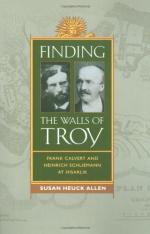
Born January 6, 1822, Heubukow, Mecklenburq-Schwerin, Germany
Died December 26, 1890, Naples, Italy
Since the Middle Ages, historians, mapmakers, and travelers have tried to find the actual sites where the events of Homer’s epic poem the Iliad took place. Was the ancient Greek poet’s account of the final years of the Trojan War based on fact, or merely a myth? Did the ancient city of Troy really exist? Listening spellbound to these stories as a boy, Heinrich Schliemann was certain that the tales were true, and determined that someday he would be the one to rediscover the city.
The son of a pastor, Schliemann had to leave school early to help with the family finances. He was apprenticed to a grocer when he was fourteen, and a short time later became an office boy for a firm located in Amsterdam, the Netherlands. All the while he studied about the ancient Greeks and even learned their language. He learned to read and write other languages as well, nearly a dozen in all. In 1844 he became a bookkeeper for a company in Amsterdam that sent him to St. Petersburg, Russia. There he started his own business, importing indigo (a plant used for dye) and tea. During the Crimean War—the conflict between Russia and France, England, and Turkey—he made his fortune as a military supplier. He made a second fortune as a banker while in California during the gold rush. Because he was living in the territory when it became a state in 1850, he was given American citizenship.
Retiring from business at the age of forty-one, Schliemann studied and traveled for some time before taking up his childhood dream: that of finding Troy and other ancient Greek sites. At his own expense he began excavation of a desolate region near the village of Hissarlik, near Turkey’s western coast, in 1873. At daybreak on May 31 the self-taught archaeologist unearthed the first object in an incredible collection of treasures, one of the richest archaeological finds ever made. It consisted of nearly nine thousand objects, including thousands of pieces of jewelry, such as diadems (royal headbands) of woven and hammered gold, rings, bracelets, earrings, necklaces, buttons, belts, and pins. Also among the collection were human figurines, bowls and vessels for perfumed oils, and copper weapons. Schliemann called his find “Priam’s Treasure” after the Iliad’s Trojan king, certain he had uncovered the royal palace. The world was stunned by the magnificence of the objects the amateur archaeologist had found and grateful for the proof, at last, that Homer’s epic poem was based on historical fact.
The science of archaeology was still in its early stages during Schliemann’s time, with methods of digging, taking field notes, and dating finds not firmly established. Scholars later dated the objects he unearthed to a thousand years before the time of Homer’s Troy. (There had actually been nine cities at various times on the site.) They also criticized Schliemann’s crude methods of excavation, which actually destroyed layers representing the Homeric period as he dug beneath them. They questioned Schliemann’s dramatic accounts of the discovery as well. For instance, he wrote that his wife Sophia had secretly whisked away the earliest treasures in her shawl to protect them from the untrustworthy hired help; later he admitted that she had not been there. Worse still, there were repeated rumors that the fame-seeking amateur archaeologist had added objects found elsewhere or purchased from the Turkish black market to the excavation site—all in an effort to prove his beliefs about Homer’s writings and to further his own reputation.
Rules about ownership of archaeological finds were not well-defined during Schliemann’s time—and later scholars agreed that he certainly took advantage of them. To start, the amateur archaeologist did not have the permission of the Ottoman (now Turkish) government when he began his original excavation. When he later agreed to split his findings with the Turks, he smuggled many of the objects out of the country. Turkey sued for the return of the treasures but received only a small amount of money representing its share. Schliemann tried to sell his finds in Europe, but with their ownership in question, major museums turned him down. So in the early 1880s he donated Priam’s Treasure to Germany, which gratefully accepted the dazzling collection. But questions of legal ownership continued to plague the archaeological treasures.
Despite Schliemann’s personal flaws and careless science, there is no denying the importance of the objects he unearthed, which painted a picture of ancient Greek life that had only been imagined. The archaeologist made other important excavations over the next decade. From 1876 to 1878 he unearthed the ancient Greek trade and cultural center of Mycenae (legendary home of Agamemnon, leader of the Greeks in the Trojan War) and its royal tombs; in 1878 he found the remains of Ithaca, the reported home of Homer’s Odysseus; from 1881 to 1882 he excavated Orchomenus, location of the ancient Boeotian city of Thebes; and from 1884 to 1885 he dug at the site of Tiryns, an ancient Mycenaen city of great splendor and palaces. Schliemann wrote several books colorfully describing his expeditions and finds, as well as an autobiography that was published in 1892. Between excavations he lived in a mansion in Athens with his second wife, Sophia Engastromenos, with whom he had two children. He died on December 26, 1890, in Naples, Italy.
Some fifty years later, at the start of World War II, the thousands of ancient objects that comprised Priam’s Treasure were removed from the Berlin museum in which they had been exhibited. German chancellor and Führer (leader) Adolf Hitler had ordered that all museum collections be put into underground storage to protect them from bombs. When the Soviet Army entered Berlin in May of 1945 the treasure vanished altogether, and it was generally assumed that Russian soldiers had melted down the priceless artifacts and sold them.
But in the early 1990s the treasures of Priam were found. Officials at Moscow’s Pushkin Museum, after years of denial, admitted with embarrassment that they had held the objects since the end of the war, when they were flown to Moscow. Researchers from England, Greece, Turkey, Germany, and the United States helped the Russians identify and catalog the artifacts. In 1996 an exhibition of 259 of the most stunning of the objects opened at the Pushkin, and the public was again able to journey into the remarkable ancient world that Schliemann’s excavations had opened to them.
Still, not everyone was happy with the treasure’s reappearance. The German government wanted it back, along with other artwork the Soviets had taken near the end of the war. And Turkey insisted, as it had all along, that Schliemann had illegally obtained the artifacts. The Turks claimed ownership of Priam’s Treasure, hoping one day to retrieve it and place it in a museum at the site of Homer’s Troy.
Homer and the Trojan War
Homer was an ancient Greek poet believed to have lived somewhere between 1200 and 850 B.C. He is thought to have written the epic works the Iliad and the Odyssey, which recount the Trojan War and the wanderings of Odysseus (Ulysses), a leader of Greek forces during that war.
The Trojan War was a conflict between the Greeks and the people of Troy. According to Greek mythology, the war began when Trojan prince Paris kidnapped Helen, the beautiful wife of Menelaus of the Greek city-state of Sparta. The Greeks gathered together and attacked Troy’s surrounding cities and countryside. The city itself was well fortified, however, and the only way the Greeks were able to get inside was through trickery. They built a large hollow wooden horse in which to hide a small group of warriors. Despite warnings, the Trojans took the fascinating horse within their city walls, and at night the soldiers crept out and opened the city gates. Troy was destroyed. It is thought that the Trojan War might reflect a real war that took place around 1200 B.C. over the control of trade between the invading Greeks and the people of Troas (the territory surrounding the ancient city of Troy).
James, Jamie. “Treasures of Troy.” Opera News. December 25, 1993: 17.
Lemonick, Michael D. “Troy’s Lost Treasure.” Time. April 22, 1996: 78.
Plagens, Peter. “The Golden Hoard; a Soviet Secret for Fifty Years, Ancient Trojan Treasure Goes Public in Moscow.” Newsweek. April 8, 1996: 72.
Steiner, George. “Letter from Lyons.” Opera News. August 1995: 38.
This is the complete article, containing 1,414 words
(approx. 5 pages at 300 words per page).