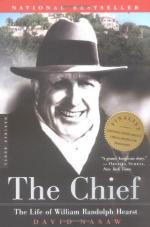
Hearst, William Randolph (1863-1951)
William Randolph Hearst defined twentieth-century media for better and for worse. His style of journalism emphasized a focus on the audience, and that approach has resulted in the look and content of today's mass media.
Born in San Francisco on April 29, 1863, to George Hearst and Phoebe Apperson Hearst, William was raised with all the strength and inspiration that a self-made multimillionaire and a well-educated woman could impart in one of the most exceptional environments of the century. San Francisco bred larger-than-life figures of success and failure. Although his parents demanded a high standard, they provided excellent examples of the rewards that would accrue from such efforts.
Around the time that Hearst, studying at Harvard, was discovering an interest in media, his father acquired a small newspaper, The San Francisco Examiner, as compensation for a debt owed to him. Hearst sent a letter to his father requesting that he be given control of the newspaper. "I am convinced that I could run a newspaper successfully," he wrote. "With enough money to carry out my schemes—I'll tell you what I would do!" In 1887, at the age of twenty-three, Hearst named himself "Proprietor" of The Examiner and devoted both his energy and his intellect to disparaging those who felt that his fortune and his position were unwarranted. Through a combination of long hours, hard work, and nearly unlimited resources, Hearst developed a set of principals of journalism that were devoted to providing an advocate for the average person as much as to providing useful information. He spared no expense to hire the best reporters of the day and encouraged them to use a style of prose designed to entertain as much as to inform. "The Monarch of the Dailies"—as Hearst referred to his newspaper—began a crusade for the people. Corruption and muckraking exposed civic decay. Exposés were standard fare. Hearst established his publishing "dynasty" with the 1895 purchase of a second newspaper, The New York Journal. Now firmly established on both coasts of the United States, his creation of The Chicago American in 1900 established him as a force throughout the country. By the 1920s, "The Chief"—a nickname given to Hearst—was the owner of a chain of more than twenty-four newspapers that had been carefully chosen to reach as many people as possible.
Hearst emphasized the importance of talent (as much as content) in writing to convey information to the public. With this in mind, he hired writers such as Stephen Crane, Mark Twain, and Jack London to work for his newspapers. Sensationalist stories, the hallmark of "Yellow Journalism" (which emphasized flamboyant interpretation over objective presentation and was a style first associated with Joseph Pulitzer and his New York World), drew in a large audience—at one point, one in four people in America read a Hearst newspaper.
The coverage of the events leading to the Spanish-American War provided a significant incident in the rivalry between Hearst and Pulitzer. Reporting on the Cuban rebellion against Spanish rule, correspondents from both papers filed a string of lurid accounts. Starving women and children, abuse toward prisoners, and valiant rebels fighting to be free were regular features in both newspaper chains. Stories that featured women were particularly inflammatory as well as circulation building. The drawing "Spanish Dons Search American Women" by Frederic Remington is an example of this sensationalism. However, in 1897, Remington cabled Hearst that everything was quiet in Havana. Remington wanted to return to the United States. Hearst replied, "Please remain. Youfurnish the pictures, I'll furnish the war." The sensational stories continued. By the time the Maine was sunk in Havana Harbor on February 15, 1898, Hearst and Pulitzer had managed to build U.S. public opinion to a point where intervention on the part of President William McKinley and the United States was demanded. "Remember the Maine !" became an international cry for justice. As a result of the involvement of Hearst and Pulitzer, the Spanish-American War has since become known as the first media war. In later years, however, Hearst recognized the need for balance. A 1933 memo to his editors emphasized that fair and impartial reporting was essential to the people's interest. "Give unbiased news of all creeds and parties," it read.
Hearst, not wanting to limit his influence to the newspaper world, launched his first magazine, Motor, in 1903, shortly after his marriage to Millicent Willson (with whom he would have five sons). He expanded his dominance of print media with the purchase or start of many other magazines, including Cosmopolitan, Chicago Examiner, Boston American, Daily Mirror, and Harper's Bazaar. Hearst also eventually moved into radio broadcasting and the film industry (where he produced several movies starring Marion Davies, who was his mistress from 1917 until his death). His political interests resulted in Hearst being elected to the U.S. House of Representatives (1903-1907), but his separate bids to become mayor of New York City, governor of New York State, and president of the United States all proved unsuccessful.
It is undeniable that Hearst's style of news reporting, whether through Yellow Journalism excess or reader-friendly emphasis, reached audiences in ways that journalists still strive to imitate. His legacy is more physically apparent at San Simeon—also known as Hearst Castle—in California. This lavish estate created by Hearst during the later period of his life is now a state historical monument and houses an extensive collection of Hearst memorabilia.
Journalism, History Of; Newspaper Industry, History Of; Pulitzer, Joseph.
Bibliography
Loe, Nancy. (1988). William Randolph Hearst: An Illustrated Biography. Santa Barbara, CA: Sequoia Communications.
This "Hearst for Mayor" poster was part of William Randolph Hearst's campaign to become the mayor of New York City. (Corbis)
Swanberg, W. A. (1961). Citizen Hearst: A Biography of William Randolph Hearst. New York: Scribner.
Tebbel, John. (1952). The Life and Good Times of William Randolph Hearst. New York: Dutton.
This is the complete article, containing 964 words
(approx. 3 pages at 300 words per page).