
BookRags.com Literature Guides Literature Guides Criticism/Essays Criticism/Essays Biographies Biographies My Bibliography Periodic Table U.S. Presidents Shakespeare Sonnet Shake-Up
Research Anything:        
History | Encyclopedias | Films | News | Create a Bibliography | More... Login | Register | Help

Search "Hatshepsut"

Contents Navigation
 

Hatshepsut

Print-Friendly  Order the PDF version  Order the RTF version
About 3 pages (754 words)
Hatshepsut Summary

Bookmark and Share

Hatshepsut

c. 1510 B.C.-1458 B.C.

Egyptian Pharaoh

Hatshepsut was not the only woman ruler of ancient times; however, as Egyptian pharaoh during the Eighteenth Dynasty, she was the only one to rule a world power at the height of its greatness. She did so by usurping the throne, and therefore did not engage in risky military exploits. Instead she devoted herself to building monuments, one of which records a historic visit by her emissaries to the land of Punt, a region usually identified with modern Somalia.

The elder of two daughters born to Thutmose I (r. 1493-1481 B.C.) and his wife Ahmose was named Hatshepsut (pronounced hah-CHEP-sut), which means "foremost of the royal ladies." When she was still a young girl, her parents married her to her half-brother Thutmose II (r. 1481-1479 B.C.), son of Thutmose I by a different wife. Marriage between relatives was common in Egypt, and in the case of Thutmose II, it strengthened his claim on the throne since he, unlike Hatshepsut, did not have two royal parents.

Some historians have suggested that Hatshepsut had Thutmose II poisoned in hopes of becoming pharaoh herself, but if so—and it is unlikely she did—she was in for a disappointment when he died. Egypt was not about to crown a woman, and if Hatshepsut had a son, the child would have become king. But she hadno son, so a boy born to her husband by one of his concubines became Thutmose III (r. 1479-1425 B.C.)

Initially Hatshepsut served merely as regent for the young king, who was only 10 years old when he assumed the throne. She sent an expedition southward to Upper Egypt in order to acquire granite for a pair of obelisks, which were then covered in gold and placed in the Temple of Karnak, an important ceremonial center. Leading the expedition was her chief advisor, Senenmut.

In the sixth year of Thutmose's reign, however, Hatshepsut claimed that the god Amon had spoken to her personally and told her to take the throne. She therefore proclaimed herself "king" of Egypt, and thereafter presented herself as a man, complete with a ceremonial beard. Powerful officials, most notably Senenmut, helped her secure her position, though she maintained the fiction that she ruled jointly with Thutmose III.

In about 1472 B.C. Hatshepsut sent five boats from the Red Sea port of Kosseir to the land of Punt. Though she claimed hers was the first expedition, Egypt had actually been trading with this country, which historians have located anywhere from modern-day Eritrea to Somalia, for as much as seven centuries. A relief sculpture in her tomb records the voyage, and depicts the people of Punt as physically similar to the Egyptians themselves: slender, delicate of features, with long hair. The queen of Punt, however, was apparently an odd-looking woman—short, fat, long-armed, and with a prominent behind. Inscriptions also record that the primary purpose of the expedition was trade: "the ships were laden with the costly products of the Land of Punt and with its many valuable woods, with much sweet-smelling resin and frankincense, with quantities of ebony and ivory...." Also recorded were precise observations of flora and fauna.

Later, Hatshepsut sent another expedition to Upper Egypt, as well as several to the Sinai Peninsula, to acquire rock for monuments. Her inscriptions on these monuments portray her as a queen chosen by the gods for the special mission of resurrecting Egypt from the damage left by the Hyksos when they invaded about two centuries before. This exaggerated the situation considerably, no doubt in an attempt to further justify her legitimacy as ruler.

Some scholars have suggested that Hatshepsut and Senenmut were lovers; whatever the case, the bond between them was strong. In the nineteenth year of her reign, he disappeared fromthe official record, perhaps because he fell from favor, and three years later, the name of Hatshepsut too disappeared from the list of pharaohs. Presumably she died, though it is possible she was removed from power by Thutmose III.

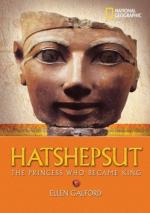
Hatshepsut. (Corbis Corportation. Reproduced with permission.)Hatshepsut. (Corbis Corportation. Reproduced with permission.)

During his long reign, Thutmose, who went on to conquests that expanded Egyptian territory into Palestine and Kush—thus bringing Egypt to its greatest territorial extent—sought to remove all evidence that Hatshepsut had ever ruled. He had her statues destroyed and her name removed from a number of monuments, and later king lists would include a fictional pharaoh, "Amensis," in her place. Despite all these efforts to erase her memory, however, the name of Hatshepsut has endured, and along with it the knowledge that a woman once ruled the most powerful nation on earth.

This is the complete article, containing 754 words (approx. 3 pages at 300 words per page).

More Information
  • View Hatshepsut Study Pack
  • Search Results for "Hatshepsut"
  • Add This to Your Bibliography
  • More Products on This Subject
    Hatshepsut
    Hatshepsut (1540-1481 BC) was an Egyptian queen of the Eighteenth Dynasty. Usurping the throne afte... more

    Hatsepshut Deserves a Pyramid
    I think that the most deserving pharaoh is Hatshepsut. She was the first female pharaoh, and she ha... more


    Copyrights
    Hatshepsut from Science and Its Times. ©2005-2006 Thomson Gale, a part of the Thomson Corporation. All rights reserved.

    Join BookRagslearn moreJoin BookRags


    About BookRags | Customer Service | Report an Error | Terms of Use | Privacy Policy

