
Forgot your password?  


Harnack, Adolf Von | Research & Encyclopedia Articles

Print-Friendly   Order the PDF version   Order the RTF version
About 5 pages (1,490 words)
Adolf von Harnack Summary


Harnack, Adolf Von

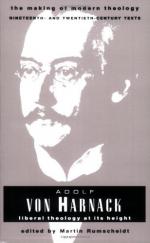
HARNACK, ADOLF VON (1851–1930), was a German Protestant church historian and theologian. Carl Gustav Adolf von Harnack was born in Dorpat (now Tartu), in the Russian province of Livonia, where his father, Theodosius Harnack (1817–1889), was a professor of theology at the German-dominated university. He was educated at the universities of Dorpat and Leipzig, received the Ph.D. in 1873, and began lecturing on church history at Leipzig in 1874. In 1879 he went, as full professor, to Giessen, in 1886 to Marburg, and in 1888 to the University of Berlin, where he taught until his retirement in 1921, thereafter lecturing as emeritus professor until the spring of 1929.

Harnack was the premier historian in modern times of early Christianity and, with Ernst Troeltsch (1865–1923), the foremost spokesman of a liberal Protestantism that sought to "overcome dogma by history." He insisted that the rise and development of Christianity could be understood solely by the use of the historical-critical method, that is, by impartial study of the extant Christian literature, to the exclusion of all metahistorical sources and standards of judgment such as authoritative church dogma or belief in an infallible teaching office or an inerrant Bible.

History, for Harnack, meant above all documentary history. Building on the seminal studies of early Christianity by F. C. Baur (1792–1860) and Albrecht Ritschl (1822–1889), he established early church history on secure textual foundations. Many of his more than sixteen hundred publications were critical editions of patristic texts, and he supervised the publication of hundreds of others, chiefly in the series "Texte und Untersuchungen zur Geschichte der altchristlichen Literatur" (1882–), of which he was a founder. He summarized the results of this textual scholarship in his Geschichte der altchristlichen Literatur bis Eusebius (1893–1904).

Harnack wrote penetrating studies of monasticism and of church polity in Christianity's first two centuries. He also wrote what is still the foundational history of the early Christian missionary enterprise, Die Mission und Ausbreitung des Christentums in den ersten drei Jahrhunderten (1902; translated as The Mission and Expansion of Christianity in the First Three Centuries, 1908). His true métier, however, was not institutional history but the history of doctrine—research that culminated in his monumental Lehrbuch der Dogmengeschichte (1885–1890; translated as History of Dogma, 1894–1899). Dogma, in Harnack's narrow definition, referred exclusively to the trinitarian and christological dogmas formulated by general church councils in the fourth and fifth centuries. Whereas Ritschl had stressed the gradual de-judaization of Christianity as the central factor in the development of early Christian doctrine, Harnack emphasized the progressive hellenization of Christianity, holding that Christian dogma was "a work of the Greek spirit on the soil of the gospel." This did not mean that the gospel (the original teaching of Jesus) had entirely disappeared into dogma, or that the dogmas of the Trinity and the Incarnation were sheer speculation, but that Greek philosophy of religion and its attendant intellectualism had shaped Christian dogmatic thought from its inception. Thus Christian faith came to be dependent on metaphysics and, most shocking of all to Harnack, a "fancied Christ" had been put in the place of the real, historical one.

In Harnack's judgment, moreover, the mainline Protestant reformers had failed to break decisively with "dogmatic Christianity," though their root religious principles actually undermined the authority of all dogma. Martin Luther, for example, had delivered the Christian faith from moralism, ritualism, hierarchicalism, and philosophical speculation, yet he continued to adhere to the old dogmas, even grounding his piety on them, and thus gave them a new vitality and authority within the Evangelical church. The result of this "unfinished Reformation" was a Protestantism beset by ordinance, doctrine, and ceremony. What was urgently required, therefore, was a "critical reduction of dogma," to be carried out in fidelity to the animating concerns of Reformation religion and to be achieved by a rigorous historical criticism that would distinguish between the timeless "kernel" of Christianity and its timebound "husks." Harnack took up this task in his most popular book, Das Wesen des Christentums (1900; translated as What Is Christianity?, 1903), based on lectures to students of all faculties at Berlin in 1899–1900.

The "essence of Christianity"—its element of permanent validity as distinguished from its transient historical forms—is the gospel, above all as Jesus proclaimed it but also as it has repeatedly found expression in the course of Christian history. Appropriating the leading theological themes of his mentor, Ritschl, Harnack contended that the gospel is a simple and self-authenticating phenomenon, centering on the rule of the holy God in the trusting heart, on the experience of God as loving father and thus the assurance of the infinite value of the human soul, and on an ethical life marked by an abiding disposition to the good, under God's grace, and by neighborly love and mercy. Hence the gospel is essentially timeless, and it addresses a human nature that, religiously viewed, is also unchanging—ever yearning for "the presence of the Eternal in time" and so for a vindication of the ultimate worth of the human spirit over against an indifferent natural order. This gospel, accordingly, requires no metaphysical foundations, no articulation in binding dogmas, no elaborate ritual, and no institutional guarantees. The religion of the Christian gospel, Harnack concluded, is not only "undogmatic" and "perennial," but also shows itself to be a "cultural" religion in the proper sense, namely, one uniquely responsive to modern humanity's insistent quest for the meaning of life.

Controversy surrounded Harnack throughout his career. The most bitter conflict broke out in 1892, when he proposed that the Apostles' Creed be replaced in liturgical worship by a shorter confession of faith based on Reformation principles and on the results of modern historical scholarship. Though denied all official recognition by the Evangelical church, he was the most widely honored theologian of his time. In 1890 he was elected to the Prussian Academy of Sciences and in 1900, on the occasion of its two-hundredth anniversary, he wrote the academy's official history. He was a founder and the first president (1903–1911) of the Evangelical-Social Congress. From 1905 to 1921 he was director general of the Royal Library in Berlin. He served as the first president (1911–1930) of the Kaiser Wilhelm Gesellschaft for the Advancement of the Sciences (now called the Max Planck Gesellschaft). In 1914 he was raised to the dignity of hereditary nobility by Kaiser Wilhelm II.

Harnack's theology went into eclipse soon after his death, largely owing to its repudiation by Karl Barth (1886–1968) and other leaders of the regnant Protestant neoorthodoxy. Church historians and theologians otherwise sympathetic to Harnack's program have criticized his narrow definition of dogma, his thesis of hellenization, and his cardinal notion of a "timeless gospel" for a "timeless humanity." Nevertheless, his reputation as the greatest modern student of the ancient church is secure, and his insistence that Christianity must be interpreted by the historical method has been upheld.

Bibliography

The indispensable biography is that by his daughter, Agnes von Zahn-Harnack: Adolf von Harnack (1936; 2d ed., Berlin, 1951). His collected essays and speeches were published under the title Reden und Aufsätze, 7 vols. (Giessen, 1904–1930). Friedrich Smend compiled a complete listing of his writings, Adolf von Harnack: Verzeichnis seiner Schriften (Leipzig, 1927), supplemented by Verzeichnis seiner Schriften (1927–1930) (Leipzig, 1931).

Harnack's thought has been discussed most fully by Karl H. Neufeld, S.J., in two works: Adolf von Harnack: Theologie als Suche nach der Kirche (Paderborn, 1977) and Adolf von Harnacks Konflikt mit der Kirche (Innsbruck, 1979). The best treatment to date in English is by G. Wayne Glick, The Reality of Christianity: A Study of Adolf von Harnack as Historian and Theologian (New York, 1967), to be supplemented by Wilhelm Pauck's Harnack and Troeltsch: Two Historical Theologians (Oxford, 1968), a masterly essay by a former student of Harnack at Berlin. Harnack's interpretation of Luther and of Reformation thought is considered by Jaroslav Pelikan in his essay "Adolf von Harnack on Luther," in Interpreters of Luther: Essays in Honor of Wilhelm Pauck, edited by Pelikan (Philadelphia, 1968), pp. 253–274. Harnack's indebtedness to Albrecht Ritschl and his controversy with Karl Barth are discussed, respectively, by E. P. Meijering in Theologische Urteile über die Dogmengeschichte: Ritschls Einfluss auf von Harnack (Leiden, 1978) and by H. Martin Rumscheidt in Revelation and Theology: An Analysis of the Barth-Harnack Correspondence of 1923 (Cambridge, 1972).

New Sources

Forni, Guglielmo. The Essence of Christianity: The Hermeneutical Question in the Protestant and Modernist Debate (1897–1904). Atlanta, 1995.

Pilhofer, Peter. "Harnack and Goodspeed: Two Readers of Codex Parisinus Graecus 450." Second Century: A Journal of Early Christian Studies 5, no. 4 (1985–1986): 233–242.

Pillay, Gerald J. "The Relation between Church History and General History: Reflections on Adolf von Harnack's View." Studia historiae ecclesiasticae 20, no. 2 (1994): 156–168.

Rollmann, Hans. "Adolf von Harnack and the 'History of Religions' as a University Discipline." In Religious Studies, pp. 85–103. Atlanta, 1991.

White, L Michael. "Adolf Harnack and the 'Expansion' of Early Christianity: A Reappraisal of Social History." Second Century: A Journal of Early Christian Studies 5, no. 2 (1985–1986): 97–127.

This is the complete article, containing 1,490 words (approx. 5 pages at 300 words per page).

More Information
  • View Harnack, Adolf Von Study Pack
  • Search Results for "Harnack, Adolf Von"
  • More Products on This Subject
    Adolf von Harnack
    The German theologian and scholar Adolf von Harnack (1851-1930) fashioned the historicopositivist a... more


    Ask any question on Adolf von Harnack and get it answered FAST!
    Answer questions in BookRags Q&A and earn points toward
    discounted or even FREE Study Guides and other BookRags products!
    Learn more about BookRags Q&A
    Copyrights
    Harnack, Adolf Von from Encyclopedia of Religion. Copyright © 2001-2006 by Macmillan Reference USA, an imprint of the Gale Group. All rights reserved.

    Join BookRagslearn moreJoin BookRags

    Join BookRagslearn moreJoin BookRags

