BookRags.com Literature Guides Literature
Guides
Criticism & Essays Criticism &
Essays
Questions & Answers Questions &
Answers
Lesson Plans Lesson
Plans
My Bibliography Periodic Table U.S. Presidents Shakespeare Sonnet Shake-Up
Research Anything:        
History | Encyclopedias | Films | News | Create a Bibliography | More... Login | Register | Help

Search "Guadalupe Hidalgo, Treaty Of"

Contents Navigation
 
Not What You Meant?  There are 22 definitions for Hidalgo.

Guadalupe Hidalgo, Treaty Of

Print-Friendly  Order the PDF version  Order the RTF version
About 3 pages (769 words)
Treaty of Guadalupe Hidalgo Summary

Bookmark and Share

Guadalupe Hidalgo, Treaty Of

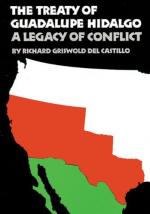
On February 2, 1848, representatives of the United States and Mexico signed the Treaty of Guadalupe Hidalgo, ending the war between those two countries that had begun two years earlier. This document ceded to the United States almost half of Mexico's national territory in exchange for a payment of fifteen million dollars. The discovery of gold in California a few weeks before the treaty was signed led to a massive western migration that changed the future of the country.

The Treaty of Guadalupe Hidalgo contained provisions promising to protect the civil rights of the more than one hundred thousand Mexicans who lived in the conquered territories. Their lands and ways of life, however, came under attack by the new settlers, and the treaty guarantees were largely ignored. This violation of the treaty fueled decades of conflict, especially over land. Furthermore, the acquisition of new territories intensified conflicts between northern and southern politicians over the extension of slavery. The Compromise of 1850, the Fugitive Slave Law, and the violence surrounding the idea of popular sovereignty, all of which were instrumental in bringing about the Civil War, all resulted from the incorporation of these new territories.

The war between the United States and Mexico broke out in May 1846. Though the causes of this conflict were many, the most important was the spirit of expansionism called manifest destiny. Thousands of Anglo-Americans believed that it was God's will that they should move west across the entire North American continent, occupying lands of Mexicans and Indians and casting their inhabitants aside in the process. For many, manifest destiny had an economic dimension, justifying a more efficient use of natural resources by the industrious Anglo-Americans. Mixed in with this economic motive was an attitude of racial superiority. As one American writer wrote, "The Mexicans are Aboriginal Indians, and they must share the destiny of their race."

Two articles in the treaty promised to protect the private property and provide eventual U.S. citizenship to those living on the land, but these provisions were often disregarded. In California, thousands of gold-rush migrants encroached on "Californio" land grants and demanded that something be done to free up the land so they could claim it. The result was the passage by Congress of the California Land Claims Act of 1851, which set up a three-person commission to adjudicate Mexican land grants in California. Eventually the commission confirmed most of the grants brought before it, but many Mexican landholders lost their land, for only the wealthy could afford the lengthy litigation process. The conflict over the land claims continued until the beginning of the twentieth century, leaving a bitter legacy that many have not forgotten. In the eyes of Mexico and the millions of Hispanos, Tejanos, and Chicanos now living in the United States, the promises made to them were ignored.

With the signing of the Treaty of Guadalupe Hidalgo, the U. S. government had vast lands open for westward expansion. One of the most difficult issues that emerged was the determination of whether these lands would be open to slavery. In 1846, foreseeing this problem, Congressman David Wilmot of Pennsylvania presented what became known as the Wilmot Proviso, urging that Congress prohibit the expansion of slavery into whatever territory the United States might acquire from the war. That bill did not pass, but the issue it raised exacerbated an enormous debate over the future of the American West. Many northerners were opposed to opening the land to slavery, feeling that it should be "free soil." They did not want to compete with slave labor or see southern states expand their power.

Map of the United States expansion, ca. 1900.  BETTMANN/CORBISMap of the United States expansion, ca. 1900. © BETTMANN/CORBIS

Two years after the war ended, California petitioned for statehood, and the Senate had to grapple with the question of whether that state would be slave or free. The result of that debate was the Compromise of 1850. For the next decade, the U.S. government was in conflict over the issue of the expansion of slavery into the western lands. The Treaty of Guadalupe Hidalgo ending the War with Mexico fostered the internal war over slavery, which ultimately led to the outbreak of the Civil War.

Age of Westward Expansion; Compromise of 1850; Polk, James K.

Bibliography

del Castillo, Richard. The Treaty of Guadalupe Hidalgo: A Legacy of Conflict. Norman: University of Oklahoma Press, 1990.

Merk, Frederick. Manifest Destiny and Mission in American History, a Reinterpretation. New York: Knopf, 1963.

Pletcher, David M. The Diplomacy of Annexation: Texas, Oregon, and the Mexican War. Columbia: University of Missouri Press, 1973.

Internet Resource

"Treaty of Guadalupe Hidalgo." Avalon Project at Yale Law School. Available from <http://www.yale.edu/lawweb/aval on/diplomacy/mexico/guadhida.htm> ;.

This is the complete article, containing 769 words (approx. 3 pages at 300 words per page).

More Information
  • View Guadalupe Hidalgo, Treaty Of Study Pack
  • 22 Alternative Definitions
  • Search Results for "Guadalupe Hidalgo, Treaty Of"
  • Add This to Your Bibliography
  • More Products on This Subject
    Guadalupe Hidalgo, Treaty Of
    (Feb. 2, 1848), treaty between the United States and Mexico that ended the Mexican War. It was sign... more

    Guadalupe Hidalgo, Treaty Of
    (Feb. 2, 1848) Treaty between the U.S. and Mexico that ended the Mexican War, named for the Mexico ... more


    Copyrights
    Guadalupe Hidalgo, Treaty Of from Americans at War. Copyright © 2001-2006 by Macmillan Reference USA, an imprint of the Gale Group. All rights reserved.

    Join BookRagslearn moreJoin BookRags


    About BookRags | Customer Service | Report an Error | Terms of Use | Privacy Policy