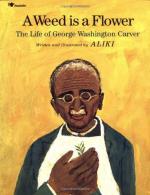
George Washington Carver
1861?-1943
American Chemist and Agronomist
George Washington Carver is credited with the development of innovative crop-rotation methods that preserved soils and allowed sustainable levels of increased agricultural productivity. During a long and productive scientific and teaching career, Carver discovered hundreds of uses for crops and his work revitalized a Southern economy left barren and depressed by war and land mismanagement.
Carver was born a slave in Missouri. A frail and sickly child, he was orphaned during the Civil War, and nursed back to health by his former owners, Moses and Susan Carver. Young George lived with the Carvers until he was 10 or 12, when he left to pursue an education at a segregated school nearby. He lived with a black family, doing chores for room and board. Carverwas well into his twenties before he was able to move from a one-room schoolhouse to become an outstanding student at Minneapolis High School in Kansas. Though subsequently denied admission to the school of his choice because of his race, Carver eventually undertook his college studies at Simpson College in Indianola, Iowa.
Carver set out to be a scientist and a few years into his studies he transferred to Iowa Agricultural College (now Iowa State University), where he earned his baccalaureate in 1894 and his master's degree in 1897. Shortly thereafter, Booker T. Washington, founder of what was then known as the Tuskegee Normal and Industrial Institute for Negroes (now Tuskegee University) located in Tuskegee, Alabama, asked Carver to accept a post as the school's director of agricultural studies.
Carver accepted and moved to Tuskegee, where he taught and spent research time developing improved crop-rotation methods. Carver's training in chemistry allowed him to spot a glaring deficiency in traditional uses of soils. He measured dramatic depletions of critical minerals and nutrients in fields planted with the same crops season after season. Carver designed a plan whereby nitrate producing crops, such as such as peanuts and peas, would be alternated annually with cotton. Although cotton was the most important cash crop for Southern farmers, repeated planting left fields depleted and unable to sustain or produce profitable crops. When farmers followed Carver's advice—alternating annual crops of cotton and peanuts—the soil nutrient balances remained within acceptable levels. In addition, healthy soils reduced erosion and water contamination by runoff. In a South sorely pressed by the boll weevil, Carver's planting techniques actually proved to be an effective means of pest control.
Unfortunately, farmers were initially unable to find profitable uses for their off-year crops and many had to return to planting cotton, despite the long-term risks. In response, Carver rescued his soil rotation plan by find more than 300 economic uses for the peanut and more than 100 uses for the sweet potato. The resulting availability of two cash crops offered new hope for Southern farmers who had suffered one deprivation after another since the Civil War.
During his lifetime, Carver garnered great honor and became an internationally respected scientist. Carver maintained a simple lifestyle and remained dedicated to his work at Tuskegee. He repeatedly turned away offers and opportunities to enrich himself. Thomas A. Edison(1847-1931) reportedly offered Carver a salary greater than that earned by the president if Carver would come to work with Edison.
Carver was awarded an honorary doctorate and was made a member of the British Royal Society of Arts. In 1923 he received the Spingarn Medal, awarded annually by the National Association for the Advancement of Colored People (NAACP) to the person who has made the greatest contribution to the advancement of his race.
George Washington Carver in his laboratory. (Library of Congress. Reproduced with permission.)
Despite his simple outlook on life, Carver was sought out by some of the most influential leaders in the world. At various times Carver's views were sought by such disparate figures as Franklin D. Roosevelt, Joseph Stalin, and Mohandas Gandhi. As per his wishes, Carver's life savings, following his death, went toward the establishment of a research institute for agriculture at Tuskegee. Carver was buried on the Tuskegee campus beside Booker T. Washington.
This is the complete article, containing 670 words
(approx. 2 pages at 300 words per page).