
Forgot your password?  

Not What You Meant?  There are 19 definitions for Geiger.

Geiger, Abraham | Research & Encyclopedia Articles

Print-Friendly   Order the PDF version   Order the RTF version
About 3 pages (855 words)
Abraham Geiger Summary


Geiger, Abraham

GEIGER, ABRAHAM (1810–1874), rabbi, foremost exponent and idealogue of Reform Judaism in nineteenth-century Germany and outstanding scholar of Wissenschaft des Judentums (the modern scholarly study of Judaism). Geiger was born in Frankfurt, where he received a distinguished, traditional Talmudic education. He was also attracted to secular studies and in 1833 received his doctorate from the University of Bonn for a work entitled Was hat Mohammed aus dem Judenthume aufgenommen (What did Muḥammad take from Judaism?), a study that measured Judaism's influence on early Islam. In 1832 Geiger became rabbi in Wiesbaden, and there he set out to rescue Judaism from medieval rabbinic forms that he regarded as rigid, unaesthetic, and unappealing to Jews of contemporary cultural sensibilities. He did this by initiating reforms in the synagogue service and by calling, in 1837, for a conference of Reform rabbis in Wiesbaden. Moreover, he hoped to show how the academic study of the Jewish past could be enlisted as an aid in the causes of Jewish political emancipation and religious reform through the publication of the Wissenschaftliche Zeitschrift für jüdische Theologie (1835–1847).

Geiger became embroiled in controversy in 1838 when the Breslau Jewish community selected him as dayyan (religious judge) and assistant rabbi over the strong protests of the Breslau Orthodox rabbi, Solomon Tiktin. Indeed, because of this opposition, Geiger could not accept the position until 1840. Upon Tiktin's death in 1843 Geiger became rabbi of the city. There he continued his activities on behalf of Reform, playing an active role in the Reform rabbinical conferences of 1845 and 1846, held respectively in Frankfurt and Breslau.

Geiger's undiminished commitment to the academic study of Judaism and his belief in the need for a modern rabbinical seminary to train rabbis in the spirit of modern Western culture and Wissenschaft des Judentums led, in 1854, to the creation of the Jüdisch-Theologisches Seminar in Breslau. Geiger was bitterly disappointed, though, when the board of the seminary decided to appoint as principal the more conservative Zacharias Frankel instead of himself. It was not until 1872, two years after Geiger had come to Berlin as a Reform rabbi to the community, that his dream of directing a modern rabbinical seminary came to fruition. For in that year the Hochschule für die Wissenschaft des Judentums was established, with Geiger at its head. He remained director of this center for the training of Liberal rabbis until his death.

Geiger's scholarship was prodigious and profound. His most influential work, Urschrift und Uebersetzungen der Bibel (The original text and translations of the Bible; 1857), advocated the methodology of biblical criticism, and a host of other scholarly and polemical articles and books displays his broad knowledge of all facets of Jewish history and culture. These publications reveal his determination to make Judaism an integral part of Western culture and indicate both his theological bent and his ability to employ historical and philological studies in the cause of religious reform.

Geiger's work, carried out in the context of Religions-wissenschaft, pointed to the evolutionary nature of the Jewish religion and, under the influence of Schleiermacher, allowed him to focus on the inwardness of the Jewish religious spirit. Having thereby mitigated the force of tradition, Geiger was able, in terms borrowed from Hegel, to view Judaism as a universal religion identified with the self-actualization of the Absolute. He therefore downplayed nationalistic elements in the Jewish past, denied them any validity in the present, and justified Jewish separateness in the modern world by speaking of Judaism's theological uniqueness and spiritual mission. Nevertheless, Geiger, unlike his more radical colleague Samuel Holdheim, represented a moderate approach to Reform. He refused to serve a Reform congregation that separated itself from the general Jewish community, he observed Jewish dietary laws, and he urged the retention of traditional Jewish laws of marriage and divorce. In addition, he favored the observance of the second day of the festivals and, like his more conservative peer Frankel, spoke of "positive-historical" elements in Judaism.

Bibliography

The best English introduction to Geiger's life and writings appears in Abraham Geiger and Liberal Judaism, compiled and edited by Max Wiener and translated by Ernst J. Schlochauer (Philadelphia, 1962). David Philipson's The Reform Movement in Judaism (New York, 1967) also contains a great deal of information about Geiger's career and thought. Geiger's own views of Judaism are summarized in a series of lectures he delivered in Frankfurt that have been translated by Charles Newburgh as Judaism and Its History (New York, 1911). Jakob J. Petuchowski provides interesting insights into Geiger's approach to Judaism and contrasts him with Samuel Holdheim in the article "Abraham Geiger and Samuel Holdheim: Their Differences in Germany and Repercussions in America," Leo Baeck Institute Yearbook 22 (1977): 139–159. Finally, Petuchowski has edited a series of essays by several eminent scholars on the meaning and significance of Geiger's career and scholarship in a work entitled New Perspectives on Abraham Geiger (Cincinnati, 1975).

New Sources

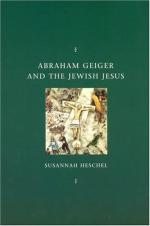
Heschel, Susannah. Abraham Geiger and the Jewish Jesus. Chicago, 1998.

Koltun-Fromm, Kenneth. "Historical Memory in Abraham Geiger's Account of Modern Jewish Identity." Jewish Social Studies 7 (2000): 109–126.

Mack, Michael. German Idealism and the Jew: The Inner Anti-Semitism of Philosophy and German Jewish Responses. Chicago, 2003.

This is the complete article, containing 855 words (approx. 3 pages at 300 words per page).

Ask any question on Abraham Geiger and get it answered FAST!
Answer questions in BookRags Q&A and earn points toward
discounted or even FREE Study Guides and other BookRags products!
Learn more about BookRags Q&A
Copyrights
Geiger, Abraham from Encyclopedia of Religion. Copyright © 2001-2006 by Macmillan Reference USA, an imprint of the Gale Group. All rights reserved.

Join BookRagslearn moreJoin BookRags

Join BookRagslearn moreJoin BookRags

