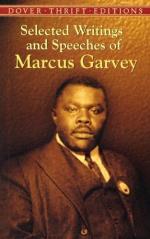
Garvey, Marcus
GARVEY, MARCUS. Marcus Mosiah Garvey (August 17, 1887–June 10, 1940), the founder of the Universal Negro Improvement Association (UNIA), led the largest mass movement among African Americans and can be regarded as one of the founding fathers of Pan-Africanism and the Black Consciousness movement.
Garvey was born in Saint Ann's Bay, Jamaica. During the first decade of the twentieth century, he was involved in the labor movement and advocated for labor reforms in his paper, the Watchman. But he quickly became disillusioned and grew skeptical about the ability of unions to bring about meaningful improvements in the lives of blacks, and about the willingness of whites to cooperate in achieving such a goal. After a brief stint working for the United Fruit banana plantation in Costa Rica, he moved to London, where he came under the influence of Duse Muhammad Ali and wrote articles for his paper, Africa Times and Orient Review. While he was in London, Garvey was inspired with a new vision after reading Booker T. Washington's Up from Slavery. When he returned to Jamaica in 1914, Garvey quickly formed the UNIA, whose purpose was to unite Africans from all over the world in a common purpose of uplift.
Following Washington's Tuskegee model, Garvey's first program was the establishment of a trade school. This effort never enjoyed success, however, due primarily to lack of financial resources. Washington invited Garvey to visit Tuskegee but died a few months before Garvey arrived in New York City in March 1916. Garvey began introducing himself at different churches and sharing his vision. By 1918 he had started a weekly, the Negro World that grew in circulation to fifty thousand. By 1919 Garvey had raised enough funds to purchase an auditorium on West 138th Street in Harlem called Liberty Hall, where throngs came to hear his spellbinding oratory. The popularity of Garvey and his movement grew exponentially after he launched his project to purchase ocean steamers to trade with Africa and take black people back to Africa. Blacks purchased stocks in his company, the Black Star Line, at five dollars per share. Over half a million dollars was raised, and the first ship was purchased in the first year. The UNIA's first international convention, attended by thousands of delegates from every part of the world, was held at Liberty Hall and Madison Square Garden in August 1920. The convention proclaimed Garvey the provisional president of the Republic of Africa and adopted a Declaration of the Rights of the Negro Peoples of the World.
Garvey's movement also had a religious component. Garvey did not think blacks could ever acquire a strong sense of self-esteem while worshipping a white God and a white Savior. He argued that God, Christ, and Mary were black. In 1921 the UNIA's chaplain general, George Alexander McGuire, formed the Good Shepherd Independent Episcopal Church and authored The Universal Negro Catechism and The Universal Negro Ritual. McGuire and Garvey disagreed over forming a separate denomination, and McGuire then formed the African Orthodox Church.
The Black Star Line's financial difficulties contributed significantly to Garvey's demise and the decline of his movement. The ships purchased were unsound, and the organization lacked the resources to repair them after two disastrous ventures. By 1921 two of Garvey's ships were inoperable. African American critics of Garvey's movement, including the leader of the National Association for the Advancement of Colored People, W. E. B. Du Bois, instigated Garvey's arrest for mail fraud. Garvey was tried and convicted in 1923; he was sentenced to five years in prison and fined $1,000.
Garvey was pardoned by President Calvin Coolidge in 1927 and was deported to Jamaica, where he tried unsuccessfully to rebuild his movement. In 1935 he moved to London and published a periodical, the Black Man. He died of a stroke in June 1940. Even though he achieved few of his goals, Garvey's name is still revered among black nationalists.
Bibliography
Burkett, Randall K. Garveyism as a Religious Movement. Metu-chen, N.J., 1978.
Garvey, Amy Jacques, ed. The Philosophy and Opinions of Marcus Garvey. 2 vols. New York, 1923–1925; reprint, Dover, Mass., 1986.
Hill, Robert A., ed. The Marcus Garvey and Universal Negro Improvement Association Papers. 9 vols. Berkeley, Calif., 1983–.
Martin, Tony. Race First: The Ideological and Organizational Struggles of Marcus Garvey and the Universal Negro Improvement Association. Westport, Conn., 1976; reprint, Dover, Mass., 1986.
Martin, Tony. Marcus Garvey, Hero: A First Biography. Dover, Mass, 1983. Published by the Majority Press as part of the New Marcus Garvey Library.
This is the complete article, containing 741 words
(approx. 2 pages at 300 words per page).