BookRags.com Literature Guides Literature
Guides
Criticism & Essays Criticism &
Essays
Questions & Answers Questions &
Answers
Lesson Plans Lesson
Plans
My Bibliography Periodic Table U.S. Presidents Shakespeare Sonnet Shake-Up
Research Anything:        
History | Encyclopedias | Films | News | Create a Bibliography | More... Login | Register | Help

Not What You Meant?  There are 4 definitions for MKG.  Also try: Bapu.

Gandhi, Mohandas

Print-Friendly  Order the PDF version  Order the RTF version
About 5 pages (1,498 words)
Mahatma Gandhi Summary

Bookmark and Share Know this topic well? Help others and get FREE products!

Gandhi, Mohandas

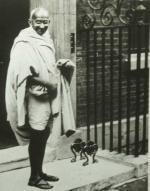
Mohandas Gandhi, 18691948. Gandhi was an Indian revolutionary religious leader who used his religious power for political and social reform. Although he held no governmental office, he was the prime mover in the struggle for independence of theMohandas Gandhi, 1869–1948. Gandhi was an Indian revolutionary religious leader who used his religious power for political and social reform. Although he held no governmental office, he was the prime mover in the struggle for independence of the world's second-largest nation. (© Corbis-Bettmann.)

Mohandas Karamchand Gandhi (1869–1948) was born in Porbandar, Gujarat, India, on October 2, and led India to independence from Great Britain on August 15, 1947, by preaching and practicing nonviolent resistance. After studying jurisprudence at University College, London, Gandhi began practicing law in Durban, South Africa, in 1893. It was here that he started his political career by fighting discrimination against Indians. Following World War I he returned to India and became involved with the Indian National Congress and the movement for national independence. He was repeatedly imprisoned for his use of civil disobedience, fasting, and boycotts as methods of social reform. In addition to his nonviolent opposition to Western colonialism and capitalism, Gandhi advocated the reformation of the caste system and the harmonious coexistence of Muslims and Hindus in a unified India. His critiques of modern technoscience also influenced later theoretical developments and social movements. Gandhi was assassinated by a Hindu radical in New Delhi on January 30.

Nonviolence and Westernization

Gandhi initially defined his method of social action as passive resistance, but later refined and strengthened his ideals into a principle called Satyagraha. The term is derived from two Sanskrit words highlighting his central beliefs: satya, truth, and agraha, firmness—but practiced with ahimsa, non-injury to living things. As a method of direct social action, Satyagraha is a nonviolent insistence on truth in the political realm. Gandhi employed this principle with its offshoots, noncooperation and civil disobedience, in order to vindicate the truth by inflicting self-suffering rather than forcing his opponents to suffer. His persistence provoked anger in the British, including Winston Churchill, who called Gandhi "a malignant subversive fanatic" (Hardiman 2004, p. 238). The political success of this social reform method demonstrated the efficacy of nonviolence to the world and inspired other peace activists such as Nelson Mandela (b. 1918) and Martin Luther King Jr. (1929–1968).

Gandhi's experiments with Satyagraha made him aware of the economic, social, and political exploitation of people around the world, especially the uneducated and impoverished in South Africa and India. He believed that the root of this oppression and poverty was the culture of violence that resulted from Western materialist values, and he maintained that adopting the culture of nonviolence is the only way to attain truth, peace, and harmony. Thus Gandhi's nonviolent social reform was directly targeted against the globalization of Western values and material culture in the form of capitalism and imperialism.

He described the culture of violence in terms of the seven social sins of the world: wealth without work; pleasure without conscience; knowledge without character; commerce without morality; science without humanity; worship without sacrifice; and politics without principles. Gandhi's philosophy of nonviolence requires one to live life as an eternal quest for truth. It is often interpreted dogmatically or rejected as impractical, although it is founded upon the positive and near-universal values of love, respect, understanding, acceptance, and appreciation.

Gandhi believed that the westernization of India would destroy its culture and result in an unequal distribution of wealth and resources. Unlike his political heir, Jawaharlal Nehru (1889–1964), he did not believe that the systems of political organization that develop around Western science and technology could ever promote justice and human dignity. Gandhi maintained that the benefits of westernization would never trickle down to the poor because capitalist technology thrives on exploitation and creates a cycle of greed and consumption that never brings fulfillment.

Gandhi did not espouse communism, and in fact believed that capitalism could work if based on compassion rather than greed. Furthermore he understood that humans have legitimate material needs. The Western model of human development, however, sacrifices morality by overemphasizing materialism. He argued that human relationships ought to be guided by trusteeship and constructive action, meaning that human beings do not own their talents but hold them in trust for humanity. This fosters constructive action by helping the dis-enfranchised achieve greater self-confidence and self-sufficiency.

Gandhi's Reforms

Gandhi's opposition to Western values created an ideological gulf between him and other Indian political leaders. This motivated him to institute several societal reforms (he referred to them as the constructive program) even as the country struggled for independence, because he knew that his vision of an agrarian, self-sufficient, and traditional India would not be championed by his successors.

He developed small-scale technologies such as the charkha, or spinning wheel that helped liberate poor peasants from England's textile monopoly. Gandhi also helped in the effort to expand and improve basic education. Students learned reading and writing as well as best practices in agriculture. They were exposed to other cultures and religions in order to develop character and foster tolerance.

This education plan was a part of Gandhi's two part social reformation: promoting Hindu-Muslim unity and eradicating the caste system. Acutely aware of the multiethnicity of India and the tensions therein, Gandhi practiced interreligious harmony in his prayers by incorporating hymns from every major religion. His courage in the face of religious and ethnic violence inspired many Muslims to remain in a predominantly Hindu India.

Gandhi worked quietly to eradicate the caste system. He was cautious not to incite bitterness, because he feared the British would capitalize on divisions within India to strengthen their rule. Gandhi wished to change the name of untouchables from the derogatory Bhangi to the respectful Harijan (Children of God). With typical wisdom, he argued that by their suffering the untouchables had earned the right to be called Harijan, but other members of Hindu society will also earn that right when they atone for their sins.

Alternatives to Modern Science and Technology

When asked what he thought of Western civilization, Gandhi famously replied, "I think it would be a great idea." Thus he did not equate increasing scientific and technological sophistication with progress in civilization. In Hind Swaraj (1909), one of the earliest critiques of modernity as a development paradigm, Gandhi defined civilization as the ethical performance of one's duty and the attainment of mastery over passion. He also argued that "all research will be useless if it is not allied to internal research, which can link your hearts with those of the millions" (Gupta 2002 Internet site).

Nonetheless admitting there are lessons to be learned from modernity, Gandhi wrote that his "resistance to Western civilisation is really a resistance to its indiscriminate and thoughtless imitation based on the assumption that Asiatics are fit only to copy everything that comes from the West" (Hardiman 2004, p. 71). Gandhi believed that technoscience must be guided toward true human fulfillment and the alleviation of suffering. The fact that it is often used instead in the service of oppression, slavish consumerism, and war fueled Gandhi's conviction that Western values were bankrupt. In 1935, he initiated a movement called Science for People, which sought small-scale technological solutions for the problems faced by the rural poor. This indicated his vision for an alternative Indian future, which influenced especially ideas related to alternative technology.

For example, E. F. Schumacher's calls for a more humane economic system built upon small-scale intermediate technology were inspired by Gandhi. Likewise the Ghandian economists J. C. Kumarappa and D. R. Gadgil developed the concept of appropriate technology to counter the injustices that arise from the application of universal science in mass production processes. Although Gandhi is not explicitly mentioned, parts of Ivan Illich's Medical Nemesis (1975) echo Gandhi's Hind Swaraj. Gandhi's thought has also informed workers at development nongovernmental organizations (NGOs) such as Oxfam and ecological activists such as Ramachandra Guha and those participating in the Chipko and Narmada movements.

Faced with the pressures of economic and technoscientific globalization, Gandhi's vision of a traditional India has largely failed to materialize. It may be that the forces of westernization are too difficult to resist. As Chakravarti Rajagopalachari, a former Governor-General of independent India, wryly assessed, "The glamour of modern technology, money, and power is so seductive that no one ... can resist it. The handful of Gandhians who still believe in his philosophy of a simple life in a simple society are mostly cranks" (Rushdie Internet site). Yet this does not diminish Gandhi's inspirational legacy or his teaching that life is more than science and technology.

Development Ethics;; Indian Perspectives.

Bibliography

Andrews, C. F. (1930). Mahatma Gandhi's Ideas. Woodstock, VT: Skylight Paths.

Bondurant, Joan. (1965). Conquest of Violence, revised edition. Berkeley: University of California Press.

Fischer, Louis, ed. (1962). The Essential Gandhi: His Life, Work, and Ideas: An Anthology. New York: Random House.

Gandhi, Mahatma. (1949). An Autobiography: The Story of My Experiments With Truth, trans. Mahadev Desai. London: Phoenix Press.

Hardiman, David. (2004). Gandhi in His Time and Ours: The Global Legacy of His Ideas. New York: Columbia University Press.

Husain, Abid S. (1959). The Way of Gandhi and Nehru. London: Asia House Publishing.

Internet Resources

Gupta, Vibha. (2002). "The Economics of Scarcity." Life Positive. Available from http://www.lifepositive.com/Spirit/mast ers/mahatma-gandhi/gandhian-economics.a sp.

Rushdie, Salman. "Mohandas Gandhi." Time. Available from http://www.time.com/time/time100/leader s/profile/gandhi.html.

This is the complete article, containing 1,498 words (approx. 5 pages at 300 words per page).

More Information
  • View Gandhi, Mohandas Study Pack
  • 4 Alternative Definitions
  • Search Results for "Gandhi, Mohandas"
  • Add This to Your Bibliography
  • More Products on This Subject
    Mohandas Karamchand Gandhi
    Mohandas Karamchand Gandhi (1869-1948) was an Indian revolutionary religious leader who used his re... more

    Mohandas Karamchand Gandhi
    Mohandas Karamchand Gandhi was an revolutionary spiritual leader who used his influence for politic... more


    Ask any question on Mahatma Gandhi and get it answered FAST!
    Answer questions in BookRags Q&A and earn points toward
    discounted or even FREE Study Guides and other BookRags products!
    Learn more about BookRags Q&A
    Copyrights
    Gandhi, Mohandas from Encyclopedia of Science, Technology, and Ethics. Copyright © 2001-2006 by Macmillan Reference USA, an imprint of the Gale Group. All rights reserved.


    Join BookRagslearn moreJoin BookRags


    About BookRags | Customer Service | Report an Error | Terms of Use | Privacy Policy