
BookRags.com Literature Guides Literature Guides Criticism/Essays Criticism/Essays Biographies Biographies My Bibliography Periodic Table U.S. Presidents Shakespeare Sonnet Shake-Up
Research Anything:        
History | Encyclopedias | Films | News | Create a Bibliography | More... Login | Register | Help

Search "Frobenius, Leo"

Contents Navigation
 
Not What You Meant?  There are 8 definitions for Frobenius.

Frobenius, Leo

Print-Friendly  Order the PDF version  Order the RTF version
About 3 pages (847 words)
Leo Frobenius Summary

Bookmark and Share

Frobenius, Leo

FROBENIUS, LEO (1873–1938), was a German ethnologist and philosopher of culture. Leo Viktor Frobenius was born July 29, 1873, in Berlin, where he spent his early years. Even in his youth he devoted himself enthusiastically to the investigation of African cultures, collecting all available written and pictorial material that dealt with particular ethnological motifs. (Later, these materials became the matrix for an Africa archive that Frobenius assembled.) Despite the fact that he never received a high school diploma and did not complete a university program, Frobenius achieved extraordinary success in his scientific pursuits.

Stimulated by the work of Heinrich Schurtz (whom Frobenius claimed as his teacher), Friedrich Ratzel, and Richard Andree, Frobenius was responsible for introducing a new way of scientific thinking into the field of ethnology. His new concept, hinging on the term Kulturkreis ("culture circle"), first appeared in his 1898 work Der Ursprung der afrikanischen Kulturen (The origin of African civilization). Unlike other scholars, who put the term to one-dimensional uses, Frobenius developed the concept of Kulturkreis into an all-encompassing cultural morphology. His method involved the notion that individual elements of culture should be investigated according to their placement within the organic whole of which they are parts. According to Frobenius, this method provides a way for understanding the complex, historical nature of cultures.

Frobenius's primary concern was for the investigator's recognition of the essence of culture in general. Frobenius found that cultures display "biological" characteristics similar to those of living organisms. He drew parallels between a culture's stages and the elements of an organic life cycle, using terms such as Ergriffenheit ("emotion," by which Frobenius meant to signify a culture's youth), Ausdruck ("expression," or a culture's maturity), and Anwendung ("utilization," its old age). Every culture, argued Frobenius, possesses laws that determine its process independently of the individual human beings who participate in the culture. He labeled this inherent power with the Greek word paideuma ("what is acquired by learning") and devoted an entire book, Paideuma: Umrisse einer Kultur- und Seelenlehre (Outline of a theory of culture and spirit; 1921), to this theme. Paideuma is also the title of a periodical, established by Frobenius in 1938, devoted to the problem of cultural morphology. Although the philosophy of culture espoused by Frobenius has been disputed, he is still considered an ethnological field-researcher of the first order.

Frobenius went on twelve research expeditions to various parts of Africa to document the lives of tribal peoples. In addition, he studied the most important rock-painting sites of both northern and southern Africa. The results of his ethnological researches were presented in a work entitled Und Afrika sprach, 3 vols. (1912–1913; translated as The Voice of Africa, 2 vols., 1913). He also published a series of twelve volumes of folk tales and poems under the general title Atlantis between 1921 and 1928; these have proved to be particularly rich source materials for historians of religions. He summarized his research in Kulturgeschichte Afrikas (1933).

Frobenius's impact upon the world outside his professional field is demonstrated by the fact that the Senegalese politician and poet Léopold Senghor has credited Frobenius with helping to foster a revitalization of self-awareness among present-day Africans. The materials collected on Frobenius's many expeditions were brought together in 1922 to be housed at the newly founded Institute for Cultural Morphology in Munich. In 1925 the institute was removed to Frankfurt, where Frobenius received an honorary lectureship in the department of ethnology and cultural studies at the university. In 1934 he was appointed director of the Municipal Ethnological Museum in Frankfurt. Shortly after his sixty-fifth birthday, Frobenius died at his residence on Lake Maggiore in Italy.

Kulturkreiselehre.

Bibliography

For bibliographical data, see Heinz Wieschoff's article "Das Schrifttum von Leo Frobenius," in Leo Frobenius, Ein Lebenswerk aus der Zeit der Kulturwende, edited by Walter J. Otto (Leipzig, 1933), pp. 163–170; Afrika Rundschau (1938), pp. 119–121; Jacques Waardenburg's Classical Approaches to the Study of Religion, vol. 2 (The Hague, 1974), p. 82; and especially Hermann Niggemeyer, "Das wissenschaftliche Schrifttum von Leo Frobenius," Paideuma 4 (1950): 377–418. For biographical information, see Helmut Petri's article "Leo Frobenius und die historische Ethnologie," Saeculum 4 (1953): 45–60.

New Sources

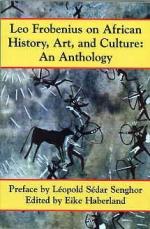
A very useful collection of Frobenius's most important articles on African history, art and ethnography in English is Leo Frobenius 1873–1973: An Anthology, edited by Eike Haberland (Wiesbaden, 1973). It includes a foreword by Léopold Sédar Senghor, an informative "Editor's Postscript," a selected bibliography of works of and on Leo Frobenius and inspiring illustrations. For biographical information and appreciation by his disciples and colleagues, see Ewald Volhard, "Leo Frobenius," Paideuma 1 (1938): 41–44; Adolf E. Jensen, "Leo Frobenius: Leben und Werk," Paideuma 1 (1938): 45–58; Wilhelm Mühlmann, "Zum Gedäcthnis von Leo Frobenius," Archiv für Anthropologie 25 (1939): 47–51. Hans-Jürgen Heinrichs, Die fremde Welt, das bin ich. Leo Frobenius: Ethnologe, Forschungsreiseinder, Abenteurer, Wuppertal, 1998, is a monograph that includes a bibliography. For Frobenius's virtual connections with Bachofen's legacy and his contribution to the theory of historical ethnology, see Giovanni Casadio, "Bachofen, o della rimozione," in Agathe Elpis. Studi storico-religiosi in onore di Ugo Bianchi, edited by G. S. Gasparro, Rome, 1994, pp. 63–78, 69–70.

This is the complete article, containing 847 words (approx. 3 pages at 300 words per page).

More Information
  • View Frobenius, Leo Study Pack
  • 8 Alternative Definitions
  • Search Results for "Frobenius, Leo"
  • Add This to Your Bibliography
  • More Products on This Subject
    Leo Frobenius
    Leo Viktor Frobenius (29 June 1873 - 9 August 1938) was an ethnologist and archaeologist and a major... more


    Copyrights
    Frobenius, Leo from Encyclopedia of Religion. Copyright © 2001-2006 by Macmillan Reference USA, an imprint of the Gale Group. All rights reserved.

    Join BookRagslearn moreJoin BookRags


    About BookRags | Customer Service | Report an Error | Terms of Use | Privacy Policy

