 Print
Print Word
Word PDF
PDF|
This section contains 1,690 words (approx. 6 pages at 300 words per page) |

|
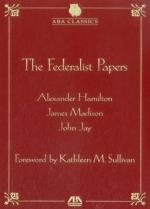
The Federalist Papers, a series of eighty-five essays written by Alexander Hamilton, James Madison, and John Jay, were intended to win public support for the Constitution by explaining in detail how the proposed system of government would work. The essays, signed with the pseudonym "Publius," appeared in several New York newspapers from October 1787 to April 1788, and were also reprinted in other states. Their carefully crafted arguments in favor of the Constitution convinced many Americans to support its ratification and influenced later interpretations of constitutional principles.
Origins and Authorship
Supporters of the Constitution realized that winning ratification in New York would be a difficult task. Governor George Clinton, who led the opposition, attacked the Constitution in several published letters signed "Cato," charging that the framers had no authority to devise a new system of government, and that the Constitution threatened the rights of the citizens as well...
|
This section contains 1,690 words (approx. 6 pages at 300 words per page) |
|