BookRags.com Literature Guides Literature Guides Criticism/Essays Criticism/Essays Biographies Biographies My Bibliography Periodic Table U.S. Presidents Shakespeare Sonnet Shake-Up
Research Anything:        
History | Encyclopedias | Films | News | Create a Bibliography | More... Login | Register | Help

Search "Fathers and Sons"

Contents Navigation
 

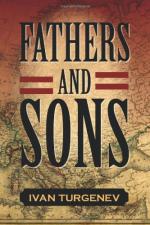
Fathers and Sons

Print-Friendly  Order the PDF version  Order the RTF version
Ivan Turgenev
About 12 pages (3,733 words)
Fathers and Sons Summary

Bookmark and Share

Fathers and Sons

by Ivan Turgenev

Born to a wealthy and aristocratic family in the Russian province of Orel, Ivan Sergeyevich Turgenev (1818-83) was educated in Moscow and Saint Petersburg, Russia, before going on to study philosophy at the University of Berlin in Germany. He established his literary reputation with a series of brief portraits of Russian village life published from 1847 to 1852 and collected as A Sportsman’s Sketches in 1852. After 1856 Turgenev lived primarily in Western Europe. His writings continued to focus on Russian country life, depicting the concerns of Russian nobility and peasants within their rural environment, but his outlook continued to be strongly influenced by Western European ideas. In fact, Turgenev stands out as the most Westernized of Russia’s great nineteenthcentury writers. His novels typically feature a young Russian who presents new, Western ideas to a more conservative audience, often in the setting of a country estate. Turgenev’s first major novel, Rudin (1855), follows this basic formula, as do (with some variation) later works such as On the Eve (1860) and Virgin Soil (1876). Conforming to but also going beyond this pattern is Fathers and Sons. Regarded as Turgenev’s most artistically successful work, it dramatizes the social and ideological conflict between two generations of Westernized Russians: the older liberals of the 1830s and 1840s, and the younger radicals of the 1850s and 1860s.

This is a free page. This page contains 201 words. This article contains 3,733 words (approx. 12 pages at 300 words per page).

Read the rest of this Article with our Fathers and Sons Access Pass.

Copyrights
Fathers and Sons from Literature and Its Times. ©2008 Thomson Gale, a part of the Thomson Corporation. All rights reserved.

Join BookRagslearn moreJoin BookRags


About BookRags | Customer Service | Report an Error | Terms of Use | Privacy Policy