 Print
Print Word
Word PDF
PDF|
This section contains 1,868 words (approx. 7 pages at 300 words per page) |

|
The Eubacteria, also called just "bacteria," are one of the three main domains of life, along with the Archaea and the Eukarya. Eubacteria are prokaryotic, meaning their cells do not have defined, membrane-limited nuclei. As a group they display an impressive range of biochemical diversity, and their numerous members are found in every habitat on Earth. Eubacteria are responsible for many human diseases, but also help maintain health and form vital parts of all of Earth's ecosystems.
Structure
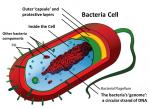
Like archeans, eubacteria are prokaryotes, meaning their cells do not have nuclei in which their DNA is stored. This distinguishes both groups from the eukaryotes, whose DNA is contained in a nucleus. Despite this structural resemblance, the Eubacteria are not closely related to the Archaea, as shown by analysis of their RNA (see below).
Eubacteria are enclosed by a cell wall. The wall is made of cross-linked chains of peptidoglycan...
|
This section contains 1,868 words (approx. 7 pages at 300 words per page) |
|