BookRags.com Literature Guides Literature
Guides
Criticism & Essays Criticism &
Essays
Questions & Answers Questions &
Answers
Lesson Plans Lesson
Plans
My Bibliography Periodic Table U.S. Presidents Shakespeare Sonnet Shake-Up
Research Anything:        
History | Encyclopedias | Films | News | Create a Bibliography | More... Login | Register | Help

Search "Ernest Rutherford"

Contents Navigation
 
Not What You Meant?  There are 23 definitions for Rutherford.  Also try: Ernest.

Ernest Rutherford

Print-Friendly  Order the PDF version  Order the RTF version
About 2 pages (646 words)
Ernest Rutherford Summary

Bookmark and Share Know this topic well? Help others and get FREE products!

Ernest Rutherford

1871-1937

New Zealand-born British Physicist

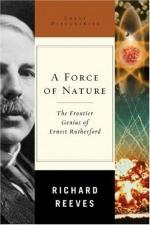
Ernest Rutherford identified alpha and beta radiation, showed that an element could transmute by radioactivity, probed the interior structure of matter, and split the atom. He has been called the father of modern physics, but was a somewhat reluctant parent, disliking many mathematical and philosophical aspects of the "new science." Rutherford preferred simple, descriptive interpretations, once saying that if a piece of physics could not be explained to a barmaid, then it was not a very good piece of physics.

Ernest was born the fourth child of Martha and James Rutherford, in the Nelson district of the South Island of New Zealand. His education had a number of fortunate coincidences. His local primary school opened the year he was eligible to start schooling, so he did not miss years like his elder brothers and sisters. He won a scholarship to Nelson College (a high school), where his mathematical abilities were encouraged. From there he won a scholarship to attend Canterbury College (a university), where he became only the 338th graduate, and performed his first important experiments in physics, using a cloakroom as his laboratory. Rutherford missed a scholarship for further study in England, but as runner-up received the award when the winner turned down the prize. He was lucky enough to arrive at Cambridge University, England, just after major reforms allowing non-Cambridge graduates to study there.

In 1895 Rutherford joined Cambridge's respected Cavendish laboratory, the same year x rays were discovered. He established his reputation in this revolutionary field before turning to another new area, radioactivity. In 1898 he identified two different types of radiation, alpha and beta. Rutherford then became professor at McGill University in Montreal, Canada. With Frederick Soddy (1877-1956) he determined that alpha radiation consisted of helium atoms (without electrons). This work culminated in their "Disintegration Theory" (1903), which stated that one element could transform into another by radiation, which some critics called alchemy.

In 1907 Rutherford moved to Manchester, England, to become one of the highest paid physics professors in the world. He was awarded the 1908 Nobel Prize in Chemistry for his work on the transmutation of elements by radiation, and joked about his own sudden "transmutation" from a physicist to a chemist. Rutherford continued looking at atomic structure, firing alpha particles at thin sheets of gold foil, and unexpectedly finding that some were greatly deflected. Rutherford commented it was "as if you fired a 15-inch naval shell at a piece of tissue paper and the shell came right back and hit you." This led Rutherford to propose that the atom had a very small positively charged nucleus with distant orbiting negative electrons.

Rutherford was knighted in 1914. During World War One he worked in submarine detection, but still found time for some inspired research. When late for a military meeting he explained that the importance of his science experiment was "far greater than that of the war." He was in fact busy splitting the atom!

After the war Rutherford moved to the Cavendish laboratory as its new head, leading it to more ground-breaking research. In one celebrated year,1932, Cavendish researchers discovered the neutron, and purposefully split lithium atoms, both experiments resulting in Nobel prizes. As his fame grew he became a popular public lecturer around the world. Rutherford preferred simple experiments, using basic equipment, with common sense interpretations of the results, saying of mathematical theorists that "they play their games with symbols ... but we in the Cavendish turn out the real solid facts of Nature." However, he gladly used theories that supported his own experimental results.

Rutherford's loud voice and heavy build could be intimidating, but his booming laugh was legendary. He guided the careers of many talented experimenters and encouraged women scientists. From 1925-30 he was President of the Royal Society. In 1931 he was made Baron Rutherford of Nelson. He died in 1937, and was buried at Westminster Abbey.

This is the complete article, containing 646 words (approx. 2 pages at 300 words per page).

More Information
  • View Ernest Rutherford Study Pack
  • 23 Alternative Definitions
  • Search Results for "Ernest Rutherford"
  • Add This to Your Bibliography
  • More Products on This Subject
    Ernest Rutherford
    The British physicist Ernest Rutherford, 1st Baron Rutherford of Nelson (1871-1937), discovered tra... more

    Ernest Rutherford
    Biographies of Ernest Rutherford are studded with superlatives: "founder of nuclear physics"; "cert... more


    Ask any question on Ernest Rutherford and get it answered FAST!
    Answer questions in BookRags Q&A and earn points toward
    discounted or even FREE Study Guides and other BookRags products!
    Learn more about BookRags Q&A
    Copyrights
    Ernest Rutherford from Science and Its Times. ©2005-2006 Thomson Gale, a part of the Thomson Corporation. All rights reserved.

    Join BookRagslearn moreJoin BookRags


    About BookRags | Customer Service | Report an Error | Terms of Use | Privacy Policy