
BookRags.com Literature Guides Literature Guides Criticism/Essays Criticism/Essays Biographies Biographies My Bibliography Periodic Table U.S. Presidents Shakespeare Sonnet Shake-Up
Research Anything:        
History | Encyclopedias | Films | News | Create a Bibliography | More... Login | Register | Help
Not What You Meant?  There are 14 definitions for Erasmus.


Erasmus, Desiderius (1466?–1536)

Print-Friendly  Order the PDF version  Order the RTF version
About 9 pages (2,577 words)
Desiderius Erasmus Summary

Bookmark and Share

Erasmus, Desiderius(1466?–1536)

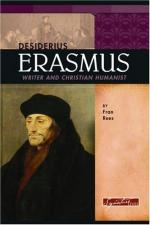
Desiderius Erasmus, the great Renaissance humanist and scholar, was born at either Rotterdam or Gouda in Holland, the illegitimate son of a priest. As a child he studied at Gouda, and from 1475 to 1483 he studied at Deventer with the Brethren of the Common Life, a pious, modernist-humanist order. Next, he studied at Hertogenbosch, became an Augustinian friar at St. Gregory's (near Gouda), and, in 1492, was ordained a priest. Disliking monastic life, in 1494 he became the Latin secretary to the bishop of Cambrai. The next year he went to the University of Paris to study theology, but he found both the life and the scholastic philosophy distasteful. In 1499 he went to England, where he became a close friend of the humanists John Colet and Thomas More and devoted himself to the study of the classics and sacred literature, desiring to combine the new humanistic spirit, based on the revival of interest in the classics, with Christian learning. In 1500 he returned to the Continent and devoted himself to the study of Greek. One of his first famous works was published in this period, the Enchiridion Militis Christiani (Handbook of a Christian soldier; 1501), an appeal for a return to the simple spirit of early Christianity.

This is a free page. This page contains 201 words. This article contains 2,577 words (approx. 9 pages at 300 words per page).

Read the rest of this Article with our Erasmus, Desiderius (1466?–1536) Access Pass.

Copyrights
Erasmus, Desiderius (1466?–1536) from Encyclopedia of Philosophy. Copyright © 2001-2006 by Macmillan Reference USA, an imprint of the Gale Group. All rights reserved.

Join BookRagslearn moreJoin BookRags


About BookRags | Customer Service | Report an Error | Terms of Use | Privacy Policy

