Energy
Energy is the ability to do work—to exert a force over a distance. This ability may reside in many different places--in the muscles of a horse or a human body, in coal that can be burned, in the electrical energy distributed from the power company, in the light of the sun, in a nuclear reactor, etc. But while man has known how to use energy since time immemorial, it is only in about the last 200 years that it has been understood that energy can be converted from one form into another.
There are two kinds of energy a simple object can have. Kinetic energy is energy due to motion, such as the energy of a car moving down the highway. Potential energy is energy gained from moving an object from one place to another, such as a ball picked from the ground and held at arm's length, ready to be dropped and turn into kinetic energy. This is an example of potential energy being converted into kinetic energy. Another example is the pendulum. A pendulum stops momentarily at each end of its swing, so there it has zero kinetic energy. But because it has risen slightly in the earth's gravitational field, it has gained potential energy. Likewise, at the midpoint of its swing, the pendulum is moving fast and has kinetic energy, but has no potential energy relative to its topmost point. Together, kinetic energy and potential energy are known as mechanical energy
One of the most hallowed laws in all of physics is that of conservation of energy, also known as the first law of thermodynamics. It states that an isolated system has the same amount of energy at all times. This energy may be in different forms, and it may be constantly converting from one form to another, but energy is neither created or destroyed.
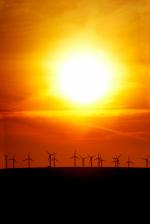
In the 17th century, physicists like Isaac Newton mostly considered simple mechanical systems, like billiard balls or planets in orbit. As scientists began to investigate other realms, such as the properties of heat, or electric charge, or light, or chemical bonds, they realized that energy can take many different forms. A moving body can create heat, and sometimes light, through friction. The combination of certain chemicals can create light, heat, and perhaps noise as well. Wind turbines can translate the kinetic energy of wind into energy that can be used to generate electricity.
Scientists recognize six main types of energy: (1) mechanical energy, (2) thermal energy, or heat, (3) electrical energy, (4) chemical energy, (5) radiant energy, the energy of light, and (6) nuclear energy. Any of these forms of energy can, in principle, be converted into any other form, with the conversion of nuclear energy understood only since the 1905 development of Albert Einstein's special theory of relativity. The nuclear energy inside the nuclei of atoms can be converted into electrical energy in a nuclear reactor, or into an immense amount of heat, light, and mechanical energy via the hydrogen bomb. Photons of light from the sun impinge on solar panels to produce electricity. In particular Einstein showed that mass must be considered to have an amount of energy E=mc2, and that this energy can be converted into other types of energy under the right circumstances. Even a tiny amount of mass has within it a huge amount of energy.
Because it is such a useful concept, energy is measured in many different units. Some of the more common are the joule and the calorie, and others sometimes used are the kilowatt-hour, the Btu (British thermal unit), the electron-volt, and the foot-pound. The calorie is the amount of energy required to raise the temperature of one gram of water from 14.5°C to 15.5°C. The word "calorie" as used by nutritionists (and dieters!) to state the energy equivalent of food is actually somewhat misleading, because one of their "calories" is actually a kilocalorie (1,000 calories) as defined by scientists.
Amounts of energy can vary over a huge scale. The energy exerted in one hour of life for a mouse is about 1 joule, while a human laborer would expend about 107 joules a day. The bonding energy of two atoms in a hydrogen molecule is about 10-20 joules, and the total energy of all sunlight reaching the earth each day is about 1020 joules.
Until about 1890, wood generated most of the energy in the United States, when coal became the nation's major source. By 1910 wood virtually disappeared as a source of energy, and in 1950 oil replaced coal as the nation's major source of energy. In the United States today, about 50% of our electrical energy comes from coal, 20% from nuclear energy, 15% from natural gas, 8% from hydroelectric plants, 3% from oil, and 3% from solar energy.
As society has gotten more complex, each of us uses more energy in a typical day, requiring the production of more energy. The energy cost for the production of a loaf of bread today is estimated to be about 100 times that of a primitive society, much of it used in the distribution of the bread to whoever needs to eat it. We each use about 33 times more energy than we used 130 years ago, and each person uses approximately four times more energy than their great-grandparent used.
This is the complete article, containing 880 words
(approx. 3 pages at 300 words per page).