
 Print
Print Word
Word PDF
PDF|
This section contains 2,555 words (approx. 9 pages at 300 words per page) |

|
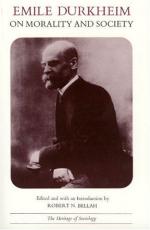
The French sociologist and philosopher Émile Durkheim was born in Épinal (Vosges). At an early age Durkheim decided not to follow the rabbinical tradition of his family. On leaving the Collège d'Épinal Durkheim went to Paris, first to the Lycée Louis-le-Grand, and then, in 1879, to the École Normale Supérieure. He was dissatisfied with what he saw as a too literary, unscientific style of education, connected with a superficial dilettantism in contemporary philosophy. On graduating in 1882, he decided to devote his career to sociology with the aim of establishing an intellectually respectable, positive science of society to replace, or at least supplement, speculative philosophy and provide an intellectual foundation for the institutions of the Third Republic. At an early stage, then, Durkheim developed a preoccupation which was to dominate his whole intellectual life—to establish a genuine...
|
This section contains 2,555 words (approx. 9 pages at 300 words per page) |
|



