BookRags.com Literature Guides Literature
Guides
Criticism & Essays Criticism &
Essays
Questions & Answers Questions &
Answers
Lesson Plans Lesson
Plans
My Bibliography Periodic Table U.S. Presidents Shakespeare Sonnet Shake-Up
Research Anything:        
History | Encyclopedias | Films | News | Create a Bibliography | More... Login | Register | Help

Not What You Meant?  There are 16 definitions for DNA.  Also try: SSB or Template or DSB or Edna.

Dna Structure

Print-Friendly  Order the PDF version  Order the RTF version
About 3 pages (746 words)
DNA Summary

Bookmark and Share Know this topic well? Help others and get FREE products!

Dna Structure

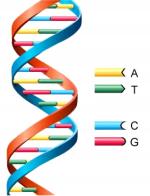
Deoxyribonucleic acid (DNA) consists of two twisted polymeric strands, made up of mononucleotide units. Each nucleotide is composed of three separate parts: a 2-deoxyribose sugar ("2-deoxy-" because the hydroxyl or -OH group of the ribose sugar is missing from the second carbon position on the sugar ring), a phosphate, and one of the four bases: adenine (A), guanine (G), cytosine (C), thymine (T). The deoxyribose sugar and phosphate are linked by phosphodiester bridges in such a way as to form an unbranched polynucleotide chain. According to the Watson Crick model, the DNA molecule consists of two such polynucleotide chains which are complementary but not identical and which spiral around an imaginary common axis. The two strands are antiparallel, meaning that the phosphodiester links between the deoxyribose units read in opposite directions designated 5' to 3' on one chain and 3' to 5' on the other. The bases, which are perpendicular to the helix axis, protrude at regular intervals from the two spiral sugar phosphate strands, and reach into the interior of the helix. The strands are annealed together by hydrogen bonds between the bases of opposite strands and for correct annealing to occur a purine on one strand must pair with a pyrimidine on the other. Within the constraints of the double helix, hydrogen bonds can only form between adenine and thymine (A:T) and between guanine and cytosine (G:C). Through this pairing, the arrangement of bases along one strand determines that of the other and the genetic information is thus coded in these base sequences.

The double helix is not symmetrical and has a broad groove and a narrow groove between the chains, known respectively as the major and minor grooves. These arise because the glycosidic bonds, the bonds between the backbone sugars and the bases, are not diametrically opposite each other The bases are always oriented in a particular way with respect to these grooves. In every base pair, the oxygen at the second position (O2) of the pyrimidine ring and the nitrogen at the third position (N3) of the purine ring always protrude into the minor groove and the major groove is thus on the opposite side.

The most commonly described DNA structure is that of the right-handed Watson-Crick double helix, also known as B-DNA, which has a diameter of 20Å. Adjacent bases are separated by 3.4Å along the helix axis and related by a rotation of 36° which causes the helix structure repeat after 10 residues on each chain, that is at intervals of 34Å. DNA is, however, a dynamic molecule whose structure can vary and there are two other commonly found DNA conformations, each with slightly different dimensions. For example, it has been shown that the DNA fragment with the guanine (G) -cytosine (C) sequence CGCGCG crystallizes as a left-handed double helix known as Z-DNA, because an imaginary line joining the phosphate groups around the outer surface of the molecule describes a zig-zag course, in contrast to B-DNA in which the phosphate groups follow a smooth spiral. The two strands of Z-DNA are antiparallel and complementary bases are hydrogen bonded as in B-DNA; but the orientation of the bases to the backbone of the molecule is different. In Z-DNA the flat planes of the base ring systems are still more or less at 90° to the long axis of the molecule and parallel with one another, but they are effectively rotated through 180 ° in comparison with the bases in B-DNA. In the case of G, this occurs by rotation about the glycosidic bond between the base and the deoxyribose sugar, and in the case of C, both the base and the deoxyribose are rotated. The result is an alternating orientation of adjacent sugars and because of this, the repeating unit of Z-DNA is a dinucleotide and the molecule contains only one, deep helical groove.

A third type of helix is observed in x-ray studies of DNA made under conditions of low (75%) humidity and this is known as A-DNA. A-DNA is a right-handed helix, but it has nearly 11 base pairs per twist, and they are inclined by 13° with respect to the plane perpendicular to the helical axis. A-DNA also has a very deep major groove. Hybrids between DNA and RNA, which form during transcription, are also thought to adopt the A conformation because the hydroxyl group (2'-OH) of the ribose in RNA prevents it from adopting a B conformation made possible in DNA by the 2-deoxyribose moietieswhich lack the hydroxyl group.

This is the complete article, containing 746 words (approx. 2 pages at 300 words per page).

More Information
  • View Dna Structure Study Pack
  • 16 Alternative Definitions
  • Search Results for "Dna Structure"
  • Add This to Your Bibliography
  • More Products on This Subject
    Dna
    organic chemical of complex molecular structure that is found in all prokaryotic and eukaryotic cel... more

    Dna
    One of two types of nucleic acid (the other is RNA); a complex organic compound found in all living... more


    Ask any question on DNA and get it answered FAST!
    Answer questions in BookRags Q&A and earn points toward
    discounted or even FREE Study Guides and other BookRags products!
    Learn more about BookRags Q&A
    Copyrights
    Dna Structure from World of Genetics. ©2005-2006 Thomson Gale, a part of the Thomson Corporation. All rights reserved.

    Join BookRagslearn moreJoin BookRags


    About BookRags | Customer Service | Report an Error | Terms of Use | Privacy Policy