BookRags.com Literature Guides Literature
Guides
Criticism & Essays Criticism &
Essays
Questions & Answers Questions &
Answers
Lesson Plans Lesson
Plans
My Bibliography Periodic Table U.S. Presidents Shakespeare Sonnet Shake-Up
Research Anything:        
History | Encyclopedias | Films | News | Create a Bibliography | More... Login | Register | Help

Search "Dillard, Annie (1945—)"

Contents Navigation
 
Not What You Meant?  There are 23 definitions for Dillard.

Dillard, Annie (1945—)

Print-Friendly  Order the PDF version  Order the RTF version
About 3 pages (939 words)
Annie Dillard Summary

Bookmark and Share

Dillard, Annie (1945—)

One of the best-known writers of the twentieth century and winner of the 1975 Pulitzer Prize for general nonfiction, Annie Dillard developed a following unique among writers. Her readers embrace her mixture of literary, philosophical, theological, and scientific themes regardless of the genre in which they appear, from the essays of Pilgrim at Tinker Creek, Holy the Firm, and Teaching a Stone to Talk, to the poetry of Tickets for a Prayer Wheel and Mornings Like This, and from the autobiographical prose of Encounters with Chinese Writers, An American Childhood, and The Writing Life to the literary criticism of Living by Fiction and the fiction of The Living. In part, Dillard achieved her popularity because of her ongoing interest in spiritual experience, interdisciplinary knowledge, and aesthetic creation, all topics that mirror the concerns of a growing segment of the reading public.

Born Meta Ann Doak in Pittsburgh, Pennsylvania, on April 30, 1945, Dillard was the oldest of Frank and Pam Doak's three daughters. She spent her youth reading books, studying the natural world, and "getting religion," experiences she recounts in detail in An American Childhood. After graduating from the Ellis School in Pittsburgh, she attended Hollins College in Roanoke, Virginia, where she received her B.A. (1967) and M.A. (1968) in English literature. While there, she met her first husband—her writing teacher, Richard Dillard—whom she married in 1965 and whose name she retained after the marriage ended.

Her first book, the slim volume of poetry titled Tickets for a Prayer Wheel (1974), was well received, but its publication was overshadowed by Pilgrim at Tinker Creek (1974), released only a few months later. Described by Dillard, quoting Thoreau, as "a meteorological journal of the mind," the book recounts the year (1972) she spent walking, reading, and journal-keeping while living on Tinker Creek in the Blue Ridge Mountains of Virginia. After advance chapters were published in Harper's and the Atlantic, the book was widely and enthusiastically reviewed, launching its 29-year-old author into instant literary celebrity.

Disturbed by the attention she was receiving, especially after winning the Pulitzer Prize, Dillard accepted a position as scholar-in-residence at Western Washington University in 1975 and moved to an isolated island in Puget Sound. There she wrote Holy the Firm (1977), a short but powerful prose narrative about the relationship between beauty and violence, a topic she had previously begun to explore in Pilgrim. Inspired by a plane crash in which a neighbor's child was badly burned, the book relates Dillard's process of coming to terms with the seeming contradiction between the existence of human suffering and the idea of a loving and all-powerful God.

In 1979, Dillard took up a new post as visiting professor of creative writing at Wesleyan University in Middletown, Connecticut, where she subsequently remained as writer-in-residence. Having divorced her first husband in 1975, Dillard married anthropologist Gary Clevidence in 1980. In 1982 she published two books, Teaching a Stone to Talk: Expeditions and Encounters and Living by Fiction. The first, a collection of essays, received excellent reviews; the second, a work of literary criticism, garnered more muted praise. She followed these two works in 1984 with Encounters with Chinese Writers, an account based in part on her visit to China in 1982 as a member of a cultural delegation.

In 1988, having published An American Childhood (1987), Dillard divorced Gary Clevidence and married Robert D. Richardson, Jr., whom she had met after reading his biography, Henry Thoreau: A Life of the Mind (1986). At this time she also worked on The Writing Life (1989), a description of the writing process and the creative energies it entails.

Dillard published her first novel, The Living, in 1992. Expanding a short story of the same name that she had written for Harper's in 1978, the story spans 42 years, from 1855 to 1897, and explores the frontier history of Whatcom, a town on Bellingham Bay in Washington State. Although the tale is related by an omniscient narrator, The Living nonetheless reflects Dillard's continuing concerns throughout her books with the arbitrariness of death, the insignificance of individuals in an indifferent universe, and the necessity of faith despite the knowledge of these uncomfortable truths.

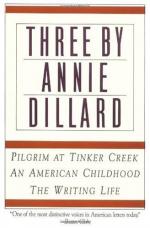
The popularity of Dillard's writing during the late 1980s and 1990s can be judged by the frequency with which her work was reprinted during these decades. As well as excerpts included in multi-author collections, the four-volume Annie Dillard Library appeared in 1989, followed by Three by Annie Dillard (1990), and The Annie Dillard Reader (1994). During these years, she also served as the coeditor of two volumes of prose—The Best American Essays (1988), with Robert Atwan, and Modern American Memoirs (1995), with Cort Conley—and crafted Mornings Like This: Found Poems (1995), a collection of excerpts from other writers' prose, which she reformatted into verse.

Though a minor work, Mornings Like This could be said to encapsulate all of the qualities that have made Dillard's work consistently popular among readers: clever and playful, it displays her wide learning and eclectic tastes, her interest in the intersection of nature and science with history and art, and her desire to create beauty and unity out of the lost and neglected fragments of human experience.

Further Reading:

Dillard, Annie. An American Childhood. New York, Harper and Row, 1987.

——. The Annie Dillard Reader. New York, Harper Collins, 1994.

——. Pilgrim at Tinker Creek. New York: Harper's Magazine Press, 1974.

Johnson, Sandra Humble. The Space Between: Literary Epiphany in the Work of Annie Dillard. Kent, Ohio, Kent State University Press, 1992

Parrish, Nancy C. Lee Smith, Annie Dillard, and the Hollins Group: A Genesis of Writers. Baton Rouge, Louisiana State University Press, 1998.

Smith, Linda L. Annie Dillard. Boston, Twayne, 1991.

This is the complete article, containing 939 words (approx. 3 pages at 300 words per page).

More Information
  • View Dillard, Annie (1945—) Study Pack
  • 23 Alternative Definitions
  • Search Results for "Dillard, Annie (1945—)"
  • Add This to Your Bibliography
  • More Products on This Subject
    Annie Dillard
    Annie Dillard has carved a unique niche for herself in the world of American letters. Over the cour... more

    Annie Dillard
    Annie Dillard--the eldest of three daughters of Frank and Pam Doak--grew up in a world of country c... more


    Copyrights
    Dillard, Annie (1945—) from St. James Encyclopedia of Popular Culture. ©2005-2006 Thomson Gale, a part of the Thomson Corporation. All rights reserved.


    Join BookRagslearn moreJoin BookRags


    About BookRags | Customer Service | Report an Error | Terms of Use | Privacy Policy