Forgot your password?  

Not What You Meant?  There are 21 definitions for Removal.

Deforestation | Research & Encyclopedia Articles

Print-Friendly   Order the PDF version   Order the RTF version
About 4 pages (1,064 words)
Deforestation Summary


Deforestation

Deforestation occurs when the trees in a forested area are cut or destroyed faster than they can replace themselves. When too many trees are cut or destroyed, a very important element is taken from nature, making it difficult for the forest ecosystem to maintain a healthy balance in its natural cycle. The imbalance of the natural forest cycle threatens the humans, plants, and animals that depend on the forest for food, shelter, and protection. The loss of trees also causes negative effects on the natural cycles that affect water, soil, atmosphere, and weather.

Why Does Deforestation Occur?

Deforestation can be a natural or manmade process. Natural deforestation is caused by changes in weather patterns during glacial periods, fires started by lightning, windstorms, floods, and volcanic eruptions. Forests often recover from natural deforestation.

Deforestation caused by humans often results in permanent deforestation. Even when humans were living as small bands of hunters and gatherers they were deforesting areas for hunting animals or to practice swidden agriculture, planting areas they had cleared and moving on after the soil was spent. Over time, population levels grew and areas of permanent agriculture were established, around which civilizations began to grow. These civilizations began intensely farming fields to meet the growing demand for food. As civilizations expanded, more land had to be cleared for fields and forests had to be cut to meet the demand for wood products. The stress on forested areas grew as pressure was exerted from both swidden and permanent agriculture. These stresses intensified in times of conflict as people were forced to use more marginal areas or to overcut forests to meet their needs.

The Industrial Revolution and the technology that came with it has allowed the world population to grow at an exponential rate and has helped bring about a different lifestyle, one based on consumerism and sustained economic growth. The end result is that the last remaining areas that still have extensive forest cover, especially tropical forests, are being cut to satisfy unsustainable human consumption patterns and economic growth models. At the turn of the twenty-first century, more than one-half of the forests that once covered the globe were gone, with much of the cutting occurring over the last decades of the twentieth century.

Effects of Deforestation

The effects of deforestation can be both local and global. In the local forest ecosystem, trees, water, soil, plants, and animals are all dependent on one another to keep healthy. When trees are cut this natural balance is upset and the important functions that trees perform such as holding the soil in place, protecting groundwater, and providing food and shelter for plants and animals cannot take place. Overcutting forests and the disruption of the forest ecosystem are causing erosion of soil, the drop in water tables, loss of biodiversity as plant and animal species become extinct, loss of soil fertility, and the silting up of many water bodies. When the process continues for a long period of time or over a large area there can be total environmental collapse. Parts of the world that are now desert, such as Syria, Iraq, and Lebanon, were once covered with healthy forests.

Deforestation, slumping, and soil erosion in Papua New Guinea's Star Mountains caused by a combination of mining and heavy tropical rainfall.Deforestation, slumping, and soil erosion in Papua New Guinea's Star Mountains caused by a combination of mining and heavy tropical rainfall.

Globally the effects of deforestation are more difficult to see. Forests play an important part in the greater natural cycles that make and affect the weather and that clean the air in our atmosphere. They keep the hydrological cycle healthy by putting water back into the atmosphere through transpiration, making clouds and rain. They also capture carbon dioxide produced by the burning of fossil fuels from the atmosphere, replacing it with oxygen and thus reducing the risk of global warming. If too many forests are cut these important functions cannot be carried out. The result could be less rain, higher temperatures, and more severe weather patterns in many regions of the world.

Local and global effects of deforestation are beginning to have devastating consequences. Some areas in West Africa, for example, are already feeling the effects of lost precipitation, higher temperatures, and increased desertification. Other areas, like Venezuela, have experienced devastating floods due to treeless slopes being unable to catch the rain from heavy storms, sending it rushing into valleys. All of these problems impact the environment, but they also take a heavy toll on humans.

Alternative Strategies to Deforestation

There are several things that can be done to decrease deforestation and to offset its negative effects. Many communities are trying to reduce theburden placed on forests by instituting recycling programs and by using alternative materials like plastics in place of wood. In business, companies have begun to use wood products that come only from certified renewable forests that are carefully managed to ensure that they are cut in a sustainable way. Alternative methods of agriculture, such as agroforestry and permaculture, promote the use of trees and the diversification of crops to reduce the stress placed on forests by large-scale agriculture. Protecting forests by creating parks and reserves is another strategy to keep forest resources intact. For those areas that are already devastated, great efforts are being made to replant once-forested lands with native species.

Other efforts are aimed at changing our ideas about the value of forests. Economists are now trying to calculate the true value of the forest as an ecosystem and the benefits it gives as a whole, not only the value of cut logs. This reevaluation will help us make more informed choices about how we use forest land. All of these efforts have helped reduce the burden on the forests, but cutting continues unsustainably. Without the cooperation of all humans to create alternative strategies to deforestation, it will continue with terrible results for the health of our planet.

Biome; Coniferous Forests; Deciduous Forests; Desertification; Ecosystem; Forestry; Human Impacts; Rain Forests.

Bibliography

Bryant, D., D. Nielsen, and L. Tangley. The Last Frontier Forests: Ecosystems and Economics on the Edge. Washington, DC: World Resources Institute, 1997.

Eisenberg, E. The Ecology of Eden. New York: Vintage Books, 1998.

Global Forest Watch. Forests of the World. [Online] Available at http://www.globalforestwatch.org.

Hodge, I. Environmental Economics: Individual Incentives and Public Choices. London: MacMillan Press Ltd., 1995.

New Forests Project. [Online] Available at http://www.newforestsproject.com.

Ponting, C. A Green History of the World: The Environment and the Collapse of the Great Civilizations. New York: Penguin Books, 1991.

Timberlake, L. Only One Earth. New York: Sterling Publishing Company, Inc., 1987.

This is the complete article, containing 1,064 words (approx. 4 pages at 300 words per page).

More Information
  • View Deforestation Study Pack
  • 21 Alternative Definitions
  • Search Results for "Deforestation"
  • More Products on This Subject
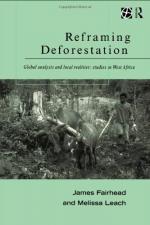
    Deforestation in Africa
    Adam Wood Approximately 90 percent of West Africa's coastal rain forest has disappeared since 1900 ... more


    Ask any question on Deforestation and get it answered FAST!
    Answer questions in BookRags Q&A and earn points toward
    discounted or even FREE Study Guides and other BookRags products!
    Learn more about BookRags Q&A
    Copyrights
    Deforestation from Macmillan Science Library: Plant Sciences. Copyright © 2001-2006 by Macmillan Reference USA, an imprint of the Gale Group. All rights reserved.

    Join BookRagslearn moreJoin BookRags

    Join BookRagslearn moreJoin BookRags