BookRags.com Literature Guides Literature
Guides
Criticism & Essays Criticism &
Essays
Questions & Answers Questions &
Answers
Lesson Plans Lesson
Plans
My Bibliography Periodic Table U.S. Presidents Shakespeare Sonnet Shake-Up
Research Anything:        
History | Encyclopedias | Films | News | Create a Bibliography | More... Login | Register | Help


Social Darwinism

Print-Friendly  Order the PDF version  Order the RTF version
About 8 pages (2,506 words)
Social Darwinism Summary

Bookmark and Share Questions on this topic? Just ask!

Darwin, Charles

Naturalist Charles Darwin originated the theory of evolution by means of natural selection. Darwin (1809–1882), who was born in Shrewsbury, England, on February 12, established the modern scientific understanding of humanity's place in nature. After his undergraduate education at Cambridge, Darwin served for nearly five years as a naturalist aboard a surveying ship, HMS Beagle, which traveled up and down the coasts of South America and then circled the globe. Darwin spent several years after his voyage publishing the results of his researches into fossils, botany, zoology, and geology. On the basis of this work, he formulated his initial ideas on evolution in the late 1830s and then spent two decades developing the theory of natural selection before publishing his chief work, On the Origin of Species by Means of Natural Selection, or the Preservation of Favoured Races in the Struggle for Life (1859). In The Descent of Man, and Selection in Relation to Sex (1871), Darwin explicitly included human beings within the theory of evolution and analyzed the biological basis of human social and moral behavior. Darwin died on April 19 in England and is buried at Westminster Abbey.


In his autobiography, Darwin says that the one book he most admired as an undergraduate was William Paley's Natural Theology: or, Evidences of the Existence and Attributes of the Deity, Collected from the Appearances of Nature (1802). Paley (1743–1805) was the best-known proponent of natural theology, a school of thought that combined providential theology with inquiry into adaptive structures in animals. From the perspective of natural theology, adaptive structure or design is evidence for the beneficent governance of the world by its creator. Darwin's theory of natural selection provided an alternative scientific explanation for adaptive structure. Within Darwin's theory, adaptive structure is the result of natural selection. Innate variations in physiology or anatomy regularly occur. Many such variations are neutral or harmful to an organism, but some variations offer advantages that enable an organism to survive or reproduce more effectively than its competitors. These favorable variations are inherited and transmitted, and over many generations inherited variations produce new species.

Darwin's theory of natural selection is not grounded in theology or ethics, but it has implications for metaphysical and ethical beliefs. In his later years, Darwin became a professed agnostic, but at the time of writing On the Origin of Species, he was still vaguely theistic andregarded the development of life on earth as the result of a divine creation. The evolutionary process that he explains nonetheless exhibits qualities of ruthlessness and cruelty. In order to describe this process, Darwin frequently uses metaphors such as the "Struggle for Life," the "battle of life," or the "war of nature." In all species, many more individuals are born than can ever survive or reproduce. This disproportion between birth rates and the rates of survival and reproduction provides the competitive situation within which natural selection operates. Individuals within and among species compete for food and other resources; individuals of one species prey on individuals of other species; and most species eventually become extinct and leave no successor species. In a letter of 1856 to his botanist friend Joseph Hooker (1817–1911), Darwin exclaims almost in despair over "the clumsy, wasteful, blundering, low, and horribly cruel works of nature!" In the last paragraph of the Origin, he declares that there is "grandeur in this view of life," but it is a grandeur that emerges out of "famine and death."

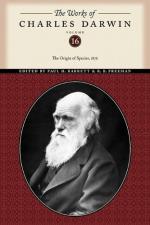
Charles Darwin, 18091882. Darwin discovered that natural selection was the agent for the transmutation of organisms during evolution, a theory he presented in Origin of Species. ( Bettmann/Corbis.)Charles Darwin, 1809–1882. Darwin discovered that natural selection was the agent for the transmutation of organisms during evolution, a theory he presented in Origin of Species. (© Bettmann/Corbis.)

Both before and after Darwin, it has been common practice to invest the larger natural order with some moral quality, either of beneficence or of ruthlessness, and to use that quality as a model or norm for human ethical behavior. The injunction to follow nature has been interpreted to mean either that one should imitate the supposedly benign character of the providential order or that one should ignore all conventional social constraints and seek only to satisfy one's own desire and ambition. Since the middle of the nineteenth century, many thinkers have rejected this approach and have argued that human morality is something separate from the natural order. In their view, humans should not follow nature but should instead cultivate their own specifically human moral sentiments independently of nature. Among Darwin's contemporaries, John Stuart Mill and Thomas Henry Huxley (1825–1895) advocated this moral philosophy, and in the later twentieth century it was advocated by prominent Darwinian thinkers such as George C. Williams (b. 1926), Richard Alexander (b. 1929), Richard Dawkins (b. 1941), and Donald Symons (b. 1942).

Darwin's own theory of human morality breaks away from the idea that one should take the larger order of nature as the model for human moral behavior, but Darwin does not argue that human morality is simply separate from the order of nature. He argues instead that human moral sentiments derive from the evolved and adapted structure of human psychology. The human capacity for moral behavior results from two aspects of our evolved psychology: our character as social animals, and our uniquely human ability to think abstractly. Our social nature enables us to feel sympathy for other humans, to feel pain at their suffering and pleasure at their happiness. Our ability to think abstractly makes it possible for us to rise above the present moment, to link the present with the past and future, and thus to take account of the long-term consequences of our behavior.

In typical Victorian fashion, Darwin hoped that humanity would progress steadily toward a higher state of moral consciousness, and he envisioned human moral progress as circles of sympathy expanding out from kin and tribe, to nations and cultures, to all human beings, and eventually to all life on earth. At the highest level of human development, Darwin hoped that humans would become ecological curators for the earth.

In Descent of Man, Darwin considered the issue of eugenics. He acknowledged that care of the weak has dysgenic effects, but he nonetheless rejected social Darwinism or ruthless social competition because, he felt, that sort of behavior would damage the more "noble" qualities of social sympathy on which all human moral behavior depends.

From the second through the sixth decade of the twentieth century, the adaptationist psychology that Darwin inaugurated in Descent of Man went into eclipse, supplanted by the belief that culture and society control behavior and are not themselves prompted and constrained by biology. The advent of human sociobiology in the 1970s brought Darwinian thinking back into psychology, anthropology, and the other human sciences. In sociobiology and related schools such as human ethology, evolutionary psychology, and behavioral ecology, the adaptationist view of human nature has had a deep and far-reaching influence on twenty-first century ethical thinking. For contemporary Darwinian theorists of human ethical behavior, the most significant issue under debate is a question about the level at which natural selection operates. Proponents of selfish gene theory argue that natural selection operates exclusively at the level of genes, and they extrapolate the idea of "selfishness" from the level of genes to the level of individual human motives. Proponents of group selection, in contrast, affirm the reality of altruistic or "unselfish" motives. Many theorists argue that selection operates at multiple levels and that these levels are interactive and interdependent. The idea of a genetically encoded "altruism" that ultimately subverts inclusive fitness would contradict the logic of natural selection, but a co-operative and interdependent structure is a fact of evolutionary history and manifests itself at the level of cells, organs, social groups, and ecosystems.

Aggression;; Christian Perspectives;; Evolutionary Ethics;; Evolution-Creationism Debate;; Gatton, Francis;; Social Darwinism;; Sociobiology;; Treat, Mary.

Bibliography

Darwin, Charles. (1845). Journal of Researches into the Geology and Natural History of the Various Countries Visited by H. M. S. Beagle, Under the Command of Captain Fitzroy from 1832 to 1836, 2nd edition. London: John Murray.

Darwin, Charles. (1859). On the Origin of Species by Means of Natural Selection, or the Preservation of Favoured Races in the Struggle for Life. London: John Murray.

Darwin, Charles. (1871). The Descent of Man, and Selection in Relation to Sex. London: John Murray.

Darwin, Charles. (1958). The Autobiography of Charles Darwin, 1809–1882. With Original Omissions Restored, ed. Nora Barlow. London: Collins.

This is the complete article, containing 1,376 words (approx. 5 pages at 300 words per page).

More Information
  • View Darwin, Charles Study Pack
  • Search Results for "Darwin, Charles"
  • Add This to Your Bibliography
  • More Products on This Subject
    Social Darwinism
    Theory that persons, groups, and “races” are subject to the same laws of natural select... more

    Social Darwinism
        The concept of Social Darwinism can be much related to the phrase "survival of th... more


    Ask any question on Social Darwinism and get it answered FAST!
    Answer questions in BookRags Q&A and earn points toward
    discounted or even FREE Study Guides and other BookRags products!
    Learn more about BookRags Q&A
    Copyrights
    Social Darwinism from Encyclopedia of Science, Technology, and Ethics. Copyright © 2001-2006 by Macmillan Reference USA, an imprint of the Gale Group. All rights reserved.

    Join BookRagslearn moreJoin BookRags


    About BookRags | Customer Service | Report an Error | Terms of Use | Privacy Policy