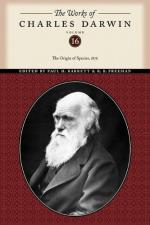
Charles Darwin's theory of evolution, with its emphasis on natural selection, was the first to win wide approval from the scientific community.
Darwin, Charles
Naturalist 1809-1882
Charles Darwin was born on February 12, 1809 in Shrewsbury, England. He died at the age of seventy-three on April 19, 1882. Darwin revolutionized biology with his theory of evolution by natural selection. Although others contributed to the theory of evolution, Darwin was the first to win wide approval from the world's experts in biology.
Darwin was the son of a physician and the grandson of the physician and naturalist Erasmus Darwin. In the 1790s Erasmus Darwin proposed a theory of evolution. Darwin studied medicine at Edinburgh University and religion at Cambridge University. He received a Bachelor of Arts degree from Cambridge in 1831. There, his interest in biology was encouraged by his friendship with John Stevens Henslow, who studied plants. Henslow recommended Darwin as naturalist for a scientific expedition to South America. In 1831 Darwin began the five-year journey aboard the ship HMS Beagle. He gained valuable knowledge about the plants, animals, and natural features of the lands that he visited. In 1839 Darwin married his first cousin, Emma Wedgewood. They had ten children, seven surviving past childhood.
By 1846 Darwin had published several works on his discoveries about coral reefs and volcanic islands. For his writings and other scientific activities, he became greatly respected in the scientific community. Darwin spent years developing his theory on evolution. It is believed that he waited a long time to share it with the world because he feared the religious controversy that would result. He finally was moved to go public when he received a paper from Alfred Wallace in 1858. Wallace had the same ideas that Darwin had been pondering for 20 years. Darwin and Wallace presented their theories in a joint paper to the Linnean Society in 1858. In 1859 Darwin published his famous book On the Origin of Species by Means of Natural Selectionor The Preservation of Favoured Races in the Struggle for Life. While the theory was accepted quickly in most scientific circles, religious leaders strongly opposed it. Many religious persons felt that the theory was inconsistent with the biblical book of Genesis. They feared that God had no place in Darwin's world. They claimed that in Darwin's theory, man was descended from apes and not placed in a superior position over other animals.
Darwin expanded his theory in other publications. His theories included the following: (1) most evolutionary changes were very gradual, requiring millions of years; (2) natural selection was the driving force behind evolutionary change; and (3) today's millions of species branched out from a single, original life form.
Darwin's theories spurred further research in biology. Charles Darwin is considered one of the greatest figures in the history of biology.
Adaptation; Biological Evolution; Natural Selection.
Bibliography
Muir, Hazel, ed. Larousse Dictionary of Scientists. New York: Larousse Kingfisher Chambers Inc., 1994.
The Year 2000 Grolier Multimedia Encyclopedia. Danbury, CT: Grolier Interactive Inc., 1999.
Internet Resources
AboutDarwin.com. <http://www.aboutdarwin.com 3e;.
Darwin. <www.public.coe.edu>.
This is the complete article, containing 496 words
(approx. 2 pages at 300 words per page).