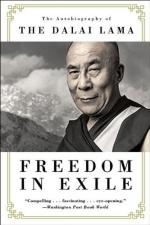
Dalai Lama
TIBETAN RELIGIOUS LEADER
1935–
The Dalai Lama traditionally is recognized as the spiritual and temporal leader of Tibet. He has lived in exile, however, since 1959, when Chinese occupation forces tightened control over his homeland, which they claimed as part of China. Named Lhamo Thondup at his birth in a small village near Tibet's border with China, as a young child he was recognized as Tibet's greatest "lama," or teacher. Later renamed Tenzin Gyatso, he represents the fourteenth incarnation in a series of distinguished predecessors (the first Dalai Lama was born in 1391). Gyatso was only 15 when the Chinese initially occupied his land, but their entry accelerated his confirmation as Tibet's preeminent religious and political leader.
In 1950, fresh from victory in China, Mao Tse-tung's (1893–1976) communist militias invaded Tibet, which they claimed as their traditional territory. The invaders intended to "liberate" the Tibetan people from an antiquated system of government led by the Dalai Lama, a sizeable monastic sector, and a small aristocracy. Although the Dalai Lama sought common ground rather than conflict with the Chinese, they pressed ahead with efforts to eradicate Tibet's socioeconomic structure and culture; Mao perceived religion as "poison." Residents of Lhasa, Tibet's capital, staged nonviolent protests against their Chinese rulers in 1959, triggering a violent crackdown. Fearing for their leader's safety, the Dalai Lama's supporters encouraged him to plead Tibet's case with India. After an arduous trip on horseback, the disguised sage found refuge in Dharamsala, a dilapidated former British colonial holiday resort in India's Himalayan Mountains, where he established a government in exile. A flood of Tibetan refugees followed, and the Dalai Lama continued to serve as the revered spiritual leader for Tibetan Buddhists.
The Dalai Lama has received significant media attention for his cause, largely because of his emphasis on peaceful reconciliation with China, the preservation of Tibetan culture and religion, and human rights. For his efforts, the Dalai Lama received the Nobel Peace Prize in 1989. Nobel committee chairman Egil Aarvik commended the Dalai Lama on his extraordinarily compassionate attitude toward his oppressors. At the awards ceremony, the Dalai Lama said that more than one million Tibetans had died under Chinese rule and more than six thousand monasteries, which he called the seat of Tibet's peaceful culture, had been destroyed. He noted that Chinese leaders relocated millions of ethnic Chinese settlers to Tibet in
DALAI LAMA VISITS TAIPEI, TAIWAN IN 1997. The fourteenth Dalai Lama officially assumed the role of Tibet's political and temporal leader in 1950 as a fifteen-year-old. He was forced into exile in India when he led a 1959 failed attempt to separate Tibet from Communist-led China. (SOURCE: © AP/WIDE WORLD PHOTOS)
order to establish numerical superiority over the indigenous Tibetan population, thereby practicing what the Dalai Lama called a form of genocide.
Aung San Suu Kyi; China (Prc); Gandhi, Mahatma; King Jr., Martin Luther; Political Protest.
Bibliography
Avedon, John F. In Exile from the Land of Snows: The Definitive Account of the Dalai Lama and Tibet Since the Chinese Conquest. New York: HarperPerennial, 1994.
The Dalai Lama's Biography. Government of Tibet in Exile. September 9, 2004. <http://www.tibet.com/DL/biograp hy.html>.
Frängsmyr, Tore, and Irwin Abrams, eds. "The 14th Dalai Lama—Biography." Nobel Lectures, Peace 1981–1990. Singapore: World Scientific Publishing, 1997. <http://nobelprize.org/peace/lau reates/1989/lama-bio.html>.
Hicks, Roger, and Ngakpa Chogyam. Great Ocean: An Authorized Biography of the Buddhist Monk Tenzin Gyatso His Holiness the Fourteenth Dalai Lama. New York: Penguin, 1990.
Norbu, Dawa. Tibet: The Road Ahead. London: Rider Books, 1998.
This is the complete article, containing 568 words
(approx. 2 pages at 300 words per page).