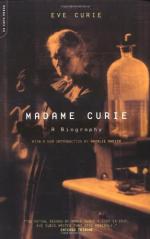
Curie, Marie Sklodowska (1867–1934)
Maria Salomee Sklodowska was born to Wladislaw and Bronislawa Sklodowski on November 7, 1867, in Warsaw, Poland. This was a difficult time in Poland's history, since Poland was under Russian control. Nevertheless, Curie excelled in school, and she finished her secondary school education in 1883 with a gold medal. Although her parents were academicians and emphasized the importance of both education and religion, Curie maintained an agnostic view. Her rejection of religion is generally attributed to the loss of her mother and sister while she was still a young child and also may be related to her attraction to science.
Because women were not allowed to pursue higher education in Poland, Curie and her elder sister Bronia decided to earn their advanced degrees in France. While Bronia studied medicine at the Sorbonne, her sister worked as a governess to support her and then joined her in Paris in 1891, enroll in the Faculty of Sciences of the Sorbonne. During this period in France, Marie adopted the French variation of her name. By 1893 Curie had finished first in her class with a degree in physics despite beginning the program with poor French-language skills. In the following year she completed a mathematics degree and met her future husband Pierre a physicist at the School of Industrial Physics and Chemistry. A respected researcher in the fields of magnetism and piezoelectricity, Pierre convinced Marie that they shared an attitude of single-minded devotion to science and they were married in 1895.
The Curies continued to work together in Pierre's lab after their marriage and in 1897 Marie published her first paper, on magnetism. In September of that same year, her daughter Irène was born. For Marie to continue her career, the Curies hired a house servant, and Pierre's father, Eugène, moved in after the death of his wife. This allowed Marie to continue her search for her doctoral thesis topic. At that time the completion of a doctoral thesis by a woman anywhere in Europe was unprecedented.
Curie chose for her dissertation research the new topic of uranium rays, a phenomenon that had only recently been observed by Henri Becquerel. The mystery was the source of the energy that allowed uranium salts to expose even covered photographic plates. Curie's first efforts in the field were systematic examinations of numerous salts to determine which salts might emit rays similar to those of Becquerel's uranium. After discovering that both thorium and uranium were sources of this radiation, Curie proposed the term "radioactive" to replace "uranium rays." She also discovered that the intensity of the emissions depended not on the chemical identity of the salt but on the amount of uranium in the compound. This key observation eventually led Curie to propose that radioactivity was an atomic property rather than a chemical property. Among the samples that Marie studied were two uranium ores that proved to be more radioactive than pure uranium. This observation led her to propose that the ores contained a new element more radioactive than uranium. Gabriel Lippmann presented the paper describing Curie's work to the Académie des Sciences on April 12, 1898.
Although the Curies noted that one equivalent gram of radium released one hundred calories of heat per hour, they were uninterested in the practical implications of this, as they were both devoted to pure scientific discovery. During their work with pitchblende in 1898, the Curies discovered two new radioactive elements, which they named polonium (in honor of Marie's homeland) and radium. By 1902 they had isolated a pure radium salt and made the first atomic weight determination.
On June 25, 1903, Curie defended her doctoral thesis at the Sorbonne, delivering a review of the research in the area of radioactivity. In December of the same year, the Curies were named joint recipients of the Nobel Prize for Physics along with Becquerel. This award was made for the recognition of the phenomenon they called radioactivity. Due to their poor health, the Curies were not able to travel to Sweden to accept the prize until June 1905. Although they were both clearly suffering from radiation sickness, neither of the Curies realized this at the time. In the meantime, Marie gave birth in 1904 to another daughter, Eve.
In 1906 Pierre was awarded a full professorship and position as chair of physics at the Sorbonne and Marie was promised a position as director of the laboratory which the university planned to create for Pierre. However, in April 1906 Pierre was killed when he stepped into the path of a horse-drawn cart. While this event personally devastated Marie, it was a pivotal point in her professional career. She was offered Pierre's chaired position at the level of assistant professor, making her the first woman in France to obtain a professorship and allowing her to both continue her research and financially support her family.
After Pierre's death, Marie was faced with having to present her work without the support and social skills of her husband. Furthermore, she spent numerous years defending her work from William Thomson (Lord Kelvin) who did not believe that radioactivity could be an atomic property. Nevertheless, in 1911 Curie became the first person to receive a second Nobel Prize when she was awarded the Nobel Prize in Chemistry for her discovery of polonium and radium and the isolation of radium.
Curie spent much of the remainder of her life raising money for research. Always politically active, she also worked with her daughter Irène (who later earned her own Nobel Prize in Chemistry) during World War I establishing mobile x-ray services and training workers to perform x-rays on the battlefield. It was not until the 1920s that the issue of the health hazards of radium emerged. Despite her own health problems, Curie was reluctant to accept that radiation could be linked to the illnesses and deaths of so many of her colleagues in the field. Eventually Curie was diagnosed with a severe form of pernicious anemia (caused by years of exposure to radiation) and she died on July 4, 1934.
Nuclear Energy; Thomson, William.
Bibliography
Curie, E. (1938). Madame Curie; A Biography, tr. V. Sheean. Garden City, NY: Doubleday, Doran.
Giroud, F. (1986). Marie Curie: A Life, tr. L. Davis. New York: Holmes & Meier.
Ogilvie, M. B. (1988). Women in Science. Cambridge, MA: MIT Press.
Rayner-Canham, M., and Rayner-Canham, G. (1997). A Devotion to Their Science: Pioneer Women of Radioactivity. Philadelphia: Chemical Heritage Foundation.
Rayner-Canham, M., and Rayner-Canham, G. (1998). Women in Chemistry: Their Changing Roles from Alchemical Times to the Mid-Twentieth Century. Philadelphia: Chemical Heritage Foundation.
Reid, R. (1974). Marie Curie. New York: Saturday Review Press/E. P. Dutton.
This is the complete article, containing 1,111 words
(approx. 4 pages at 300 words per page).