
 Print
Print Word
Word PDF
PDF|
This section contains 2,182 words (approx. 8 pages at 300 words per page) |

|
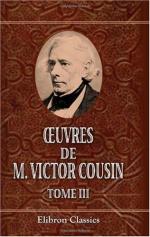
Victor Cousin, the French philosopher and historian, was born in Paris and educated at the Lycée Charlemagne and the École Normale, where he studied under Pierre Laromiguière. He began his teaching career in 1815, assisting Pierre Paul Royer-Collard in his course on the history of philosophy at the University of Paris. Cousin studied German and read Immanuel Kant and F. H. Jacobi; but he was especially attracted to the works of Friedrich Wilhelm Joseph von Schelling, whose thought had a permanent influence upon him. A trip to Germany in 1817 brought him into personal contact with both Schelling and G. W. F. Hegel, a fact which was later responsible for the accusation that he had rejected French philosophy in favor of Germany's. In 1821 Cousin was removed from his position because of his supposed antigovernmental views, and he used his freedom to make another trip...
|
This section contains 2,182 words (approx. 8 pages at 300 words per page) |
|



