BookRags.com Literature Guides Literature
Guides
Criticism & Essays Criticism &
Essays
Questions & Answers Questions &
Answers
Lesson Plans Lesson
Plans
My Bibliography Periodic Table U.S. Presidents Shakespeare Sonnet Shake-Up
Research Anything:        
History | Encyclopedias | Films | News | Create a Bibliography | More... Login | Register | Help

Not What You Meant?  There are 7 definitions for Waterwitch.

Cooper, James Fenimore

Print-Friendly  Order the PDF version  Order the RTF version
About 2 pages (641 words)
James Fenimore Cooper Summary

Bookmark and Share Know this topic well? Help others and get FREE products!

Cooper, James Fenimore

(b. September 15, 1789; d. September 14, 1851) American writer known for early U.S. war novels.

James Fenimore Cooper was part of the generation of writers who created the first distinctively American literature following the Revolutionary War. Critics debate whether or not he was a great writer, but it does seem safe to say that Cooper was the father of the American novel, and more specifically of the American war novel. This is probably all that can be said about him without argument. Mark Twain famously and wittily despised him, more for his squirishness, perhaps, than for his writing. He was often criticized in his own century for too greatly admiring (and imitating) British writers, and more recently he has been criticized for his patronizing attitude toward Native Americans, as well as for his turgid and overwritten prose.

Early Works

The scion of a landed upstate New York family (which lent its name to Cooperstown, New York), James Fenimore Cooper was raised to be a gentleman farmer, but his family's fortunes were already on the wane when in 1818, at the age of twenty-nine, he moved with his new bride Susan (née DeLancey) to her native Westchester county. There he was the owner of a substantial property called Angevine, in Scarsdale, which he managed as a gentleman farmer; but he was beset by increasing financial uncertainty, in part due to his family's financial difficulties. His decision to become a writer may well have been prompted by his need to earn money.

In 1821, Cooper published the first U.S. war novel, The Spy, which combined national pride with unabashed adulation of America's natural beauty, themes both well matched to the spirit of U.S. nationalism in the years following the War of 1812.

War Novels

Within a year after the appearance of The Spy, one contemporary critic had already dubbed Cooper the first distinguished American novelist, and he was already at work on The Pioneers (1823), which he called a "Descriptive Tale" set in the frontier wilderness near the area where he grew up in upstate New York. The novel is most significant for its introduction of the character of Natty Bumppo, who went on to be the central character in the Leatherstocking series, which included Cooper's novel of the French and Indian War and arguably his best-known work, The Last of the Mohicans (1826). In 1824, he published The Pilot, which takes place during the Revolution, using the activities of the real-life war hero John Paul Jones off the coast of England as a backdrop for its plot. Cooper had been a sailor in his youth and The Pilot drew heavily on his knowledge of the sea.

In addition to The Pilot, the final volumes of the Leatherstocking series—The Pathfinder (1840) and The Deer Slayer (1841)—and Oak Openings (1848), Cooper wrote several novels portraying Americans at war or engaged in conflict with hostile native populations, including his 1829 novel, The Wept of Wish-ton-wish, which portrayed the Puritan conflict with the American Indians in King Philip's War. He also wrote a number of works of nonfiction, including The History of the Navy of the United States of America (1839), which contains a useful, although disputed, description of the Battle of Lake Erie, and a series of biographies published as Lives of Distinguished American Naval Officers.

In the final decade of his life, Cooper wrote a trilogy known as the Littlepage novels (after the name of a family whose experiences are central to the story), portraying Americans involved in the Rent War of the 1840s in New York's Ulster and Delaware counties. As a member of one of the state's oldest property-owning families, he portrayed this anti-rent struggle as representative of moral decay and social decline.

Fort William Henry Massacre, Cultural Legacy; King Philip's War, Legacy Of; Memory and Early Histories of the Revolution; The Spy; First American War Novel.

This is the complete article, containing 641 words (approx. 2 pages at 300 words per page).

More Information
  • View Cooper, James Fenimore Study Pack
  • 7 Alternative Definitions
  • Search Results for "Cooper, James Fenimore"
  • Add This to Your Bibliography
  • More Products on This Subject
    James Fenimore Cooper
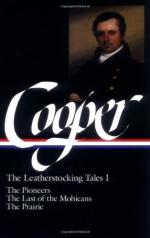
    One hundred and fifty years ago Cooper was one of the world's most widely read novelists and one of... more

    James Fenimore Cooper
    Novelist and social critic James Fenimore Cooper (1789-1851) was the first major American writer to... more


    Ask any question on James Fenimore Cooper and get it answered FAST!
    Answer questions in BookRags Q&A and earn points toward
    discounted or even FREE Study Guides and other BookRags products!
    Learn more about BookRags Q&A
    Copyrights
    Cooper, James Fenimore from Americans at War. Copyright © 2001-2006 by Macmillan Reference USA, an imprint of the Gale Group. All rights reserved.


    Join BookRagslearn moreJoin BookRags


    About BookRags | Customer Service | Report an Error | Terms of Use | Privacy Policy