BookRags.com Literature Guides Literature Guides Criticism/Essays Criticism/Essays Biographies Biographies My Bibliography Periodic Table U.S. Presidents Shakespeare Sonnet Shake-Up
Research Anything:        
History | Encyclopedias | Films | News | Create a Bibliography | More... Login | Register | Help

Search "Confucius (K'ung Fu-Tzu)"

Contents Navigation
 

Confucius (K'ung Fu-Tzu)

Print-Friendly  Order the PDF version  Order the RTF version
About 2 pages (463 words)
Confucius Summary

Bookmark and Share

Confucius (K'ung Fu-Tzu)

551-479 B.C.

Chinese Philosopher

Confucius, the Latinized name of K'ung Fu-tzu (which means "Master K'ung"), was one of world's great philosophers and the inspiration for one of the world's great religions. Although he was apparently not directly responsible for any significant scientific breakthroughs, his philosophies and beliefs were important factors that helped to stir some of the early Chinese mathematical and scientific traditions.

Like so many ancient historical figures, very little is known of Confucius's youth other than that he was apparently born into a noble family in the China of the Chou dynasty. According to traditional stories, he quickly rose in the esteem of his superiors until, at the prompting of jealous counselors, his prince gradually turned against him. By the age of 40 he had embarked on the life of an itinerant philosopher and scholar, traveling from town to town as various noble families forced him onward.

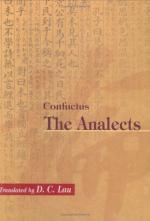
In reality, this is probably far from the truth, and it appears as though he actually spent much of his life as a retainer of the same duke and his successor. Along the way, particularly towards the end of his life, Confucius began to attract students who came to study with the master. His students listened and recorded many of his most important thoughts, publishing the Analects, a collection of Confucius's teachings, after his death in 479 B.C. Ironically, Confucius never considered himself a religious figure and died disappointed, convinced his teachings would die with him.

"Confucius said . . . ," often heard in the modern West as the comic cliché was for over two millennia equivalent to the Christian invocation, "Jesus said . . . ." Confucius was not only a great philosopher, but was also the father of Confucianism, a religion with more followers than virtually any other religion in history.

Confucius's impact on Chinese thought and culture certainly did not die with him and. In fact, it had a profound impact on China for over 2,000 years. One of the impacts of Confucianism's success was in its encouragement of scholarship and study. This helped inspire many of the ancient Chinese scientists and mathematicians, with the result that many of the West's technological innovations were either borrowed from the Chinese or had already been independently developed by the Chinese centuries earlier.

Confucius's life was nearly contemporaneous with that of Socrates (470?-399 B.C.), but their lives could hardly have ended differently. Socrates, celebrated until he was condemned to death for not believing in the gods he tried to understand, left a lasting impression on Western thought, but little else. Confucius, on the other hand, was largely ignored (with the exception of his students) and died certain he would be quickly forgotten. Not only was he remembered, but he was revered as a god himself by future generations.

This is the complete article, containing 463 words (approx. 2 pages at 300 words per page).

More Information
  • View Confucius (K'ung Fu-Tzu) Study Pack
  • Search Results for "Confucius (K'ung Fu-Tzu)"
  • Add This to Your Bibliography
  • More Products on This Subject
    Confucius
    The Chinese teacher and philosopher Confucius (551-479 BC) was the founder of the humanistic school... more

    Confucius Say:
    Confucius Say: A very long time ago, there was a man in China named Confucius. He was very wis... more


    Copyrights
    Confucius (K'ung Fu-Tzu) from Science and Its Times. ©2005-2006 Thomson Gale, a part of the Thomson Corporation. All rights reserved.

    Join BookRagslearn moreJoin BookRags


    About BookRags | Customer Service | Report an Error | Terms of Use | Privacy Policy