BookRags.com Literature Guides Literature
Guides
Criticism & Essays Criticism &
Essays
Questions & Answers Questions &
Answers
Lesson Plans Lesson
Plans
My Bibliography Periodic Table U.S. Presidents Shakespeare Sonnet Shake-Up
Research Anything:        
History | Encyclopedias | Films | News | Create a Bibliography | More... Login | Register | Help

Search "Common Sense"

Contents Navigation
Not What You Meant?  There are 9 definitions for Common sense.

Common Sense

Print-Friendly  Order the PDF version  Order the RTF version
Thomas Paine
About 6 pages (1,683 words)
Common Sense (pamphlet) Summary

Bookmark and Share Know this topic well? Help others and get FREE products!

Common Sense

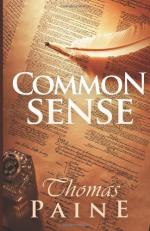
More than any other speech, pamphlet or newspaper article, Thomas Paine's Common Sense transformed pre-Revolutionary opinion among the bickering thirteen colonies from confusion and complacency to a near-universal acceptance of full political and economic independence from England. Written in January, 1776 when America appeared to be on the verge of losing its war against Britain, Common Sense was both a plea to persevere and an appeal to fight for new ideals that would later be expressed in the Declaration of Independence and the Constitution. Winning the War for Independence made possible the creation of new republic that adopted those guiding principles.

Prior to the publication of Common Sense, citizens and leaders of the colonies were deeply divided as to the action to take as they struggled with issues such as taxation without representation. And while there was no doubt about the anger felt by most regarding the repressive policies of the British government, few were willing in 1775 to even toy with the idea of full independence. Even the more radical colonial leaders, such as John Adams and Thomas Jefferson, still believed that the crisis with England could be resolved through the political system—that the British Parliament and powerful colonial ministers could be persuaded to give New World colonists the full rights accorded British citizens in the

homeland.

This is a free page. This page contains 201 words. This article contains 1,683 words (approx. 6 pages at 300 words per page).

Read the rest of this Article with our Common Sense Access Pass.

Ask any question on Common Sense (pamphlet) and get it answered FAST!
Answer questions in BookRags Q&A and earn points toward
discounted or even FREE Study Guides and other BookRags products!
Learn more about BookRags Q&A
Copyrights
Common Sense from Americans at War. Copyright © 2001-2006 by Macmillan Reference USA, an imprint of the Gale Group. All rights reserved.

Join BookRagslearn moreJoin BookRags


About BookRags | Customer Service | Report an Error | Terms of Use | Privacy Policy