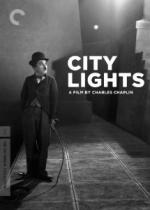
City Lights
A silent film at the dawn of the talking picture technological revolution, City Lights appeared to popular acclaim and remains, for many, Charlie Chaplin's finest achievement. When Chaplin, known the world over for his "Little Tramp" character, began filming City Lights in 1928, talking pictures had become the rage in the movie industry, and most filmmakers who had originally conceived of their works as silent films were now adapting them into partial talkies or junking them altogether. Chaplin halted production on City Lights to weigh his options, and, when he resumed work several months later, he stunned his Hollywood peers by deciding to keep the film in asilent form. "My screen character remains speechless from choice," he declared in a New York Times essay. " City Lights is synchronized [to a musical score] and certain sound effects are part of the comedy, but it is a non-dialogue picture because I preferred that it be that." For many, the film that resulted is a finely wrought balance of pathos and comedy, the very quintessence of Chaplin. The movie debuted in 1931.
Charlie Chaplin in a scene from the film City Lights.
Chaplin, who not only produced, directed, and starred in City Lights but also wrote and edited it and composed its musical score, centered his film on the Little Tramp and his relationship with a young, blind flower vendor who has mistaken him for a rich man. The smitten Tramp, not about to shatter her fantasy, undergoes a series of comic misadventures while trying to raise money for an operation that would restore her vision. He interrupts the suicide attempt of a drunken man who turns out to be a millionaire. The two become friends, but unfortunately the millionaire only recognizes the Tramp when drunk. Determined to help the young woman, the Tramp takes on such unlikely occupations as street sweeping and prize fighting (both of which go comically awry) before the millionaire finally offers him one thousand dollars for the operation. Robbers attack at just that moment, knocking the millionaire in the head. Police arrive and assume the Tramp is the thief (the millionaire, sobered by the blow, does not recognize him), but the Tramp manages to give the money to the woman before they catch him and haul him off to jail. After his release, he discovers that the young woman, now sighted, runs her own florist shop. She doesn't recognize the shabbily dressed Tramp at first and playfully offers him a flower. When she at last realizes who he is, the film concludes with the most poignant exchange of glances in the history of world cinema.
Chaplin found the casting of the nameless young blind woman to be particularly difficult. According to his autobiography, one of his biggest challenges "was to find a girl who could look blind without detracting from her beauty. So many applicants looked upward, showing the whites of their eyes, which was too distressing." The filmmaker eventually settled on Virginia Cherrill, a twenty-year-old Chicagoan with little acting experience. "To my surprise she had the faculty of looking blind," Chaplin wrote. "I instructed her to look at me but to look inwardly and not to see me, and she could do it." He later found the neophyte troublesome to work with, however, and fired her about a year into production. He recruited Georgia Hale, who had co-starred with him in The Gold Rush in 1925, to replace her but eventually re-hired Cherrill after realizing how much of the film he would have to re-shoot.
Chaplin's problems extended to other aspects of the movie. He filmed countless retakes and occasionally stopped shooting for days on end to mull things over. Most famously, he struggled for eighty-three days (sixty-two of which involved no filming whatsoever) on the initial encounter of the Tramp and the young woman, unable to find a way of having the woman conclude that the Tramp is wealthy. Inspiration finally struck, and Chaplin filmed a brief scene in which a limousine door slammed shut a moment before the Tramp met her.
Chaplin's difficulties on the set mattered little to audiences. They loved his melancholy yet comic tale of two hard-luck people and made it an unqualified hit (the movie earned a profit of five million dollars during its initial release alone). A few reviewers criticized the film's old-fashioned, heavily sentimental quality, but the majority praised Chaplin's work. Its regressive form and content notwithstanding, City Lights appealed strongly to audiences and critics alike.
Further Reading:
Chaplin, Charles. My Autobiography. New York, Simon and Schuster, 1964.
——. "Pantomime and Comedy." New York Times. January 25,1931, H6.
Maland, Charles J. Chaplin and American Culture: The Evolution of a Star Image. Princeton, Princeton University Press, 1989.
Molyneaux, Gerard. Charlie Chaplin's City Lights. New York, Garland, 1983.
This is the complete article, containing 790 words
(approx. 3 pages at 300 words per page).