
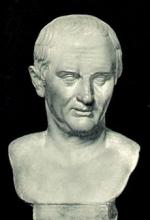
CICERO (106 BCE–43 BCE) was a lawyer and public figure who undertook the senatorial cursus honorum, reaching the consulship in 63 BCE. He was subsequently involved in the civil war between Pompey and Caesar before falling victim to the purge of the Second Triumvirate (Octavian, Lepidus, Mark Antony). In discussions of Cicero and religion one should avoid the temptation to anachronistically confuse what may be defined as the religion of the ancient Romans with the common idea of religion in modern times, and one should be careful to distinguish what might be termed ancient "personal religion" from public and private devotion and cult (sacra publica, sacra privata). Personal religion for a man of learning such as Cicero meant philosophical speculation. For him, investigation into the nature of the gods and personal opinion on divinity belonged to the sphere of philosophy, while "religion" indicated an official institution with the purpose of paying homage to the essential values of the res publica.
If the diverse interests of Cicero converge upon everything involving public life and the public figure, religion, from his point of view, was an inalienable part of this. The laws on religion that form the opening of his ideal constitution in the work De legibus show how far from his mode of thought was the notion of the independence of the clergy from the state. But religion, consisting of sacra publica, did not require speculative thought. In De natura deorum the pontifex Cotta compares the immutable contents of the mores handed down by their parents with the transient nature of philosophical speculation regarding divinity. Religion signifies an entire collection of customs, festivals, rites, sacrifices, prayers, processions, and feasts, all serving to express the essence of productive, civic human society. For Cicero, religion was an institution, not a creed; it was an institution of protection that permitted and ensured social stability, a safeguard of law and constitutional order. Ethical values, emphasized by Cicero, are independent of religion: gods and human beings have the same rational ability. On the other hand, the problem of transcendence was discussed philosophically and without any particularly personal contribution or involvement. Cicero provides a more or less contemporary bibliography, so to speak, on the subject, and the discussion on divinity is unfolded in minute, scholarly detail.
In De natura deorum, the existence of the gods is seen as a social, political, and philosophical problem, but it does not have any bearing upon religious feeling: the problem of the existence of the gods is resolved via a patriotic list of political occurrences. A member of the pontifical college, Cotta, is entrusted with the refutation of the Stoic theory of the Pronoia. Religion is the servant of ethics and the patriotic sentiments and institutions created by the empire. But the inherently fragmentary and compartmentalized nature of ancient religion makes it inaccessible to the modern mind, which sees religion as a kind of system complete in itself.
Ancient religion is open and dynamic. The res divinae are not a complete self-contained corpus. Four centuries later, Augustine makes fun of the pedantic and muddled account of Varro. The emperor Julian counted 300,000 gods. For the ancients, religion was an uninterrupted and endless discovery of divine powers, which could be in turn individually identified and worshiped. Religion neither concerns itself with nor explains the afterlife. In Seneca, the investigation of the nature of god and the creation of the world is completely devoid of any religious content whatsoever. Again, the gods of Cicero, as simply gods of his own age, are ephemeral in character and they fall short of modern expectations, which have been formed by two millennia of subtle and detailed speculation on divinity. Christian apologists had great sport contrasting the sublime and profound nature of speculation on God with the weak and disorganized nature of the gods. The discussion of the Stoic Balbo in De natura deorum ends up as a naturalistic treatise and a doctrinal summary in which the gods are in effect everything that humanity sees and considers admirable. Besides, the ancient names of the gods are closely derived from the power they represent. Jupiter, Neptune, and Minerva are names behind which are hidden powers, made legitimate and institutionalized by pietas, via ancestral ceremonies and rites. Thus, syncretism is a defining characteristic of ancient religion. These gods do not possess ideological or philosophical depth; they are not, in effect, the subject of speculation.
The reader is surprised by the Ciceronian passages discussing the numerous and confused nature of the gods and their realms of competence (a catalog of the various spheres of influence of the Catholic saints would be similarly disorganized). Cicero's approach is quantitative because research on divinity is either focused upon the religious principle of "manifestation" (epiphania) or else on the popular discussion of the main findings of Greek philosophical knowledge. The theme of destiny and predestination assigns to the gods an instrumental and secondary role. As with every polytheist, so with Cicero: the divine may be broken down into an infinite number of powers and aspects, which are often ascribed by ancient traditions to legendary figures with various names, depending upon time and place.
The mystical note that Cicero introduces in Somnium Scipionis is in defense of the civic virtues of a man who goes to heaven because he has behaved on earth not as a saint but as a man of state. Even the philosophical consideration of transcendence is proposed in terms of the well-trodden path of Greek philosophy. It is a handbook on research into the divine. Prayer and interior contemplation to seek the divine within oneself are not properties of Ciceronian thought. Religious discourse is constantly and firmly linked to civic values and the merit of an active public life. Fate, of which the gods are instruments, is the subject of speculation in the light of its reflection and influences on public life. In short, there exists a preordained order or an inaccessible fate that is interested in the political events of the state and of no great relevance per se. Cicero is well aware that the gods must be invoked, not so as to become better, but for the sake of good health and prosperity. As Seneca notes (Epistulae ad Lucilium 10, 5), acknowledgment of one's own weakness to a god was not unknown to the religious sensibility of the ancient world. This form of religion was unacceptable to the nobles, however, and they criticized this attitude amongst any in their ranks who endorsed this approach. For example, the frequent attendance of Scipio Africanus to the temple of Zeus Capitolinus was regarded by Valerius Maximus (I, 2, 2) as a case of "fake religion."
There is little recent work concerning religion in Cicero (in the sense of analyzing all his works), although the numerous commentaries on the works of Cicero on this subject may be of use. See, for example, The Nature of the Gods, translated with an introduction by P. G. Walsh (Oxford, 1997). The commentary of Arthur Stanley Pease remains essential: M. T. Ciceronis: De natura deorum, I–II (Cambridge, Mass., 1955–1958; reprint, 1979). See also Pease's commentary on De divinatione (Urbana, Ill., 1923; reprint, Darmstadt, Germany, 1963) and De fato (reprint, Darmstadt, 1963). For various aspects of Cicero's concern with religious matters, see:
Auvray-Assayas, Clara. Modèles anthropologiques romains dans le De natura deorum. Paris, 1994. See pages 207–219.
Fontanella, Francesca. "L'interpretazione ciceroniana del culto degli eroi e delle virtù." Rivista storica Italiana 102 (1995): 5–19.
Guillaumont, François. Philosophe et augure: Recherches sur la théorie cicéronienne de la divination. Brussels, 1984.
Mandel, Joshua. "State Religion and Superstition as Reflected in Cicero's Philosophical Works." Euphrosyne 12 (1983–1984): 79–110.
Troiani, Lucio. "La religione e Cicerone." Rivista storica Italiana 96 (1984): 920–952.
Turpin, Jean. "Cicéron: De legibus I-II et la religion romaine." In Aufstieg und Niedergang der römischen Welt II 16, no. 3. Berlin, 1986. See pages 1877–1908.
This is the complete article, containing 1,319 words
(approx. 4 pages at 300 words per page).

